Download high-resolution image Look inside
Listen to a clip from the audiobook
audio play button
0:00
0:00

Mohawk

Look inside
Listen to a clip from the audiobook
audio play button
0:00
0:00
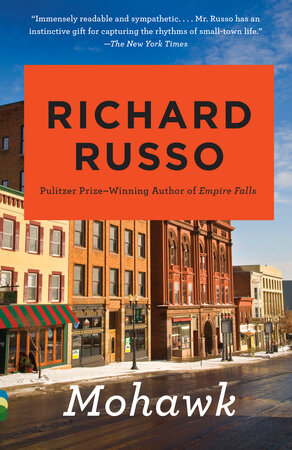
Originally published in 1986 Richard Russo’s Mohawk remains today as it was described then: A first novel with all the assurance of a mature writer at the peak of form and ambition. Mohawk is set in upstate New York and chronicles over a dozen lives in a leather town, long after the tanneries have started closing down. Ranging over three generations—and clustered mainly in two clans, the Grouses and the Gaffneys—these remarkably various lives share only the common human dilemmas and the awesome physical and emotional presence of Mohawk itself.

Mohawk, New York, is one of those small towns that lie almost entirely on the wrong side of the tracks. Its citizens, too, have fallen on hard times. Dallas Younger, a star athlete in high school, now drifts from tavern to poker game, losing money, and, inevitably, another set of false teeth. His ex-wife, Anne, is stuck in a losing battle with her mother over the care of her sick father. And their son, Randall, is deliberately neglecting his school work—because in a place like Mohawk it doesn't pay to be too smart. In Mohawk Richard Russo explores these lives with profound compassion and flint-hard wit. Out of derailed ambitions and old loves, secret hatreds and communal myths, he has created a richly plotted, densely populated, and wonderfully written novel that captures every nuance of America's backyard.

For this is a town like Winesburg, Ohio or Our Town, in our time, that encompasses a plethora of characters, events and mysteries. At once honestly tragic and sharply, genuinely funny, Mohawk captures life, then affirms it.

"Moving dramatizes an older, innocent way of life...brisk, colorful, and often witty."— The New York Times Book Review

© Elena Seibert
RICHARD RUSSO is the author of ten novels, most recently Somebody's Fool, Chances Are . . . , Everybody’s Fool, and That Old Cape Magic; two collections of stories; and the memoir Elsewhere. In 2002 he received the Pulitzer Prize for Empire Falls, which, like Nobody’s Fool, won multiple awards for its screen adaptation, and in 2023 his novel Straight Man was adapted into the television series Lucky Hank. In 2017 he received France’s Grand Prix de Littérature Américaine. He lives in Port­land, ME. View titles by Richard Russo
"Moving dramatizes an older, innocent way of life ... brisk, colorful, and often witty." —The New York Times Book Review

"Immensely readable and sympathetic.... Mr. Russo has an instinctive gift for capturing the rhythms of small-town life." —The New York Times

“Richard Russo [is] a masterful storyteller with a mission: to chronicle with insight and compassion the day-to-day life of small-town America ... alternating episodes of boisterous humor with moments of heart-wrenching pathos ... His characters are wholly sympathetic, but they are also human.”
Houston Chronicle

“After the last sentence is read, the reader continues to see Russo’s tender, messed-up people coming out of doorways, lurching through life. And keeps on seeing them because they are as real as we are.”
—Annie Proulx

“Russo is a master craftsman ... The blue-collar heartache at the center of his fiction has the sheen of Dickens but the epic levity of John Irving.”—The Boston Globe

About

Originally published in 1986 Richard Russo’s Mohawk remains today as it was described then: A first novel with all the assurance of a mature writer at the peak of form and ambition. Mohawk is set in upstate New York and chronicles over a dozen lives in a leather town, long after the tanneries have started closing down. Ranging over three generations—and clustered mainly in two clans, the Grouses and the Gaffneys—these remarkably various lives share only the common human dilemmas and the awesome physical and emotional presence of Mohawk itself.

Mohawk, New York, is one of those small towns that lie almost entirely on the wrong side of the tracks. Its citizens, too, have fallen on hard times. Dallas Younger, a star athlete in high school, now drifts from tavern to poker game, losing money, and, inevitably, another set of false teeth. His ex-wife, Anne, is stuck in a losing battle with her mother over the care of her sick father. And their son, Randall, is deliberately neglecting his school work—because in a place like Mohawk it doesn't pay to be too smart. In Mohawk Richard Russo explores these lives with profound compassion and flint-hard wit. Out of derailed ambitions and old loves, secret hatreds and communal myths, he has created a richly plotted, densely populated, and wonderfully written novel that captures every nuance of America's backyard.

For this is a town like Winesburg, Ohio or Our Town, in our time, that encompasses a plethora of characters, events and mysteries. At once honestly tragic and sharply, genuinely funny, Mohawk captures life, then affirms it.

"Moving dramatizes an older, innocent way of life...brisk, colorful, and often witty."— The New York Times Book Review

Author

© Elena Seibert
RICHARD RUSSO is the author of ten novels, most recently Somebody's Fool, Chances Are . . . , Everybody’s Fool, and That Old Cape Magic; two collections of stories; and the memoir Elsewhere. In 2002 he received the Pulitzer Prize for Empire Falls, which, like Nobody’s Fool, won multiple awards for its screen adaptation, and in 2023 his novel Straight Man was adapted into the television series Lucky Hank. In 2017 he received France’s Grand Prix de Littérature Américaine. He lives in Port­land, ME. View titles by Richard Russo

Praise

"Moving dramatizes an older, innocent way of life ... brisk, colorful, and often witty." —The New York Times Book Review
"Immensely readable and sympathetic.... Mr. Russo has an instinctive gift for capturing the rhythms of small-town life." —The New York Times
“Richard Russo [is] a masterful storyteller with a mission: to chronicle with insight and compassion the day-to-day life of small-town America ... alternating episodes of boisterous humor with moments of heart-wrenching pathos ... His characters are wholly sympathetic, but they are also human.”
Houston Chronicle

“After the last sentence is read, the reader continues to see Russo’s tender, messed-up people coming out of doorways, lurching through life. And keeps on seeing them because they are as real as we are.”
—Annie Proulx

“Russo is a master craftsman ... The blue-collar heartache at the center of his fiction has the sheen of Dickens but the epic levity of John Irving.”—The Boston Globe