
Books for Arab American Heritage Month
In honor of Arab American Heritage Month in April, we are sharing books by Arab and Arab American authors that share their culture, history, and personal lives.


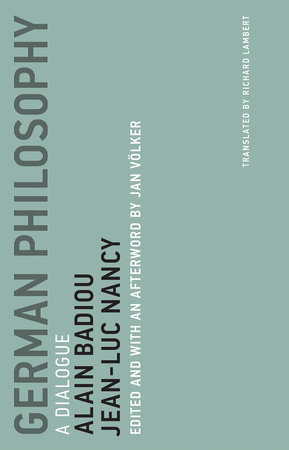
In this book, Alain Badiou and Jean-Luc Nancy, the two most important living philosophers in France, discuss German philosophy from a French perspective. Written in the form of a dialogue, and revised and expanded from a 2016 conversation between the two philosophers at the Universität der Künste Berlin, the book offers not only Badiou's and Nancy's reinterpretations of German philosophers and philosophical concepts, but also an accessible introduction to the greatest thinkers of German philosophy. Badiou and Nancy discuss and debate such topics as the legacies of Kant, Hegel, and Marx, as well as Nietzsche, Adorno, Fichte, Schelling, and the unavoidable problem of Heidegger and Nazism. The dialogue is contentious, friendly, and often quotable, with strong—at times passionate—positions taken by both Badiou and Nancy, who find themselves disagreeing over Kant, for example, and in unexpected agreement on Marx, for another.
What does it mean, then, to conduct a dialogue on German philosophy from a French perspective? As volume editor Jan Völker observes, “German philosophy” and “French philosophy” describe complex constellations that, despite the reference to nation-states and languages, above all encompass shared concepts and problems—although these take a range of forms. Perhaps they can reveal their essential import only in translation.
In this book, Alain Badiou and Jean-Luc Nancy, the two most important living philosophers in France, discuss German philosophy from a French perspective. Written in the form of a dialogue, and revised and expanded from a 2016 conversation between the two philosophers at the Universität der Künste Berlin, the book offers not only Badiou's and Nancy's reinterpretations of German philosophers and philosophical concepts, but also an accessible introduction to the greatest thinkers of German philosophy. Badiou and Nancy discuss and debate such topics as the legacies of Kant, Hegel, and Marx, as well as Nietzsche, Adorno, Fichte, Schelling, and the unavoidable problem of Heidegger and Nazism. The dialogue is contentious, friendly, and often quotable, with strong—at times passionate—positions taken by both Badiou and Nancy, who find themselves disagreeing over Kant, for example, and in unexpected agreement on Marx, for another.
What does it mean, then, to conduct a dialogue on German philosophy from a French perspective? As volume editor Jan Völker observes, “German philosophy” and “French philosophy” describe complex constellations that, despite the reference to nation-states and languages, above all encompass shared concepts and problems—although these take a range of forms. Perhaps they can reveal their essential import only in translation.











In honor of Arab American Heritage Month in April, we are sharing books by Arab and Arab American authors that share their culture, history, and personal lives.
For National Poetry Month in April, we are sharing poetry collections and books about poetry by authors who have their own stories to tell. These poets delve into history, reimagine the present, examine poetry itself—from traditional poems many know and love to poems and voices that are new and original.
/