
Books for Arab American Heritage Month
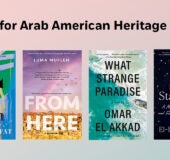
In honor of Arab American Heritage Month in April, we are sharing books by Arab and Arab American authors that share their culture, history, and personal lives.


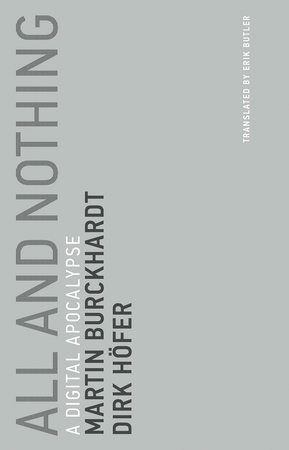
In the beginning was the Zero, and the Zero was with God, and God was the One.
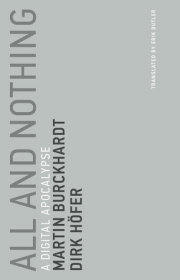
—All and Nothing
In 1854, the British mathematician George Boole presented the idea of a universe the elements of which could be understood in terms of the logic of absence and presence: 0 and 1, all and nothing—the foundation of binary code. The Boolean digits 0 and 1 do not designate a quantity. In the Boolean world, x times x always equals x; all and nothing meet in the formula x = xn. As everything becomes digitized, God the clockmaker is replaced by God the programmer. This book–described by its authors as “a theology for the digital world”—explores meaning in a digital age of infinite replication, in a world that has dissolved into information and achieved immortality by turning into a pure sign.
All and Nothing compares information that spreads without restraint to a hydra—the mythological monster that grew two heads for every one that was cut off. Information is thousand-headed and thousand-eyed because Hydra's tracks cannot be deleted. It shows that when we sit in front of a screen, we are actually on the other side, looking at the world as an uncanny reminder of the nondigitized. It compares our personal data to our shadows and our souls, envisioning the subconscious laid out on a digital bier like a corpse.
The digital world, the authors explain, summons forth fantasies of a chiliastic or apocalyptic nature. The goal of removing the representative from mathematics has now been achieved on a greater scale than Boole could have imagined.
In the beginning was the Zero, and the Zero was with God, and God was the One.
—All and Nothing
In 1854, the British mathematician George Boole presented the idea of a universe the elements of which could be understood in terms of the logic of absence and presence: 0 and 1, all and nothing—the foundation of binary code. The Boolean digits 0 and 1 do not designate a quantity. In the Boolean world, x times x always equals x; all and nothing meet in the formula x = xn. As everything becomes digitized, God the clockmaker is replaced by God the programmer. This book–described by its authors as “a theology for the digital world”—explores meaning in a digital age of infinite replication, in a world that has dissolved into information and achieved immortality by turning into a pure sign.
All and Nothing compares information that spreads without restraint to a hydra—the mythological monster that grew two heads for every one that was cut off. Information is thousand-headed and thousand-eyed because Hydra's tracks cannot be deleted. It shows that when we sit in front of a screen, we are actually on the other side, looking at the world as an uncanny reminder of the nondigitized. It compares our personal data to our shadows and our souls, envisioning the subconscious laid out on a digital bier like a corpse.
The digital world, the authors explain, summons forth fantasies of a chiliastic or apocalyptic nature. The goal of removing the representative from mathematics has now been achieved on a greater scale than Boole could have imagined.
In honor of Arab American Heritage Month in April, we are sharing books by Arab and Arab American authors that share their culture, history, and personal lives.
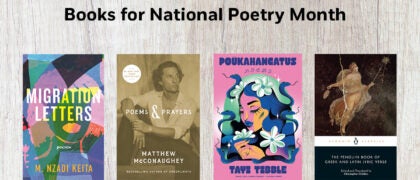
For National Poetry Month in April, we are sharing poetry collections and books about poetry by authors who have their own stories to tell. These poets delve into history, reimagine the present, examine poetry itself—from traditional poems many know and love to poems and voices that are new and original.