
Books for Arab American Heritage Month
In honor of Arab American Heritage Month in April, we are sharing books by Arab and Arab American authors that share their culture, history, and personal lives.


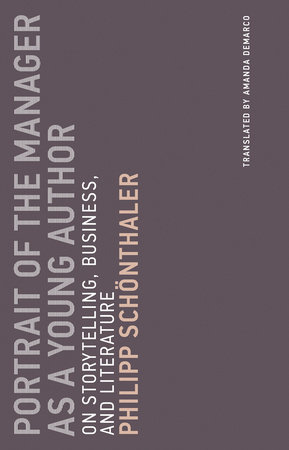
Corporations love a good story. Microsoft employs a chief storyteller, who heads a team of twenty-five corporate storytellers. IBM, Coca-Cola, and the World Bank are among other organizations that have worked with storytelling methods. And, of course, Steve Jobs was famous for his storytelling. Today, narrative is a privileged form of communication for organizations. In Portrait of the Manager as a Young Author, Philipp Schönthaler explains this unlikely alliance between business and storytelling.
The contradictions are immediately apparent. If, as the philosopher Hans Blumenberg writes, stories are told to pass the time, managers would seem to have little time to spare. And yet, Schönthaler reports, stories are useful in handling complexity. When digital information flows too quickly and exceeds the capacity of the human brain, narrative can provide communicative efficiency and effectiveness. Words and numbers both vouch for truth, are both instrumentalized by management, and are inextricably interdependent.
What happens, if narrative becomes ubiquitous? Does the commercialization of narratives have an effect on literature? Through the lens of storytelling, Schönthaler explores the relationship between economics and literature and describes a form of writing that takes place in their shared spheres. Most books on storytelling in the corporate world are written by business writers; this book offers the perspective of an award-winning literary author, who considers both the impact of storytelling on business and the impact of business on literature.
Corporations love a good story. Microsoft employs a chief storyteller, who heads a team of twenty-five corporate storytellers. IBM, Coca-Cola, and the World Bank are among other organizations that have worked with storytelling methods. And, of course, Steve Jobs was famous for his storytelling. Today, narrative is a privileged form of communication for organizations. In Portrait of the Manager as a Young Author, Philipp Schönthaler explains this unlikely alliance between business and storytelling.
The contradictions are immediately apparent. If, as the philosopher Hans Blumenberg writes, stories are told to pass the time, managers would seem to have little time to spare. And yet, Schönthaler reports, stories are useful in handling complexity. When digital information flows too quickly and exceeds the capacity of the human brain, narrative can provide communicative efficiency and effectiveness. Words and numbers both vouch for truth, are both instrumentalized by management, and are inextricably interdependent.
What happens, if narrative becomes ubiquitous? Does the commercialization of narratives have an effect on literature? Through the lens of storytelling, Schönthaler explores the relationship between economics and literature and describes a form of writing that takes place in their shared spheres. Most books on storytelling in the corporate world are written by business writers; this book offers the perspective of an award-winning literary author, who considers both the impact of storytelling on business and the impact of business on literature.












In honor of Arab American Heritage Month in April, we are sharing books by Arab and Arab American authors that share their culture, history, and personal lives.
For National Poetry Month in April, we are sharing poetry collections and books about poetry by authors who have their own stories to tell. These poets delve into history, reimagine the present, examine poetry itself—from traditional poems many know and love to poems and voices that are new and original.
/