
Books for Arab American Heritage Month
In honor of Arab American Heritage Month in April, we are sharing books by Arab and Arab American authors that share their culture, history, and personal lives.


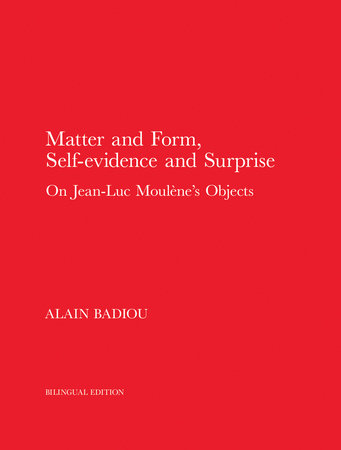
In this unique essay, first delivered as a lecture during a panel discussion with the artist and philosopher Reza Negarestani, Alain Badiou identifies and “dialecticizes” five of the artist Jean-Luc Moulène's objects with five conceptual formations from the history of Western philosophy. Aristotle's complex of matter and form is called to mind to describe the inner logic of a hard foam sculpture. A bronze statue with holes activates Plato's notion of participation of the concrete world in the “injured Idea of the Beautiful.” A small metallic and incomplete “angel” engages Leibniz's affirmation that “everything that exists is composed of an infinity of things.” Badiou's musings go on to pair a broken and repaired plastic chair with Victor Hugo; a terrible hand made of concrete with the Freudian unconscious; and a large-scale “red and blue monster” with rudimentary mechanisms of the Cartesian cogito, the famous “I think, therefore I am,” with unexpected inversions and variations.
Badiou refrains, of course, from claiming that Moulène thinks about any of these philosophers when making his specific works. What he points to, however, in this richly illustrated bilingual volume, is that the artist and his art are “on the side of philosophy.”
In this unique essay, first delivered as a lecture during a panel discussion with the artist and philosopher Reza Negarestani, Alain Badiou identifies and “dialecticizes” five of the artist Jean-Luc Moulène's objects with five conceptual formations from the history of Western philosophy. Aristotle's complex of matter and form is called to mind to describe the inner logic of a hard foam sculpture. A bronze statue with holes activates Plato's notion of participation of the concrete world in the “injured Idea of the Beautiful.” A small metallic and incomplete “angel” engages Leibniz's affirmation that “everything that exists is composed of an infinity of things.” Badiou's musings go on to pair a broken and repaired plastic chair with Victor Hugo; a terrible hand made of concrete with the Freudian unconscious; and a large-scale “red and blue monster” with rudimentary mechanisms of the Cartesian cogito, the famous “I think, therefore I am,” with unexpected inversions and variations.
Badiou refrains, of course, from claiming that Moulène thinks about any of these philosophers when making his specific works. What he points to, however, in this richly illustrated bilingual volume, is that the artist and his art are “on the side of philosophy.”
In honor of Arab American Heritage Month in April, we are sharing books by Arab and Arab American authors that share their culture, history, and personal lives.
For National Poetry Month in April, we are sharing poetry collections and books about poetry by authors who have their own stories to tell. These poets delve into history, reimagine the present, examine poetry itself—from traditional poems many know and love to poems and voices that are new and original.