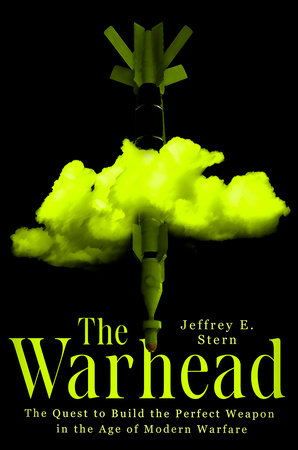

Though The Warhead uses a single weapon to illustrate how nations interact with each other, the economics of war, how technology drives policy and vice versa, it was not primarily an interest in weapons (or in any of those topics) that inspired me to write it.
Instead, the inspiration came from a single astonishing encounter I had in a remote part of northern Yemen while reporting for The New York Times Magazine.
I was in the process of trying to earn the trust of a community there and, one day over tea, a villager sitting across the carpet scooted over and asked me to touch his face. There was something thin, small, and very hard in a lip of skin beneath his eye. He told the interpreter it was shrapnel from an airstrike.
In that moment I was struck by something I couldn’t shake: I had spent days traveling in disguise, navigating checkpoints, sneaking into rebel-held territory and evading surveillance in order to reach his valley. The bomb that delivered that piece of metal to his face had no such trouble. It crossed oceans and borders with an ease that people could not.
Back home, I began to trace the metal. A former U.S. Navy bomb disposal technician and a Human Rights Watch investigator helped me track the shrapnel to a small, inexpensive weapon called the Paveway – the world’s first laser-guided smart bomb, developed by engineers at Texas Instruments in the 1960s and first deployed in combat over Vietnam. The deeper I dug, the more this one bomb revealed itself to be part of much larger phenomena, and a way to illustrate the interplay between policy, politics, conflict economics, and technology, by taking these concepts out of the abstract and into the realm of the specific and personal. Through the stories of people interacting with this single thing.
But my mindset as a researcher and writer has always been that if I believe something is worth people knowing, I ought to make them want to know it—I wanted reading the book to feel more like reading a novel than historiography or analysis. That required eight years of exhaustive archival and documentary research, using both open source and recently-declassified texts in English German, Arabic, and Serbo-Croation. It also required thousands of hours of hours of interviews in order to uncover the conditions that drove Paveway’s invention and trace its journey across decades and continents – from WWII to Vietnam, the Cold War, Bosnia, Iraq, and Libya.
The book does not tell students what to conclude. It puts them inside the decisions of engineers, commanders, politicians, and civilians, and asks them questions that don’t resolve neatly: Does technological precision make war more humane or simply more acceptable to those waging it? What responsibility do engineers bear for the uses of their inventions? How should societies think about innovations whose benefits and risks are deeply intertwined? These are not questions that belong to any single field. They belong to historians and engineers, to political scientists and philosophers, to ethicists and journalists. Regardless of the discipline, students will find themselves confronting the same unsettling reality: the people who build and deploy things are rarely the people who bear the consequences.
Jeffrey E. Stern (Duke University B.A 07, Stanford University M.A. 2012) is an award-winning journalist and author. A graduate fellow of the Stanford Center for International Conflict and Negotiation, and grantee of the Pulitzer Center on Crisis Reporting, his books include The 15:17 to Paris, adapted as a major motion picture by Clint Eastwood, and The Last Thousand a finalist for Library Journal’s Book of the Year. His reporting has appeared in the New York Times Magazine, Vanity Fair, and The Atlantic.