
Dear Reader,
My friends and I are in the woods on the rez talking about being Indian. We’re eleven or twelve. I don’t know why or how the subject came up. Perhaps we all learned of “The Book.” We all have one. Or our parents do. It’s a small book, held together with a black binding comb, the cover showing a traditional double curve, a drawing denoting the union of tribes, the Wabanaki, the People of the Dawn. The pages, some dirty like the color of grease on a white cloth, are filled with a list of names organized alphabetically by family last name. Next to each name is a number, a percentage, denoting how much Penobscot blood runs through our veins. We see ourselves, all of us who are enrolled members of the tribe, numbered by how much Penobscot we have. You need at least 25% to be in The Book.
This is, again, the union of our tribe.
In the woods that day, one of my friends says, “I’m more Indian than you. I got 85%. And I’m more than you and you and you. And you. You’re not even Native. Your mom married in. And you—wait, no, not you, I don’t think. How much you got?”
He tells him: 100%
That night, I look at my name in the book: Morgan James Talty: 25%.
Blood quantum is a colonial tool that many federally recognized tribes use to keep track of citizenship. In those woods that day, talking about being Indian, it was before we knew better, before we knew that some will never know better. This was before we—or some of us—knew how vast the government’s plan ran, how much it festered. This was before we knew these men, the so-called white Fathers, had plans masked as survival but were intended for us to eat each other’s spirit piece by piece. This is before colonial construct is in our vocabulary.
While the government could force internalized violence on us through federal Indian policy, having us fight over who is more Indian—physically or alone mentally—they forgot one thing: feeling. We are all born with it. While we had no idea the dangers and consequences of blood quantum, we did know exactly that: how to feel. We were born with that skill. That is our true union.
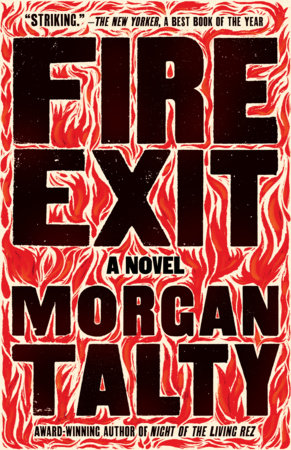
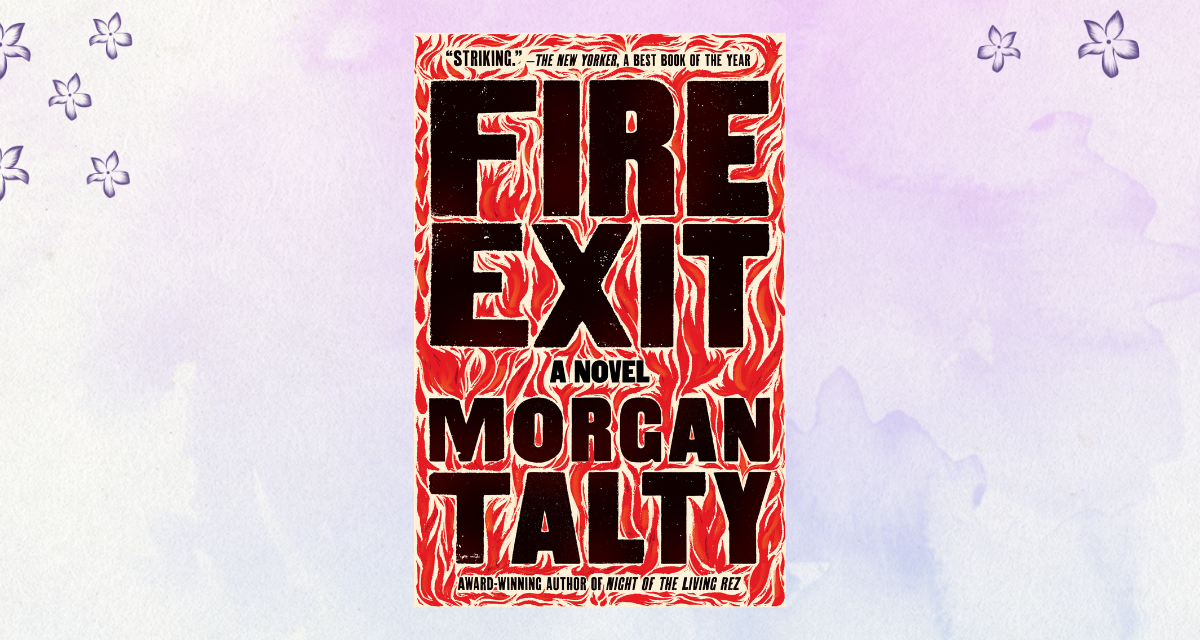
Fire Exit is not a book seeking truth about colonialism—no. It is a story about us, all of us, the very thing that binds each one of us together: our shared union of feeling that cannot be taken away. Literature should make us feel more alive, and that is what I’m trying to do here: bring us all to life a bit more, to bring us closer. We are nothing without each other.
I hope this book makes you shows you this union. I hope this book challenges you. Scares you. Makes you laugh. Saddens you. Angers you. Surprises you. Heals you. I hope this book opens to you a window through which you can see what I believe needs seeing: the core of our beings and how we need to learn to love not just ourselves better, but others.
Kci-woliwoni (many thanks) for being a Reader.
Morgan Talty
Morgan Talty is a citizen of the Penobscot Indian Nation. His debut short story collection, Night of the Living Rez, won the PEN/Robert W. Bingham Prize, the American Academy of Arts and Letters Sue Kaufman Prize, the National Book Critics Circle John Leonard Prize, the New England Book Award, the National Book Foundation’s 5 Under 35 Honor, and was a finalist for the Barnes & Noble Discover Great New Writers Award, the Andrew Carnegie Medal for Excellence in Fiction, the Mark Twain American Voice in Literature Award, and The Story Prize. His writing has appeared in The Georgia Review, Granta, Shenandoah, TriQuarterly, Narrative, Lit Hub, and elsewhere. Talty is an assistant professor of English in Creative Writing and Native American and Contemporary Literature at the University of Maine, Orono, and he is on the faculty at the Stonecoast MFA in Creative Writing as well as the Institute of American Indian Arts. He lives in Levant, Maine.