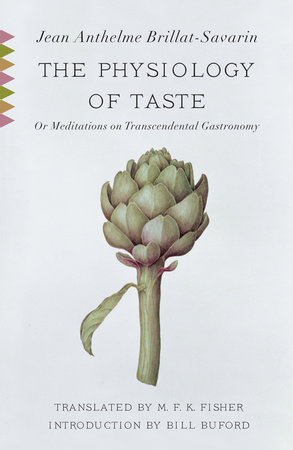
The book is — what? Does anyone know? Intermittently it is an autobiography, but told principally in dinner anecdotes (except one, which is about a breakfast, but so protracted that it, too, becomes dinner). It is not a cookbook, although the next time you are bestowed with a turbot the size and awkwardness of a small bicycle you will know how to cook it (too big to fit in the oven, the sea creature is effectively steamed in the tub). The difficulty is compounded by the book's opening, which invites us to think of it as something it never becomes. In the first two pages, we learn that a meal without cheese is as incomplete as a woman without an eye, a startling comparison to contemplate. We also learn that a dinner is never boring — at least for the first hour; that a new dish matters more to human happiness than the discovery of a star; that if, at the end of a meal, you are sated and slurring, you do not know how to eat and drink; and, most famously, that you are what you eat, a succinct expression of food and identity repeated so relentlessly that it is now a modern advertising banality. These ''Aphorisms of the Professor'' (''to serve as a preamble to his work and as a lasting foundation for the science of gastronomy'') represent a lifetime of one-liners, the stuff that, revised, scribbled into a notebook, rehearsed and repeated over a fortified beverage, kept the bachelor scholar from ever having to dine alone. But after page 2, the aphorisms disappear. Instead, there is history. Should we trust it? The Professor is not an historian. Or is he? There is science, more science than history, actually a lot of science. Do we dismiss it because we know better? Do we? Who is this guy anyway?
Copyright © 2009 by Jean Anthelme Brillat-Savarin. All rights reserved. No part of this excerpt may be reproduced or reprinted without permission in writing from the publisher.