
Books for Arab American Heritage Month
In honor of Arab American Heritage Month in April, we are sharing books by Arab and Arab American authors that share their culture, history, and personal lives.


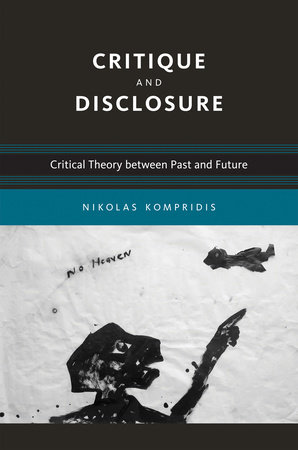
In Critique and Disclosure, Nikolas Kompridis argues provocatively for a richer and more time-responsive critical theory. He calls for a shift in the normative and critical emphasis of critical theory from the narrow concern with rules and procedures of Jürgen Habermas's model to a change-enabling disclosure of possibility and the enlargement of meaning. Kompridis contrasts two visions of critical theory's role and purpose in the world: one that restricts itself to the normative clarification of the procedures by which moral and political questions should be settled and an alternative rendering that conceives of itself as a possibility-disclosing practice. At the center of this resituation of critical theory is a normatively reformulated interpretation of Martin Heidegger's idea of "disclosure" or "world disclosure." In this regard Kompridis reconnects critical theory to its normative and conceptual sources in the German philosophical tradition and sets it within a romantic tradition of philosophical critique. Drawing not only on his sustained critical engagement with the thought of Habermas and Heidegger but also on the work of other philosophers including Wittgenstein, Cavell, Gadamer, and Benjamin, Kompridis argues that critical theory must, in light of modernity's time-consciousness, understand itself as fully situated in its time—in an ever-shifting and open-ended horizon of possibilities, to which it must respond by disclosing alternative ways of thinking and acting. His innovative and original argument will serve to move the debate over the future of critical studies forward—beyond simple antinomies to a consideration of, as he puts it, "what critical theory should be if it is to have a future worthy of its past."
This is a book that needed to be written. Habermas's critique of disclosure was at times narrow and shortsighted. But as Habermas is now rethinking some of these shortcomings, Kompridis gives him—and indeed all critical theorists—ample resources for a stronger integration of disclosive with formal and procedurally guided forms of thought.
—James Swindal, International Journal of Philosophical Studies—With Critique and Disclosure, Nikolas Kompridis makes an impressive intervention in the self-definition of Critical Theory […this book] will become a necessary reading for all those invested in the reinvigoration or, possibly, transformation of this tradition.
—Patrick Gamez, Symposium: Canadian Journal of Continental Philosophy—In Critique and Disclosure, Nikolas Kompridis argues provocatively for a richer and more time-responsive critical theory. He calls for a shift in the normative and critical emphasis of critical theory from the narrow concern with rules and procedures of Jürgen Habermas's model to a change-enabling disclosure of possibility and the enlargement of meaning. Kompridis contrasts two visions of critical theory's role and purpose in the world: one that restricts itself to the normative clarification of the procedures by which moral and political questions should be settled and an alternative rendering that conceives of itself as a possibility-disclosing practice. At the center of this resituation of critical theory is a normatively reformulated interpretation of Martin Heidegger's idea of "disclosure" or "world disclosure." In this regard Kompridis reconnects critical theory to its normative and conceptual sources in the German philosophical tradition and sets it within a romantic tradition of philosophical critique. Drawing not only on his sustained critical engagement with the thought of Habermas and Heidegger but also on the work of other philosophers including Wittgenstein, Cavell, Gadamer, and Benjamin, Kompridis argues that critical theory must, in light of modernity's time-consciousness, understand itself as fully situated in its time—in an ever-shifting and open-ended horizon of possibilities, to which it must respond by disclosing alternative ways of thinking and acting. His innovative and original argument will serve to move the debate over the future of critical studies forward—beyond simple antinomies to a consideration of, as he puts it, "what critical theory should be if it is to have a future worthy of its past."
This is a book that needed to be written. Habermas's critique of disclosure was at times narrow and shortsighted. But as Habermas is now rethinking some of these shortcomings, Kompridis gives him—and indeed all critical theorists—ample resources for a stronger integration of disclosive with formal and procedurally guided forms of thought.
—James Swindal, International Journal of Philosophical Studies—With Critique and Disclosure, Nikolas Kompridis makes an impressive intervention in the self-definition of Critical Theory […this book] will become a necessary reading for all those invested in the reinvigoration or, possibly, transformation of this tradition.
—Patrick Gamez, Symposium: Canadian Journal of Continental Philosophy—














In honor of Arab American Heritage Month in April, we are sharing books by Arab and Arab American authors that share their culture, history, and personal lives.
For National Poetry Month in April, we are sharing poetry collections and books about poetry by authors who have their own stories to tell. These poets delve into history, reimagine the present, examine poetry itself—from traditional poems many know and love to poems and voices that are new and original.
/