
Books for Arab American Heritage Month
In honor of Arab American Heritage Month in April, we are sharing books by Arab and Arab American authors that share their culture, history, and personal lives.


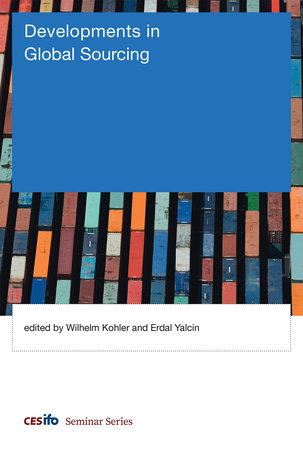
Recent decades have seen a fragmentation of production processes across borders, as firms find it increasingly profitable to organize production on a global scale. This fragmentation occurs across national borders as well as across firm boundaries; companies must decide not only the location of production but also how much control to exert over the different production stages. Economists have responded to this shift by developing new models of global sourcing, generating important insights into the driving forces and economic effects of this new form of globalization. Many questions, however, remain unanswered. This book tries to fill this gap.
The contributors ask new questions or offer new modeling approaches to fragmentation of production, focusing in particular on time and uncertainty. They examine global sourcing in firms' multinationalization strategies, including offshoring, product scope, managerial incentives, supplier search, and contractual issues; and explore the interactions of global sourcing, exports, and economic development, investigating such topics as the complementarity of offshoring and exporting, product diversification, and the relationship between vertical linkages and development. Each chapter presents recent research that further develops existing models or documents new empirical patterns related to global sourcing.
Contributors
Pol Antràs, Sasan Bakhtiari, Sebastian Benz, Giuseppe Berlingieri, Johannes Boehm, Jeronimo Carballo, Huiya Chen, Alejandro Cuñat, Fabrice Defever, Swati Dhingra, Harald Fadinger, Ana P. Fernandes, Christian Fischer, Wilhelm Kohler, Bohdan Kukharskyy, Luca Marcolin, Antonio Minniti, John Morrow, Alireza Naghavi, Han (Steffan) Qi, Jens Suedekum, Deborah L. Swenson, Edwin L.-C. Lai, Anders Rosenstand Laugesen, Ngo Van Long, Heiwai Tang, Erdal Yalcin
Recent decades have seen a fragmentation of production processes across borders, as firms find it increasingly profitable to organize production on a global scale. This fragmentation occurs across national borders as well as across firm boundaries; companies must decide not only the location of production but also how much control to exert over the different production stages. Economists have responded to this shift by developing new models of global sourcing, generating important insights into the driving forces and economic effects of this new form of globalization. Many questions, however, remain unanswered. This book tries to fill this gap.
The contributors ask new questions or offer new modeling approaches to fragmentation of production, focusing in particular on time and uncertainty. They examine global sourcing in firms' multinationalization strategies, including offshoring, product scope, managerial incentives, supplier search, and contractual issues; and explore the interactions of global sourcing, exports, and economic development, investigating such topics as the complementarity of offshoring and exporting, product diversification, and the relationship between vertical linkages and development. Each chapter presents recent research that further develops existing models or documents new empirical patterns related to global sourcing.
Contributors
Pol Antràs, Sasan Bakhtiari, Sebastian Benz, Giuseppe Berlingieri, Johannes Boehm, Jeronimo Carballo, Huiya Chen, Alejandro Cuñat, Fabrice Defever, Swati Dhingra, Harald Fadinger, Ana P. Fernandes, Christian Fischer, Wilhelm Kohler, Bohdan Kukharskyy, Luca Marcolin, Antonio Minniti, John Morrow, Alireza Naghavi, Han (Steffan) Qi, Jens Suedekum, Deborah L. Swenson, Edwin L.-C. Lai, Anders Rosenstand Laugesen, Ngo Van Long, Heiwai Tang, Erdal Yalcin


In honor of Arab American Heritage Month in April, we are sharing books by Arab and Arab American authors that share their culture, history, and personal lives.
For National Poetry Month in April, we are sharing poetry collections and books about poetry by authors who have their own stories to tell. These poets delve into history, reimagine the present, examine poetry itself—from traditional poems many know and love to poems and voices that are new and original.