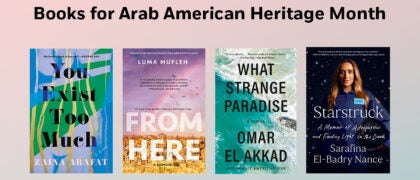
Books for Arab American Heritage Month
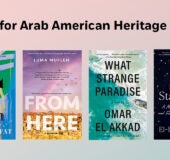
In honor of Arab American Heritage Month in April, we are sharing books by Arab and Arab American authors that share their culture, history, and personal lives.


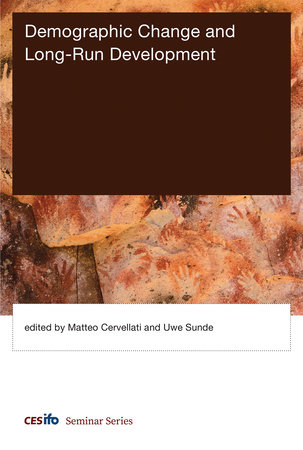
Over the last two hundred years, mortality and fertility levels in the Western world have dropped to unprecedented levels. This demographic transition was accompanied by an economic transition that led to widespread education and economic growth after centuries of near-stagnation. At the same time, other changes have occurred in family structures, culture, and the organization of society. Economists have only recently begun to take into account the demographic transition from high mortality and high fertility when modeling and researching economic development. This CESifo volume reviews recent approaches to economic demography, considering such topics as the bio-geographic origins of comparative development differences, the role of health improvements and mortality decline, as well as physiological, familial, cultural, and social aspects.
After an overview of the study of demography and economic demography, the chapters cover subjects including the Neolithic era and the period of the formation of states and social institutions; longevity and economic growth; household decision making and fertility; land inequality, education, and marriage in nineteenth century Prussia; and caste systems and technology in pre-modern societies. The book concludes with a call for further investigation of the institutional and social factors that influence demographics and economies, suggesting that unified growth theory offers a potential approach to studying development.
Contributors
Matteo Cervellati, Francesco Cinnirella, David de la Croix, Carl-Johann Dalgaard, Matthias Doepke, Elena Esposito, Davide Fiaschi, Tamara Fioroni, Oded Galor, Boris Gershman, Erik Hornung, Fabian Kindermann, Nils-Petter Lagerlöf, Holger Strulik, Uwe Sunde, David N. Weil
Over the last two hundred years, mortality and fertility levels in the Western world have dropped to unprecedented levels. This demographic transition was accompanied by an economic transition that led to widespread education and economic growth after centuries of near-stagnation. At the same time, other changes have occurred in family structures, culture, and the organization of society. Economists have only recently begun to take into account the demographic transition from high mortality and high fertility when modeling and researching economic development. This CESifo volume reviews recent approaches to economic demography, considering such topics as the bio-geographic origins of comparative development differences, the role of health improvements and mortality decline, as well as physiological, familial, cultural, and social aspects.
After an overview of the study of demography and economic demography, the chapters cover subjects including the Neolithic era and the period of the formation of states and social institutions; longevity and economic growth; household decision making and fertility; land inequality, education, and marriage in nineteenth century Prussia; and caste systems and technology in pre-modern societies. The book concludes with a call for further investigation of the institutional and social factors that influence demographics and economies, suggesting that unified growth theory offers a potential approach to studying development.
Contributors
Matteo Cervellati, Francesco Cinnirella, David de la Croix, Carl-Johann Dalgaard, Matthias Doepke, Elena Esposito, Davide Fiaschi, Tamara Fioroni, Oded Galor, Boris Gershman, Erik Hornung, Fabian Kindermann, Nils-Petter Lagerlöf, Holger Strulik, Uwe Sunde, David N. Weil
In honor of Arab American Heritage Month in April, we are sharing books by Arab and Arab American authors that share their culture, history, and personal lives.
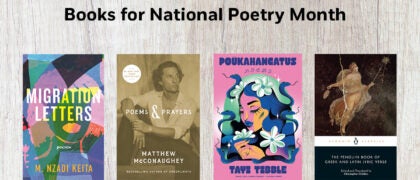
For National Poetry Month in April, we are sharing poetry collections and books about poetry by authors who have their own stories to tell. These poets delve into history, reimagine the present, examine poetry itself—from traditional poems many know and love to poems and voices that are new and original.