
Books for Arab American Heritage Month
In honor of Arab American Heritage Month in April, we are sharing books by Arab and Arab American authors that share their culture, history, and personal lives.


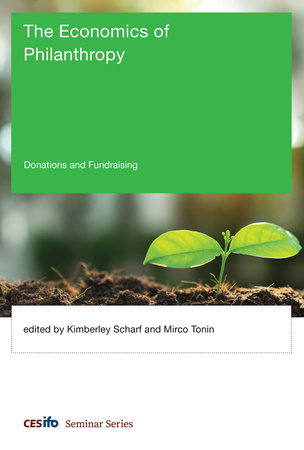
Economists are increasingly aware of the need to better understand philanthropic activities. In this book, economists address a variety of topics related to the economics of philanthropy, ranging from the determinants of giving to the effectiveness of fundraising techniques. The contributions focus on individual motives for giving and volunteering, and in particular how they affect donation outcomes, fundraising decisions, and public policies toward giving.
Previous research has viewed motives for giving as embedded in formal models of economic behavior with rational agents who maximize their own utility while constrained by a budget. These models, however, have been shown to have poor predictive power, neglecting direct and indirect motives for giving. The contributors consider, among other subjects, the free-riding problem in these models; altruistic, direct, and indirect motives for giving, addressed both theoretically and with lab experiments; the linear public good game; the role of social information; the effectiveness of matching gifts and premiums; motives for unpaid volunteering; subscription models as a way to regulate revenue streams; and increasing reliance on public funds.
Contributors
James Andreoni, Jon Behar, Avner Ben-Ner, Ted Bergstrom, Greg Bose, Sarah Brown, Catherine C. Eckel, Christina Gravert, David H. Herberich, Samantha Horn, Fantingyu Hu, Dean Karlan, Ann-Kathrin Koessler, Benjamin M. Marx, Jonathan Meer, Michael Menietti, Bradley Minaker, Mark Ottoni-Wilhelm, A. Abigail Payne, Maria P. Recalde, Kimberley Scharf, Claudia Schwirplies, Marta Serra-Garcia, Sarah Smith, Karl Taylor, Mette Trier Damgaard, Lise Vesterlund, Laura Villalobos
Economists are increasingly aware of the need to better understand philanthropic activities. In this book, economists address a variety of topics related to the economics of philanthropy, ranging from the determinants of giving to the effectiveness of fundraising techniques. The contributions focus on individual motives for giving and volunteering, and in particular how they affect donation outcomes, fundraising decisions, and public policies toward giving.
Previous research has viewed motives for giving as embedded in formal models of economic behavior with rational agents who maximize their own utility while constrained by a budget. These models, however, have been shown to have poor predictive power, neglecting direct and indirect motives for giving. The contributors consider, among other subjects, the free-riding problem in these models; altruistic, direct, and indirect motives for giving, addressed both theoretically and with lab experiments; the linear public good game; the role of social information; the effectiveness of matching gifts and premiums; motives for unpaid volunteering; subscription models as a way to regulate revenue streams; and increasing reliance on public funds.
Contributors
James Andreoni, Jon Behar, Avner Ben-Ner, Ted Bergstrom, Greg Bose, Sarah Brown, Catherine C. Eckel, Christina Gravert, David H. Herberich, Samantha Horn, Fantingyu Hu, Dean Karlan, Ann-Kathrin Koessler, Benjamin M. Marx, Jonathan Meer, Michael Menietti, Bradley Minaker, Mark Ottoni-Wilhelm, A. Abigail Payne, Maria P. Recalde, Kimberley Scharf, Claudia Schwirplies, Marta Serra-Garcia, Sarah Smith, Karl Taylor, Mette Trier Damgaard, Lise Vesterlund, Laura Villalobos








In honor of Arab American Heritage Month in April, we are sharing books by Arab and Arab American authors that share their culture, history, and personal lives.
For National Poetry Month in April, we are sharing poetry collections and books about poetry by authors who have their own stories to tell. These poets delve into history, reimagine the present, examine poetry itself—from traditional poems many know and love to poems and voices that are new and original.
/