The Microeconomics of Artificial Intelligence

A comprehensive treatment of the microeconomics associated with the adoption and use of artificial intelligence.

It is well-recognized that recent advances in AI are exclusively advances in statistical techniques for prediction. While this may facilitate automation, this result is secondary to AI’s impact on decision-making. From an economics perspective, predictions have their first-order impacts on the efficiency of decision-making.

In The Microeconomics of Artificial Intelligence, Joshua Gans examines AI as prediction that enhances and perhaps enables decision-making, focusing on the impacts that arise within firms or industries rather than broad economy-wide impacts on employment and productivity. He analyzes what the supply and production characteristics of AI are and what the drivers of the demand for AI prediction are. Putting these together, he explores how supply and demand conditions lead to a price for predictions and how this price is shaped by market structure. Finally, from a microeconomics perspective, he explores the key policy trade-offs for antitrust, privacy, and other regulations.
  • 1 The Economic Impact of AI
  • 2 Advances in Machine Learning
  • 3 The Value of Prediction
  • 4 Substitutes for Prediction
  • 5 Complements to Prediction
  • 6 Automation
  • 7 System Effects
  • Part II: AI Supply
  • 8 Generation of Input Data
  • 9 Generation of Training Data
  • Part III: AI Pricing
  • 10 Pricing with Exogenous Judgment
  • 11 Pricing with Endogenous Judgment
  • 12 Pricing to a Competitive Market
  • 13 Pricing to a Monopoly Market
  • 14 Prediction for Negotiations
  • Part IV: AI Policy
  • 15 Market Power
  • 16 Collusion
  • 17 Privacy Regulation
  • 18 Intellectual Property Rights
  • 19 Misinformation
  • 20 Bias and Discrimination
  • 21 Regulating Adoption
  • 22 Behavioural and Social Impacts
  • Bibliography
  • Index
Joshua Gans is Professor of Strategic Management and holds the Jeffrey S. Skoll Chair of Technical Innovation and Entrepreneurship at the University of Toronto’s Rotman School of Management. He is the author of The Disruption Dilemma (MIT Press) and other books, and coauthor of Prediction Machines and Innovation + Equality (MIT Press).
ENDORSEMENTS

The Microeconomics of Artificial Intelligence is a timely and important account of how economic insights can shed light on likely demand- and supply-side developments in AI, and on possible policy interventions (antitrust, privacy, intellectual property, misinformation). A must-read for scholars and for economics and management graduate and advanced undergraduate students interested in AI.” —Jean Tirole, 2014 Nobel Laureate, TSE & IAST Honorary Chairman, Toulouse School of Economics

“Professor Gans examines the relationship between AI prediction and economic decision, along with some side trips into digital policy. As he demonstrates, this combination is highly productive and well worth careful study.” —Hal Varian, Professor Emeritus, University of California, Berkeley; former Chief Economist, Google

“This is a much-needed book. There is immense interest in AI from economists, but as of yet they lacked a rigorous textbook to help inform them about what the economics of AI looks like. This beautifully written book fills that gap and I suggest anyone who is a trained economist and is interested in AI buys it.” —Catherine Tucker, Distinguished Professor, MIT Sloan School of Management

The Microeconomics of Artificial Intelligence serves as a comprehensive textbook that delves into the transformative impact of artificial intelligence through the lens of microeconomic theory. With clear explanations, rigorous analysis, and real-world examples, it provides students and educators with the essential tools to understand how AI is reshaping economic behaviors, markets, and decision-making. This text is a vital resource for anyone studying the intersection of AI and economics.” —Steve Tadelis, Professor and Sarin Chair in Strategy and Leadership, University of California, Berkeley

About

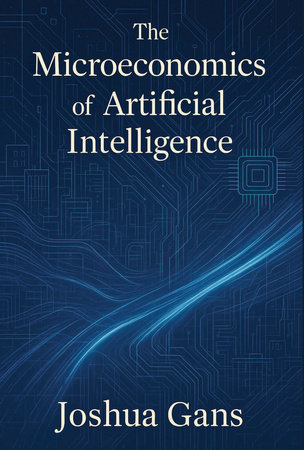
A comprehensive treatment of the microeconomics associated with the adoption and use of artificial intelligence.

It is well-recognized that recent advances in AI are exclusively advances in statistical techniques for prediction. While this may facilitate automation, this result is secondary to AI’s impact on decision-making. From an economics perspective, predictions have their first-order impacts on the efficiency of decision-making.

In The Microeconomics of Artificial Intelligence, Joshua Gans examines AI as prediction that enhances and perhaps enables decision-making, focusing on the impacts that arise within firms or industries rather than broad economy-wide impacts on employment and productivity. He analyzes what the supply and production characteristics of AI are and what the drivers of the demand for AI prediction are. Putting these together, he explores how supply and demand conditions lead to a price for predictions and how this price is shaped by market structure. Finally, from a microeconomics perspective, he explores the key policy trade-offs for antitrust, privacy, and other regulations.

Table of Contents

  • 1 The Economic Impact of AI
  • 2 Advances in Machine Learning
  • 3 The Value of Prediction
  • 4 Substitutes for Prediction
  • 5 Complements to Prediction
  • 6 Automation
  • 7 System Effects
  • Part II: AI Supply
  • 8 Generation of Input Data
  • 9 Generation of Training Data
  • Part III: AI Pricing
  • 10 Pricing with Exogenous Judgment
  • 11 Pricing with Endogenous Judgment
  • 12 Pricing to a Competitive Market
  • 13 Pricing to a Monopoly Market
  • 14 Prediction for Negotiations
  • Part IV: AI Policy
  • 15 Market Power
  • 16 Collusion
  • 17 Privacy Regulation
  • 18 Intellectual Property Rights
  • 19 Misinformation
  • 20 Bias and Discrimination
  • 21 Regulating Adoption
  • 22 Behavioural and Social Impacts
  • Bibliography
  • Index

Author

Joshua Gans is Professor of Strategic Management and holds the Jeffrey S. Skoll Chair of Technical Innovation and Entrepreneurship at the University of Toronto’s Rotman School of Management. He is the author of The Disruption Dilemma (MIT Press) and other books, and coauthor of Prediction Machines and Innovation + Equality (MIT Press).

Praise

ENDORSEMENTS

The Microeconomics of Artificial Intelligence is a timely and important account of how economic insights can shed light on likely demand- and supply-side developments in AI, and on possible policy interventions (antitrust, privacy, intellectual property, misinformation). A must-read for scholars and for economics and management graduate and advanced undergraduate students interested in AI.” —Jean Tirole, 2014 Nobel Laureate, TSE & IAST Honorary Chairman, Toulouse School of Economics

“Professor Gans examines the relationship between AI prediction and economic decision, along with some side trips into digital policy. As he demonstrates, this combination is highly productive and well worth careful study.” —Hal Varian, Professor Emeritus, University of California, Berkeley; former Chief Economist, Google

“This is a much-needed book. There is immense interest in AI from economists, but as of yet they lacked a rigorous textbook to help inform them about what the economics of AI looks like. This beautifully written book fills that gap and I suggest anyone who is a trained economist and is interested in AI buys it.” —Catherine Tucker, Distinguished Professor, MIT Sloan School of Management

The Microeconomics of Artificial Intelligence serves as a comprehensive textbook that delves into the transformative impact of artificial intelligence through the lens of microeconomic theory. With clear explanations, rigorous analysis, and real-world examples, it provides students and educators with the essential tools to understand how AI is reshaping economic behaviors, markets, and decision-making. This text is a vital resource for anyone studying the intersection of AI and economics.” —Steve Tadelis, Professor and Sarin Chair in Strategy and Leadership, University of California, Berkeley