
Books for Arab American Heritage Month
In honor of Arab American Heritage Month in April, we are sharing books by Arab and Arab American authors that share their culture, history, and personal lives.


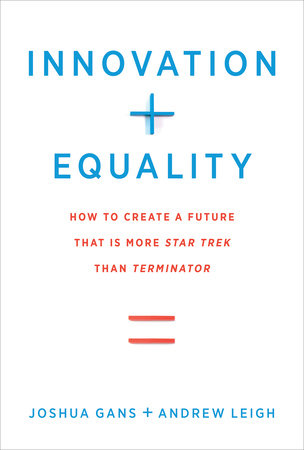
Is economic inequality the price we pay for innovation? The amazing technological advances of the last two decades—in such areas as artificial intelligence, genetics, and materials—have benefited society collectively and rewarded innovators handsomely: we get cool smartphones and technology moguls become billionaires. This contributes to a growing wealth gap; in the United States; the wealth controlled by the top 0.1 percent of households equals that of the bottom ninety percent. Is this the inevitable cost of an innovation-driven economy? Economist Joshua Gans and policy maker Andrew Leigh make the case that pursuing innovation does not mean giving up on equality—precisely the opposite. In this book, they outline ways that society can become both more entrepreneurial and more egalitarian.
All innovation entails uncertainty; there's no way to predict which new technologies will catch on. Therefore, Gans and Leigh argue, rather than betting on the future of particular professions, we should consider policies that embrace uncertainty and protect people from unfavorable outcomes. To this end, they suggest policies that promote both innovation and equality. If we encourage innovation in the right way, our future can look more like the cheerful techno-utopia of Star Trek than the dark techno-dystopia of The Terminator.
Gans and Leigh are alarmed by the winner-take-most phenomenon that characterises many parts of the tech industry. They call for a wide range of reforms, from banning non-compete clauses in work contracts and easing the process for university loans, to reducing sexual harassment in the workplace to boost the number of women in tech
—The Economist—Written in a snappy style leavened with pop culture references, this is not just a book for policy wonks.
—Sydney Morning Herald—Is economic inequality the price we pay for innovation? The amazing technological advances of the last two decades—in such areas as artificial intelligence, genetics, and materials—have benefited society collectively and rewarded innovators handsomely: we get cool smartphones and technology moguls become billionaires. This contributes to a growing wealth gap; in the United States; the wealth controlled by the top 0.1 percent of households equals that of the bottom ninety percent. Is this the inevitable cost of an innovation-driven economy? Economist Joshua Gans and policy maker Andrew Leigh make the case that pursuing innovation does not mean giving up on equality—precisely the opposite. In this book, they outline ways that society can become both more entrepreneurial and more egalitarian.
All innovation entails uncertainty; there's no way to predict which new technologies will catch on. Therefore, Gans and Leigh argue, rather than betting on the future of particular professions, we should consider policies that embrace uncertainty and protect people from unfavorable outcomes. To this end, they suggest policies that promote both innovation and equality. If we encourage innovation in the right way, our future can look more like the cheerful techno-utopia of Star Trek than the dark techno-dystopia of The Terminator.
Gans and Leigh are alarmed by the winner-take-most phenomenon that characterises many parts of the tech industry. They call for a wide range of reforms, from banning non-compete clauses in work contracts and easing the process for university loans, to reducing sexual harassment in the workplace to boost the number of women in tech
—The Economist—Written in a snappy style leavened with pop culture references, this is not just a book for policy wonks.
—Sydney Morning Herald—
In honor of Arab American Heritage Month in April, we are sharing books by Arab and Arab American authors that share their culture, history, and personal lives.
For National Poetry Month in April, we are sharing poetry collections and books about poetry by authors who have their own stories to tell. These poets delve into history, reimagine the present, examine poetry itself—from traditional poems many know and love to poems and voices that are new and original.
/