
Books for Arab American Heritage Month
In honor of Arab American Heritage Month in April, we are sharing books by Arab and Arab American authors that share their culture, history, and personal lives.


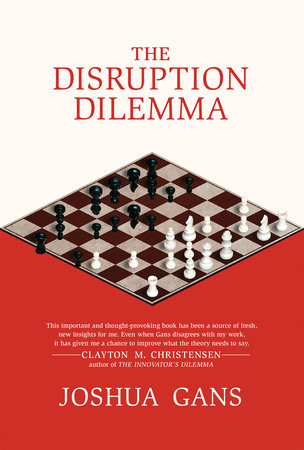
“Disruption” is a business buzzword that has gotten out of control. Today everything and everyone seem to be characterized as disruptive—or, if they aren't disruptive yet, it's only a matter of time before they become so. In this book, Joshua Gans cuts through the chatter to focus on disruption in its initial use as a business term, identifying new ways to understand it and suggesting new tools to manage it.
Almost twenty years ago Clayton Christensen popularized the term in his book The Innovator's Dilemma, writing of disruption as a set of risks that established firms face. Since then, few have closely examined his account. Gans does so in this book. He looks at companies that have proven resilient and those that have fallen, and explains why some companies have successfully managed disruption—Fujifilm and Canon, for example—and why some like Blockbuster and Encyclopedia Britannica have not. Departing from the conventional wisdom, Gans identifies two kinds of disruption: demand-side, when successful firms focus on their main customers and underestimate market entrants with innovations that target niche demands; and supply-side, when firms focused on developing existing competencies become incapable of developing new ones.
Gans describes the full range of actions business leaders can take to deal with each type of disruption, from “self-disrupting” independent internal units to tightly integrated product development. But therein lies the disruption dilemma: A firm cannot practice both independence and integration at once. Gans shows business leaders how to choose their strategy so their firms can deal with disruption while continuing to innovate.
If you think you understand when large firms are in danger, and what they should do, as well as when there are opportunities for start-ups, this is a must-read book.
—Washington Post—What makes this book compulsive is the way models of disruption are mapped onto various case studies – the introduction of the iPhone, Microsoft and the 'browser wars', the aforementioned Blockbuster – in a way that brings the theory alive and arms the reader to face future disruptions.
—Communication Director—“Disruption” is a business buzzword that has gotten out of control. Today everything and everyone seem to be characterized as disruptive—or, if they aren't disruptive yet, it's only a matter of time before they become so. In this book, Joshua Gans cuts through the chatter to focus on disruption in its initial use as a business term, identifying new ways to understand it and suggesting new tools to manage it.
Almost twenty years ago Clayton Christensen popularized the term in his book The Innovator's Dilemma, writing of disruption as a set of risks that established firms face. Since then, few have closely examined his account. Gans does so in this book. He looks at companies that have proven resilient and those that have fallen, and explains why some companies have successfully managed disruption—Fujifilm and Canon, for example—and why some like Blockbuster and Encyclopedia Britannica have not. Departing from the conventional wisdom, Gans identifies two kinds of disruption: demand-side, when successful firms focus on their main customers and underestimate market entrants with innovations that target niche demands; and supply-side, when firms focused on developing existing competencies become incapable of developing new ones.
Gans describes the full range of actions business leaders can take to deal with each type of disruption, from “self-disrupting” independent internal units to tightly integrated product development. But therein lies the disruption dilemma: A firm cannot practice both independence and integration at once. Gans shows business leaders how to choose their strategy so their firms can deal with disruption while continuing to innovate.
If you think you understand when large firms are in danger, and what they should do, as well as when there are opportunities for start-ups, this is a must-read book.
—Washington Post—What makes this book compulsive is the way models of disruption are mapped onto various case studies – the introduction of the iPhone, Microsoft and the 'browser wars', the aforementioned Blockbuster – in a way that brings the theory alive and arms the reader to face future disruptions.
—Communication Director—




In honor of Arab American Heritage Month in April, we are sharing books by Arab and Arab American authors that share their culture, history, and personal lives.
For National Poetry Month in April, we are sharing poetry collections and books about poetry by authors who have their own stories to tell. These poets delve into history, reimagine the present, examine poetry itself—from traditional poems many know and love to poems and voices that are new and original.
/