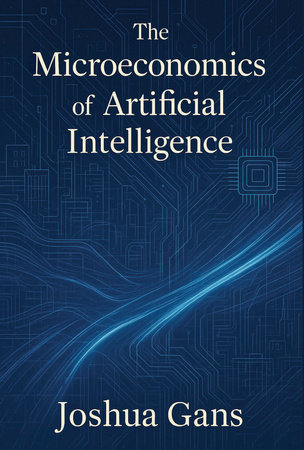

The Microeconomics of Artificial Intelligence

A comprehensive treatment of the microeconomics associated with the adoption and use of artificial intelligence.

It is well-recognized that recent advances in AI are exclusively advances in statistical techniques for prediction. While this may facilitate automation, this result is secondary to AI’s impact on decision-making. From an economics perspective, predictions have their first-order impacts on the efficiency of decision-making.

In The Microeconomics of Artificial Intelligence, Joshua Gans examines AI as prediction that enhances and perhaps enables decision-making, focusing on the impacts that arise within firms or industries rather than broad economy-wide impacts on employment and productivity. He analyzes what the supply and production characteristics of AI are and what the drivers of the demand for AI prediction are. Putting these together, he explores how supply and demand conditions lead to a price for predictions and how this price is shaped by market structure. Finally, from a microeconomics perspective, he explores the key policy trade-offs for antitrust, privacy, and other regulations.
  • 1 The Economic Impact of AI
  • 2 Advances in Machine Learning
  • 3 The Value of Prediction
  • 4 Substitutes for Prediction
  • 5 Complements to Prediction
  • 6 Automation
  • 7 System Effects
  • Part II: AI Supply
  • 8 Generation of Input Data
  • 9 Generation of Training Data
  • Part III: AI Pricing
  • 10 Pricing with Exogenous Judgment
  • 11 Pricing with Endogenous Judgment
  • 12 Pricing to a Competitive Market
  • 13 Pricing to a Monopoly Market
  • 14 Prediction for Negotiations
  • Part IV: AI Policy
  • 15 Market Power
  • 16 Collusion
  • 17 Privacy Regulation
  • 18 Intellectual Property Rights
  • 19 Misinformation
  • 20 Bias and Discrimination
  • 21 Regulating Adoption
  • 22 Behavioural and Social Impacts
  • Bibliography
  • Index
Joshua Gans is Professor of Strategic Management and holds the Jeffrey S. Skoll Chair of Technical Innovation and Entrepreneurship at the University of Toronto’s Rotman School of Management. He is the author of The Disruption Dilemma (MIT Press) and other books, and coauthor of Prediction Machines and Innovation + Equality (MIT Press).

About

A comprehensive treatment of the microeconomics associated with the adoption and use of artificial intelligence.

It is well-recognized that recent advances in AI are exclusively advances in statistical techniques for prediction. While this may facilitate automation, this result is secondary to AI’s impact on decision-making. From an economics perspective, predictions have their first-order impacts on the efficiency of decision-making.

In The Microeconomics of Artificial Intelligence, Joshua Gans examines AI as prediction that enhances and perhaps enables decision-making, focusing on the impacts that arise within firms or industries rather than broad economy-wide impacts on employment and productivity. He analyzes what the supply and production characteristics of AI are and what the drivers of the demand for AI prediction are. Putting these together, he explores how supply and demand conditions lead to a price for predictions and how this price is shaped by market structure. Finally, from a microeconomics perspective, he explores the key policy trade-offs for antitrust, privacy, and other regulations.

Table of Contents

  • 1 The Economic Impact of AI
  • 2 Advances in Machine Learning
  • 3 The Value of Prediction
  • 4 Substitutes for Prediction
  • 5 Complements to Prediction
  • 6 Automation
  • 7 System Effects
  • Part II: AI Supply
  • 8 Generation of Input Data
  • 9 Generation of Training Data
  • Part III: AI Pricing
  • 10 Pricing with Exogenous Judgment
  • 11 Pricing with Endogenous Judgment
  • 12 Pricing to a Competitive Market
  • 13 Pricing to a Monopoly Market
  • 14 Prediction for Negotiations
  • Part IV: AI Policy
  • 15 Market Power
  • 16 Collusion
  • 17 Privacy Regulation
  • 18 Intellectual Property Rights
  • 19 Misinformation
  • 20 Bias and Discrimination
  • 21 Regulating Adoption
  • 22 Behavioural and Social Impacts
  • Bibliography
  • Index

Author

Joshua Gans is Professor of Strategic Management and holds the Jeffrey S. Skoll Chair of Technical Innovation and Entrepreneurship at the University of Toronto’s Rotman School of Management. He is the author of The Disruption Dilemma (MIT Press) and other books, and coauthor of Prediction Machines and Innovation + Equality (MIT Press).