
Books for Jewish American Heritage Month
In celebration of Jewish American Heritage Month in May, we are sharing books by authors who share their individual stories, experiences, and lives. Find our full collection of books here.


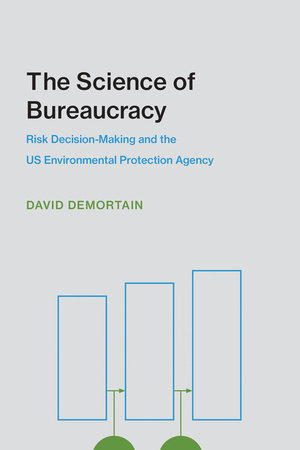
The US Environmental Protection Agency was established in 1970 to protect the public health and environment, administering and enforcing a range of statutes and programs. Over four decades, the EPA has been a risk bureaucracy, formalizing many of the methods of the scientific governance of risk, from quantitative risk assessment to risk ranking.
Demortain traces the creation of these methods for the governance of risk, the controversies to which they responded, and the controversies that they aroused in turn. He discusses the professional networks in which they were conceived; how they were used; and how they served to legitimize the EPA. Demortain argues that the EPA is structurally embedded in controversy, resulting in constant reevaluation of its credibility and fueling the evolution of the knowledge and technologies it uses to produce decisions and to create a legitimate image of how and why it acts on the environment. He describes the emergence and institutionalization of the risk assessment–risk management framework codified in the National Research Council's Red Book, and its subsequent unraveling as the agency's mission evolved toward environmental justice, ecological restoration, and sustainability, and as controversies over determining risk gained vigor in the 1990s.
Through its rise and fall at the EPA, risk decision-making enshrines the science of a bureaucracy that learns how to make credible decisions and to reform itself, amid constant conflicts about the environment, risk, and its own legitimacy.
The US Environmental Protection Agency was established in 1970 to protect the public health and environment, administering and enforcing a range of statutes and programs. Over four decades, the EPA has been a risk bureaucracy, formalizing many of the methods of the scientific governance of risk, from quantitative risk assessment to risk ranking.
Demortain traces the creation of these methods for the governance of risk, the controversies to which they responded, and the controversies that they aroused in turn. He discusses the professional networks in which they were conceived; how they were used; and how they served to legitimize the EPA. Demortain argues that the EPA is structurally embedded in controversy, resulting in constant reevaluation of its credibility and fueling the evolution of the knowledge and technologies it uses to produce decisions and to create a legitimate image of how and why it acts on the environment. He describes the emergence and institutionalization of the risk assessment–risk management framework codified in the National Research Council's Red Book, and its subsequent unraveling as the agency's mission evolved toward environmental justice, ecological restoration, and sustainability, and as controversies over determining risk gained vigor in the 1990s.
Through its rise and fall at the EPA, risk decision-making enshrines the science of a bureaucracy that learns how to make credible decisions and to reform itself, amid constant conflicts about the environment, risk, and its own legitimacy.












































In celebration of Jewish American Heritage Month in May, we are sharing books by authors who share their individual stories, experiences, and lives. Find our full collection of books here.
For Mental Health Awareness Month in May, we are sharing books to educate and raise awareness about mental health and the various factors that may affect it, and to provide tools and resources for student wellness. Find our full collection of titles here.
Each May, we honor the stories, histories, and cultures of Asian Americans, Native Hawaiians, and Pacific Islanders. Below is a selection of acclaimed fiction and nonfiction books by AANHPI creators to share with your students this month and throughout the year. Find our full collection of titles for Higher Education here.