































Books for Jewish American Heritage Month
In celebration of Jewish American Heritage Month in May, we are sharing books by authors who share their individual stories, experiences, and lives. Find our full collection of books here.
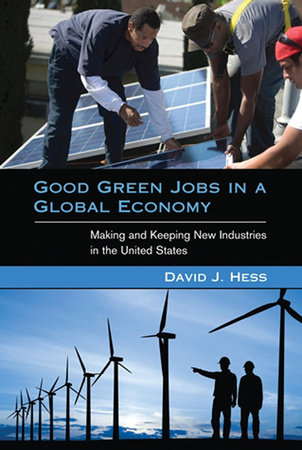
Good Green Jobs in a Global Economy is the first book to explore the broad implications of the convergence of industrial and environnmental policy in the United States. Under the banner of “green jobs,” clean energy industries and labor, environmental, and antipoverty organizations have forged “blue-green” alliances and achieved some policy victories, most notably at the state and local levels. In this book, David Hess explores the politics of green energy and green jobs, linking the prospect of a green transition to tectonic shifts in the global economy. He argues that the relative decline in U.S. economic power sets the stage for an ideological shift, away from neoliberalism and toward “developmentalism,” an ideology characterized by a more defensive posture with respect to trade and a more active industrial policy.
After describing federal green energy initiatives in the first two years of the Obama administration, Hess turns his attention to the state and local levels, examining demand-side and supply-side support for green industry and local small business. He analyzes the successes and failures of green coalitions and the partisan patterns of support for green energy reform. This new piecemeal green industrial policy, Hess argues, signals a fundamental challenge to anti-interventionist beliefs about the relationship between the government and the economy.
Good Green Jobs in a Global Economy is the first book to explore the broad implications of the convergence of industrial and environnmental policy in the United States. Under the banner of “green jobs,” clean energy industries and labor, environmental, and antipoverty organizations have forged “blue-green” alliances and achieved some policy victories, most notably at the state and local levels. In this book, David Hess explores the politics of green energy and green jobs, linking the prospect of a green transition to tectonic shifts in the global economy. He argues that the relative decline in U.S. economic power sets the stage for an ideological shift, away from neoliberalism and toward “developmentalism,” an ideology characterized by a more defensive posture with respect to trade and a more active industrial policy.
After describing federal green energy initiatives in the first two years of the Obama administration, Hess turns his attention to the state and local levels, examining demand-side and supply-side support for green industry and local small business. He analyzes the successes and failures of green coalitions and the partisan patterns of support for green energy reform. This new piecemeal green industrial policy, Hess argues, signals a fundamental challenge to anti-interventionist beliefs about the relationship between the government and the economy.
In celebration of Jewish American Heritage Month in May, we are sharing books by authors who share their individual stories, experiences, and lives. Find our full collection of books here.
For Mental Health Awareness Month in May, we are sharing books to educate and raise awareness about mental health and the various factors that may affect it, and to provide tools and resources for student wellness. Find our full collection of titles here.
Each May, we honor the stories, histories, and cultures of Asian Americans, Native Hawaiians, and Pacific Islanders. Below is a selection of acclaimed fiction and nonfiction books by AANHPI creators to share with your students this month and throughout the year. Find our full collection of titles for Higher Education here.