
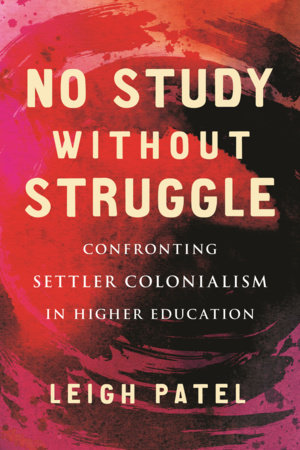

No Study Without Struggle

Confronting Settler Colonialism in Higher Education

Paperback
$15.95 US
On sale Jul 19, 2022 | 208 Pages | 9780807055632

See Additional Formats
Examines how student protest against structural inequalities on campus pushes academic institutions to reckon with their legacy built on slavery and stolen Indigenous lands

Using campus social justice movements as an entry point, Leigh Patel shows how the struggles in higher education often directly challenged the tension between narratives of education as a pathway to improvement and the structural reality of settler colonialism that creates and protects wealth for a select few. Through original research and interviews with activists and organizers from Black Lives Matter, The Black Panther party, the Student Nonviolent Coordinating Committee, the Combahee River Collective, and the Young Lords, Patel argues that the struggle on campuses reflect a starting point for higher education to confront settler strategies. She reveals how blurring the histories of slavery and Indigenous removal only traps us in history and perpetuates race, class, and gender inequalities. By acknowledging and challenging settler colonialism, Patel outlines the importance of understanding the relationship between the struggle and study and how this understanding is vital for societal improvement.
Author’s Note

CHAPTER ONE
Study and Struggle

CHAPTER TWO
Settler Colonialism

CHAPTER THREE
Profit and Debt

CHAPTER FOUR
Fugitive Learning in a Settler Society

CHAPTER FIVE
The Struggle to Study Is Vulnerable

CHAPTER SIX
Study Groups and Collective Struggle: Theories of Transformation

Acknowledgments
Notes
Index
Dr. Leigh Patel is an interdisciplinary researcher, an educator, a writer, and a professor at the University of Pittsburgh. She works extensively with societally marginalized youth and teacher activists. Patel is a recipient of the June Jordan Award for scholarly leadership and poetic bravery in social critique and is a national board member of Education for Liberation, a long-standing organization dedicated to transformative education for and by youth of color. She is the author of Youth Held at the Border and Decolonizing Educational Research. Connect with her on Twitter at @lipatel.
“A particularly poignant censure is aimed at universities’ theatrically professed diversity and inclusion efforts, which Patel contends do not actually interrupt settler colonialism and indeed exploit the labor of people of color . . . Thought-provoking interrogation for academics and reformers.”
Booklist

“In her essential new book, Dr. Leigh Patel examines how to disrupt systemic inequality on our campuses. Hint: it isn’t checkbox ‘diversity’ programs and empty land acknowledgments but a real reckoning with the settler colonialism on which our universities were built and continue to capitalize.”
Ms. Magazine

“Challenging two centuries of US colonialist higher education, Leigh Patel provides an analysis of and a road map for decolonizing the settler-colonial university.”
—Roxanne Dunbar-Ortiz, author of An Indigenous Peoples’ History of the United States

“Today, most American universities have adopted obligatory land acknowledgments, recognizing that their massive billion-dollar campuses are on stolen land. And yet, inside the classroom, the administrative halls, the financial arrangements, and in the relations between universities and their neighbors, the legacy of settler colonialism persists, unremarked and unheeded. Until now. Leigh Patel delivers a powerful, penetrating analysis of the settler-colonial roots of the modern university and the consequences for higher education and our society at large. The lesson is clear: we can’t ‘reform’ the university; it must be decolonized through critical study and struggle. This book is the essential guide.”
—Robin D. G. Kelley, author of Freedom Dreams: The Black Radical Imagination

“Leigh Patel’s writing is consistently bold, concise, timely, and filled with nuances. . . . Her moving writing is backed by historical context that brings theory to light.”
—Bettina L. Love, author of We Want to Do More Than Survive: Abolitionist Teaching and the Pursuit of Educational Freedom

About

Examines how student protest against structural inequalities on campus pushes academic institutions to reckon with their legacy built on slavery and stolen Indigenous lands

Using campus social justice movements as an entry point, Leigh Patel shows how the struggles in higher education often directly challenged the tension between narratives of education as a pathway to improvement and the structural reality of settler colonialism that creates and protects wealth for a select few. Through original research and interviews with activists and organizers from Black Lives Matter, The Black Panther party, the Student Nonviolent Coordinating Committee, the Combahee River Collective, and the Young Lords, Patel argues that the struggle on campuses reflect a starting point for higher education to confront settler strategies. She reveals how blurring the histories of slavery and Indigenous removal only traps us in history and perpetuates race, class, and gender inequalities. By acknowledging and challenging settler colonialism, Patel outlines the importance of understanding the relationship between the struggle and study and how this understanding is vital for societal improvement.

Table of Contents

Author’s Note

CHAPTER ONE
Study and Struggle

CHAPTER TWO
Settler Colonialism

CHAPTER THREE
Profit and Debt

CHAPTER FOUR
Fugitive Learning in a Settler Society

CHAPTER FIVE
The Struggle to Study Is Vulnerable

CHAPTER SIX
Study Groups and Collective Struggle: Theories of Transformation

Acknowledgments
Notes
Index

Author

Dr. Leigh Patel is an interdisciplinary researcher, an educator, a writer, and a professor at the University of Pittsburgh. She works extensively with societally marginalized youth and teacher activists. Patel is a recipient of the June Jordan Award for scholarly leadership and poetic bravery in social critique and is a national board member of Education for Liberation, a long-standing organization dedicated to transformative education for and by youth of color. She is the author of Youth Held at the Border and Decolonizing Educational Research. Connect with her on Twitter at @lipatel.

Praise

“A particularly poignant censure is aimed at universities’ theatrically professed diversity and inclusion efforts, which Patel contends do not actually interrupt settler colonialism and indeed exploit the labor of people of color . . . Thought-provoking interrogation for academics and reformers.”
Booklist

“In her essential new book, Dr. Leigh Patel examines how to disrupt systemic inequality on our campuses. Hint: it isn’t checkbox ‘diversity’ programs and empty land acknowledgments but a real reckoning with the settler colonialism on which our universities were built and continue to capitalize.”
Ms. Magazine

“Challenging two centuries of US colonialist higher education, Leigh Patel provides an analysis of and a road map for decolonizing the settler-colonial university.”
—Roxanne Dunbar-Ortiz, author of An Indigenous Peoples’ History of the United States

“Today, most American universities have adopted obligatory land acknowledgments, recognizing that their massive billion-dollar campuses are on stolen land. And yet, inside the classroom, the administrative halls, the financial arrangements, and in the relations between universities and their neighbors, the legacy of settler colonialism persists, unremarked and unheeded. Until now. Leigh Patel delivers a powerful, penetrating analysis of the settler-colonial roots of the modern university and the consequences for higher education and our society at large. The lesson is clear: we can’t ‘reform’ the university; it must be decolonized through critical study and struggle. This book is the essential guide.”
—Robin D. G. Kelley, author of Freedom Dreams: The Black Radical Imagination

“Leigh Patel’s writing is consistently bold, concise, timely, and filled with nuances. . . . Her moving writing is backed by historical context that brings theory to light.”
—Bettina L. Love, author of We Want to Do More Than Survive: Abolitionist Teaching and the Pursuit of Educational Freedom

Books for Women’s History Month

In honor of Women’s History Month in March, we are sharing books by women who have shaped history and have fought for their communities. Our list includes books about women who fought for racial justice, abortion rights, equality in the workplace, and ranges in topics from women in politics and prominent women in history to

Read more

Higher Education Must Be Decolonized Through Study and Struggle: A Q&A With Leigh Patel, author of No Study Without Struggle

  An inconvenient truth lies beneath the promises of opportunity and prestige that higher education degrees offer. US academic institutions are built upon legacies of stolen labor on stolen land. Through history, this settler-colonial foundation has trapped us in history and perpetuated race, class, and gender inequalities on campus. Social protests, often led by youth,

Read more