
Books for Arab American Heritage Month
In honor of Arab American Heritage Month in April, we are sharing books by Arab and Arab American authors that share their culture, history, and personal lives.


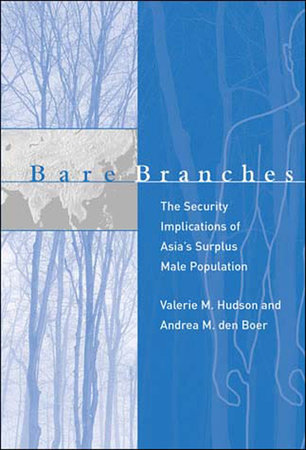
Hudson and den Boer suggest that the sex ratios of many Asian countries, particularly China and India—which represent almost 40 percent of the world's population—are being skewed in favor of males on a scale that may be unprecedented in human history. Through offspring sex selection (often in the form of sex-selective abortion and female infanticide), these countries are acquiring a disproportionate number of low-status young adult males, called "bare branches" by the Chinese.
Hudson and den Boer argue that this surplus male population in Asia's largest countries threatens domestic stability and international security. The prospects for peace and democracy are dimmed by the growth of bare branches in China and India, and, they maintain, the sex ratios of these countries will have global implications in the twenty-first century.
...an impressive and comprehensive account of sex ratios...
—The Wall Street Journal—...Bare Branches has become a flashpoint for a debate about the link between sex ratios and security.
—New York Times—...connects the dots of a huge demographic trend that carries international implications.
—The Christian Science Monitor—[E]xciting, innovative, refreshing...marks an important contribution at the nexus of the already burgeoning literatures addressing environmental and human security.
—Survival—Hudson and den Boer suggest that the sex ratios of many Asian countries, particularly China and India—which represent almost 40 percent of the world's population—are being skewed in favor of males on a scale that may be unprecedented in human history. Through offspring sex selection (often in the form of sex-selective abortion and female infanticide), these countries are acquiring a disproportionate number of low-status young adult males, called "bare branches" by the Chinese.
Hudson and den Boer argue that this surplus male population in Asia's largest countries threatens domestic stability and international security. The prospects for peace and democracy are dimmed by the growth of bare branches in China and India, and, they maintain, the sex ratios of these countries will have global implications in the twenty-first century.
...an impressive and comprehensive account of sex ratios...
—The Wall Street Journal—...Bare Branches has become a flashpoint for a debate about the link between sex ratios and security.
—New York Times—...connects the dots of a huge demographic trend that carries international implications.
—The Christian Science Monitor—[E]xciting, innovative, refreshing...marks an important contribution at the nexus of the already burgeoning literatures addressing environmental and human security.
—Survival—
In honor of Arab American Heritage Month in April, we are sharing books by Arab and Arab American authors that share their culture, history, and personal lives.
For National Poetry Month in April, we are sharing poetry collections and books about poetry by authors who have their own stories to tell. These poets delve into history, reimagine the present, examine poetry itself—from traditional poems many know and love to poems and voices that are new and original.