
Books for Jewish American Heritage Month
In celebration of Jewish American Heritage Month in May, we are sharing books by authors who share their individual stories, experiences, and lives. Find our full collection of books here.


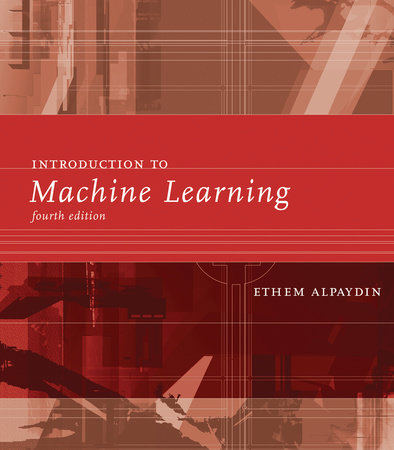
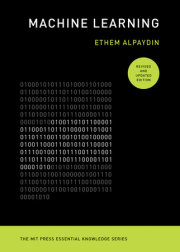
The goal of machine learning is to program computers to use example data or past experience to solve a given problem. Machine learning underlies such exciting new technologies as self-driving cars, speech recognition, and translation applications. This substantially revised fourth edition of a comprehensive, widely used machine learning textbook offers new coverage of recent advances in the field in both theory and practice, including developments in deep learning and neural networks.
The book covers a broad array of topics not usually included in introductory machine learning texts, including supervised learning, Bayesian decision theory, parametric methods, semiparametric methods, nonparametric methods, multivariate analysis, hidden Markov models, reinforcement learning, kernel machines, graphical models, Bayesian estimation, and statistical testing. The fourth edition offers a new chapter on deep learning that discusses training, regularizing, and structuring deep neural networks such as convolutional and generative adversarial networks; new material in the chapter on reinforcement learning that covers the use of deep networks, the policy gradient methods, and deep reinforcement learning; new material in the chapter on multilayer perceptrons on autoencoders and the word2vec network; and discussion of a popular method of dimensionality reduction, t-SNE. New appendixes offer background material on linear algebra and optimization. End-of-chapter exercises help readers to apply concepts learned. Introduction to Machine Learning can be used in courses for advanced undergraduate and graduate students and as a reference for professionals.
The goal of machine learning is to program computers to use example data or past experience to solve a given problem. Machine learning underlies such exciting new technologies as self-driving cars, speech recognition, and translation applications. This substantially revised fourth edition of a comprehensive, widely used machine learning textbook offers new coverage of recent advances in the field in both theory and practice, including developments in deep learning and neural networks.
The book covers a broad array of topics not usually included in introductory machine learning texts, including supervised learning, Bayesian decision theory, parametric methods, semiparametric methods, nonparametric methods, multivariate analysis, hidden Markov models, reinforcement learning, kernel machines, graphical models, Bayesian estimation, and statistical testing. The fourth edition offers a new chapter on deep learning that discusses training, regularizing, and structuring deep neural networks such as convolutional and generative adversarial networks; new material in the chapter on reinforcement learning that covers the use of deep networks, the policy gradient methods, and deep reinforcement learning; new material in the chapter on multilayer perceptrons on autoencoders and the word2vec network; and discussion of a popular method of dimensionality reduction, t-SNE. New appendixes offer background material on linear algebra and optimization. End-of-chapter exercises help readers to apply concepts learned. Introduction to Machine Learning can be used in courses for advanced undergraduate and graduate students and as a reference for professionals.



In celebration of Jewish American Heritage Month in May, we are sharing books by authors who share their individual stories, experiences, and lives. Find our full collection of books here.
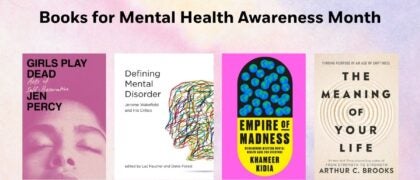
For Mental Health Awareness Month in May, we are sharing books to educate and raise awareness about mental health and the various factors that may affect it, and to provide tools and resources for student wellness. Find our full collection of titles here.
Each May, we honor the stories, histories, and cultures of Asian Americans, Native Hawaiians, and Pacific Islanders. Below is a selection of acclaimed fiction and nonfiction books by AANHPI creators to share with your students this month and throughout the year. Find our full collection of titles for Higher Education here.