
Books for Jewish American Heritage Month
In celebration of Jewish American Heritage Month in May, we are sharing books by authors who share their individual stories, experiences, and lives. Find our full collection of books here.


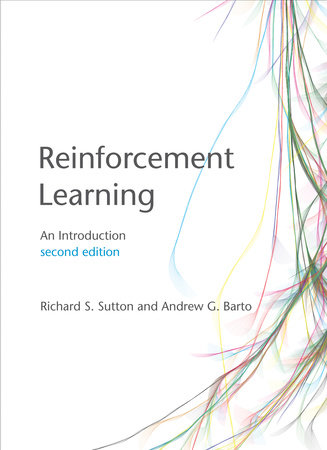
Reinforcement learning, one of the most active research areas in artificial intelligence, is a computational approach to learning whereby an agent tries to maximize the total amount of reward it receives while interacting with a complex, uncertain environment. In Reinforcement Learning, Richard Sutton and Andrew Barto provide a clear and simple account of the field's key ideas and algorithms. This second edition has been significantly expanded and updated, presenting new topics and updating coverage of other topics.
Like the first edition, this second edition focuses on core online learning algorithms, with the more mathematical material set off in shaded boxes. Part I covers as much of reinforcement learning as possible without going beyond the tabular case for which exact solutions can be found. Many algorithms presented in this part are new to the second edition, including UCB, Expected Sarsa, and Double Learning. Part II extends these ideas to function approximation, with new sections on such topics as artificial neural networks and the Fourier basis, and offers expanded treatment of off-policy learning and policy-gradient methods. Part III has new chapters on reinforcement learning's relationships to psychology and neuroscience, as well as an updated case-studies chapter including AlphaGo and AlphaGo Zero, Atari game playing, and IBM Watson's wagering strategy. The final chapter discusses the future societal impacts of reinforcement learning.
Reinforcement learning, one of the most active research areas in artificial intelligence, is a computational approach to learning whereby an agent tries to maximize the total amount of reward it receives while interacting with a complex, uncertain environment. In Reinforcement Learning, Richard Sutton and Andrew Barto provide a clear and simple account of the field's key ideas and algorithms. This second edition has been significantly expanded and updated, presenting new topics and updating coverage of other topics.
Like the first edition, this second edition focuses on core online learning algorithms, with the more mathematical material set off in shaded boxes. Part I covers as much of reinforcement learning as possible without going beyond the tabular case for which exact solutions can be found. Many algorithms presented in this part are new to the second edition, including UCB, Expected Sarsa, and Double Learning. Part II extends these ideas to function approximation, with new sections on such topics as artificial neural networks and the Fourier basis, and offers expanded treatment of off-policy learning and policy-gradient methods. Part III has new chapters on reinforcement learning's relationships to psychology and neuroscience, as well as an updated case-studies chapter including AlphaGo and AlphaGo Zero, Atari game playing, and IBM Watson's wagering strategy. The final chapter discusses the future societal impacts of reinforcement learning.



In celebration of Jewish American Heritage Month in May, we are sharing books by authors who share their individual stories, experiences, and lives. Find our full collection of books here.
For Mental Health Awareness Month in May, we are sharing books to educate and raise awareness about mental health and the various factors that may affect it, and to provide tools and resources for student wellness. Find our full collection of titles here.
Each May, we honor the stories, histories, and cultures of Asian Americans, Native Hawaiians, and Pacific Islanders. Below is a selection of acclaimed fiction and nonfiction books by AANHPI creators to share with your students this month and throughout the year. Find our full collection of titles for Higher Education here.