Introduction“These are the only genuine ideas; the ideas of the shipwrecked. All the rest is rhetoric, posturing, farce.”
—José Ortega y Gasset Almost thirty-five years ago, I gave a set of talks in Cincinnati, Ohio to link the wisdom of the Twelve Step Program with what St. Francis of Assisi (1181–1226) called “the marrow of the Gospel.” I was amazed how obvious and easy a task it was and surprised this was not equally obvious to everybody involved in either of these fields. So, the least I can hope to do here is to make what seems obvious to me a bit more obvious for you.
“Twelve Steppers” sometimes thought they had left the church when they attended Wednesday night Alcoholics Anonymous (AA) meetings in the basement, while many upstairs in the sanctuary presumed that their “higher” concerns were something different from “those people with problems” down below. The similar messages between the two teachings assure me that we are dealing with a common inspiration from the Holy Spirit and from the same collective unconscious. In fact, I am still convinced that, on the practical (read “transformational”) level, the Gospel message of Jesus and the Twelve Step message of Bill Wilson (aka Bill W; 1895–1971) are largely the same message, even in some detail, as I will try to show in this book. (I will frequently quote “Bill W” as the assigned author of the Twelve Steps and the so-called Big Book of Alcoholics Anonymous, but I am aware there is some doubt as to who exactly wrote what.)
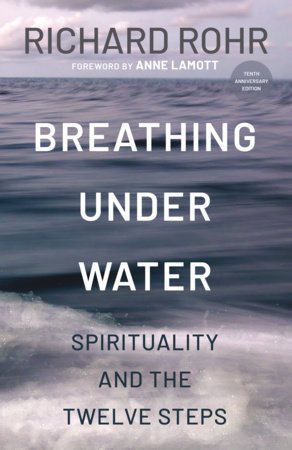
My original lectures were called “Breathing Under Water,” a title taken from a telling poem by Carol Bialock, rscj, which seemed to sum up so much of the common message. I quote it here in full:
“Breathing Underwater”
I built my house by the sea.
Not on the sands, mind you.
Not on the shifting sand.
And I built it of rock.
A strong house.
By a strong sea.
And we got well acquainted, the sea and I.
Good neighbors.
Not that we spoke much.
We met in silences.
Respectful, keeping our distance,
but looking our thoughts across the fence of sand.
Always, the fence of sand our barrier;
always the sand between.
And then one day
(I still don’t know how it happened), but the sea came.
Without warning.
Without welcome, even.
Not sudden and swift, but sifting across the sand like wine.
Less like the flow of water than the flow of blood.
Slow, but coming.
Slow, but flowing like an open wound.
And I thought of flight and I thought of drowning and I
thought of death.
And while I thought the sea crept higher, till it reached my
door.
I knew, then, there was neither flight nor death nor
drowning.
That when the sea comes calling you stop being good
neighbors.
Well-acquainted, friendly-from-a-distance neighbors.
And you give your house for a coral castle,
and you learn to breathe underwater.
The original cassette recordings continued to sell over the years, eventually became CDs, and morphed, over fifteen years later, into a second set of talks called “How Do We Breathe Under Water?” People continued to encourage me to put some of these ideas into written form. So, with some added growth and experience, here is the result. I hope it can offer all of us
some underwater breathing lessons—for a culture, and a church, that often appear to be drowning without knowing it. But do not despair. What José Ortega y Gasset (1883–1955) called the state of mind of the “shipwrecked” is perhaps a necessary beginning point for any salvation from such drowning.
Connecting the Gospel and the Twelve Steps Although in this book I will first look at the drowning individual, I will also point out the very similar parallels in institutions, cultures, and nations. As organizational consultant and psychotherapist Anne Wilson Schaef (1934–2020) noted many years ago, our society itself shows all the signs of classic addiction.4 I began to wonder whether addiction could be one very helpful metaphor for what the biblical tradition called “sin.”
I personally am convinced that is the case, which might be the first foundational connection between the Gospel and the Twelve Step Program. It is helpful to see sin, like addiction, as a
disease, a very destructive disease, instead of merely something that was culpable, punishable, or made God “unhappy.” If sin indeed made God unhappy, it was because
God desires nothing more than our happiness and wills the healing of our disease. The healing ministry of Jesus should have made that crystal clear. Healing was just about all that he did, with much of his teaching illustrating the healings—and vice versa. It is rather amazing that this did not remain at the top of all church agendas.
As Carol Bialock writes in her poem, we cannot stop the drowning waters of our addictive culture from rising, but we must at least see our reality for what it is, seek to properly detach from it, build a coral castle, and learn to breathe under water. The New Testament called this salvation (some might call it enlightenment); the Twelve Step Program calls it recovery. The trouble is that most Christians pushed this great liberation off into the next world, and many Twelve Steppers settled for mere sobriety from a substance instead of a real transformation of the self. We have all been the losers, as a result—waiting around for “enlightenment at gunpoint” (death) instead of enjoying God’s banquet much earlier in life.
The Twelve Step Program parallels, mirrors, and makes practical the same messages that Jesus gave us, but now without as much danger of spiritualizing the message and pushing its effects into a future and metaphysical world. By the fourth century, Christianity had become the official religion of the Roman Empire, which left us needing to
agree on its transcendent truth claims (for example, that Jesus is God, God is Trinity, Mary was a virgin, etc.) instead of experiencing the very practical “steps” of human enlightenment, the central message of our own transformation into “the divine nature” (2 Peter 1:4), and bringing about a “new creation” on this earth (Galatians 6:15). It became theory over practice.
We henceforth concentrated on how to worship Jesus as one united empire instead of following Jesus in any practical ways (even though he never once said “worship me,” but often said “follow me”). The emperors, not popes or bishops, convened the next few councils of the church, and their concerns were usually not the healing of the masses but a united empire—and surely not Jesus’s clear teaching on nonviolence, simplicity of lifestyle, and healing of those on the edge, which would have derailed the urgent concerns of an empire, as we see to this day.
Our Christian preoccupation with
metaphysics and the future became the avoiding of
the “physics” itself and the present. Endless theorizing, the taking of sides, and opinions about which we could be right or wrong, trumped and toppled the universally available gift of the Divine Indwelling, the real “incarnation” which still has the power to change the world.
As Tertullian (166–225), sometimes called the first Western theologian, wrote,
“Caro salutis cardo”: the flesh is the hinge on which salvation swings and the axis on which it hangs. When Christianity loses its material/physical/earthly interests, it has very little to say about how God actually loves the world into wholeness. In endless arguing about Spirit, we too often avoided both body and soul. Now we suffer the consequences of a bodily addicted—and too often soulless—society, while still arguing the abstractions of theology and liturgy, and paying out an always available Holy Spirit only to the very few who meet all the requirements.
Copyright © 2026 by Richard Rohr. All rights reserved. No part of this excerpt may be reproduced or reprinted without permission in writing from the publisher.