Books for Jewish American Heritage Month
In celebration of Jewish American Heritage Month in May, we are sharing books by authors who share their individual stories, experiences, and lives. Find our full collection of books here.
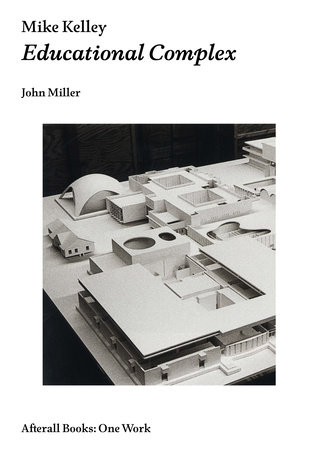
One of the most influential artists of our time, Mike Kelley (1954–2012) produced a body of innovative work mining American popular culture as well as modernist and postmodernist art—relentless examinations of subjectivity and of society that are both sinister and ecstatic. With a wide range of media, Kelley's work explores themes as varied as post-punk politics, religious systems, social class, and repressed memory. Using architectural models to represent schools he attended, his 1995 work, Educational Complex, presents forgotten spaces as frames for private trauma, real or imagined. The work's implications are at once miniature and massive. In this book, John Miller offers an illustrated examination of this milestone work that marked a significant change in Kelley's practice.
A “complex” can mean an architectural configuration, a psychological syndrome, or a political apparatus, and Miller approaches Educational Complex through corresponding lines of inquiry, considering the making of the work, examining it in terms of education and trauma (sexual or otherwise), and investigating how it tests the ideological horizon of art as an institution. Miller shows that in Educational Complex, Kelley expands his political and aesthetic focus, including not only such artifacts as generic forms of architecture but (inspired by the infamous McMartin Preschool case) popular fantasies associated with ritual sex abuse and false memory syndrome. Through this archaeology of the contemporary, Miller argues, Kelley examines the mandate for education and the liberal democratic premises underpinning it.
One of the most influential artists of our time, Mike Kelley (1954–2012) produced a body of innovative work mining American popular culture as well as modernist and postmodernist art—relentless examinations of subjectivity and of society that are both sinister and ecstatic. With a wide range of media, Kelley's work explores themes as varied as post-punk politics, religious systems, social class, and repressed memory. Using architectural models to represent schools he attended, his 1995 work, Educational Complex, presents forgotten spaces as frames for private trauma, real or imagined. The work's implications are at once miniature and massive. In this book, John Miller offers an illustrated examination of this milestone work that marked a significant change in Kelley's practice.
A “complex” can mean an architectural configuration, a psychological syndrome, or a political apparatus, and Miller approaches Educational Complex through corresponding lines of inquiry, considering the making of the work, examining it in terms of education and trauma (sexual or otherwise), and investigating how it tests the ideological horizon of art as an institution. Miller shows that in Educational Complex, Kelley expands his political and aesthetic focus, including not only such artifacts as generic forms of architecture but (inspired by the infamous McMartin Preschool case) popular fantasies associated with ritual sex abuse and false memory syndrome. Through this archaeology of the contemporary, Miller argues, Kelley examines the mandate for education and the liberal democratic premises underpinning it.
In celebration of Jewish American Heritage Month in May, we are sharing books by authors who share their individual stories, experiences, and lives. Find our full collection of books here.
For Mental Health Awareness Month in May, we are sharing books to educate and raise awareness about mental health and the various factors that may affect it, and to provide tools and resources for student wellness. Find our full collection of titles here.
Each May, we honor the stories, histories, and cultures of Asian Americans, Native Hawaiians, and Pacific Islanders. Below is a selection of acclaimed fiction and nonfiction books by AANHPI creators to share with your students this month and throughout the year. Find our full collection of titles for Higher Education here.