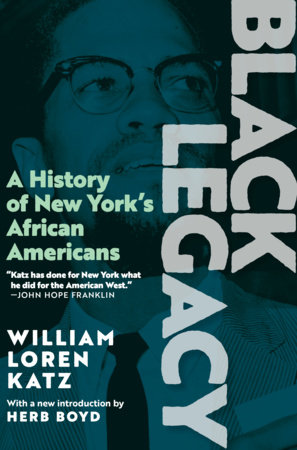
Black Legacy

A History of New York's African Americans

Introduction by Herb Boyd
Contributions by Alan J. Singer, Imani Hinson
Discover the complete Black history of New York—from 1609 to the present—by the award-winning author of Breaking the Chains and Black Indians. For readers 12 and up.

Includes a new intro and last chapter with insights on modern-day movements like Black Lives Matter, plus 50+ historical maps, illustrations, and photos. Essential for NY teachers, librarians and teens.


From the arrival of the first enslaved Africans in New Amsterdam in 1609 to the Harlem Renaissance to the impact of #BLM, here is a concise and newly updated history of Black Americans in New York for readers 12 and up. Black Legacy reasserts the essential work of teacher and historian William Loren Katz, who was committed to documenting and uplifting the stories of Black Americans’ courage and creativity, resilience and rebellion, especially for younger readers. A new introduction gives context to Katz's “full tableau of Black accomplishments and aspirations,” and a new chapter brings the book up to the present day, considering the changing economic, cultural and political influences on Black New Yorkers. Black Legacy includes, chronologically,

  • Black politicians and poets, abolitionists and athletes and activists, and the first Black children to attend public schools;
  • Sojourner Truth, Paul Robeson, W.E.B. DuBois, Frederick Douglass, Marcus Garvey, Malcolm X, the Black Panthers, and others who fought for Black freedom;
  • Shirley Chisholm, Madame C.J. Walker, NY's first Black mayor David Dinkins and many other businesspeople and politicians who brought dignity through their work toward equality;
  • and the Black history of Seneca Village and Weeksville, the Savoy and Cotton clubs of the Jazz Age, Harlem Hospital where Martin Luther King Jr. nearly died, the African burial site at Trinity Church, and so much more.

Written with economy and flair, Black Legacy is a fascinating read, a necessary teaching tool, and a great addition to the literature of the Black history of New York and of America.
William Loren Katz (1927-2019) was born in Brooklyn and grew up in Greenwich Village in a progressive family dedicated to social justice. After serving in WWII and attending college on the GI Bill, he became a teacher in New York for many years. The author of more than 40 books, many for younger readers including Breaking the Chains (reissued by Seven Stories in 2023), he documented the often overlooked contributions of black and indigenous people through history. Through his scholarship and educational outreach, he helped to refashion social studies curriculums across the country, encouraging the histories of minorities and women to be part of American history courses rather than siloed into their own fields of study. In one of his best-known books, Black Indians, he wrote, “I have been humbled by the awesome task of rejecting bias. I have never sought bland neutrality and have consoled myself that unbiased history has yet to be written.”

Herb Boyd (intro) is a journalist, activist, and teacher who has written or edited over 20 books, including Black Detroit and Baldwin's Harlem, a biography of James Baldwin, both finalists for NAACP Image Awards, and the anthology Brotherman: The Odyssey of Black Men in America, co-edited with Robert Allen, which was a recipient of a 1995 American Book Award. Several of his books inlcuding Civil Rights: Yesterday & Today, We Shall Overcome, Autobiography of a People and The Harlem Reader have been adopted for use in classrooms around the country. He has written for many publications including the Amsterdam News, Cineaste, and The Black Scholar. Boyd lives and works in Harlem, New York City.

Alan Singer (new chapter) is a social studies educator and historian at Hofstra University, and a former New York City high school teacher. Dr. Singer is a graduate of the City College of New York and has a Ph.D. in American history from Rutgers University. He is the author of many books including Social Studies For Secondary Schools, 5th Edition (Routledge, 2024), Teaching Climate History (Routledge 2022), New York and Slavery, Time to Teach the Truth (SUNY, 2008), New York’s Grand Emancipation Jubilee (SUNY, 2018), and Class-Conscious Coal Miners (SUNY, 2024). He was a participating historian in “Defining Moments: The Civil Rights Movement in North Hempstead” and the editor of the “New York and Slavery: Complicity and Resistance” curriculum guide. He lives in Brooklyn, NY.

Imani Hinson (new chapter) is a high school social studies teacher in Howard County, Maryland. She holds degrees in Social Studies Education and History from Hofstra University, and a Master's degree in History from Brooklyn College, where she won the award for outstanding thesis, a report which focused on the desegregation of schools on Long Island. Currently pursuing her EdD in Educational Leadership K-12 at Virginia Commonwealth University, Imani's research has centered around topics such as school desegregation, reparations, and African American history. She has published in Newsday on the anniversary of Brown v. Board of Education, and co-produced work on African Americans’ agency in New York for the New Jersey Council for Social Studies. She is a curriculum reviewer for the College Board AP African American Studies program.

"Dispelling the myth of Northern progressivism, Katz offers a far more compelling account of the bravery and perseverance through which Black people resisted their own subjugation and, in so doing, indelibly altered New York history. Katz reminds us that New York history is Black history, and Black history is the history of New York. This is a book that should be read by all New Yorkers." —Haley Pessin, co-editor of Voices of a People's History of the United States in the 21st Century: Documents of Hope and Resistance

"Black people have a long and complex history in New York City and have influenced nearly every aspect of the city’s life and culture.

"This comprehensive history by the late acclaimed historian Katz, originally published in 1997, has been reissued with an introduction by journalist Herb Boyd. The volume opens with “The Africans of New Amsterdam” and closes with “The Age of Obama and Black Lives Matter,” a new chapter by Singer and Hinson. Records document the presence of Africans in what would become New York beginning in the early 1600s. Katz details the struggle to end slavery and the efforts of free Black people to build lives in the face of racism and discrimination. After the American Revolution, communities prioritized the growth of Black churches, educational institutions, and mutual aid organizations along with advocating for voting rights. Later chapters present the impact of major historical events, such as the Civil War Draft Riots and the World Wars, on the city’s Black community. Katz skillfully weaves in the rise of Harlem and its cultural influence. Readers encounter familiar figures such as Frederick Douglass, Marcus Garvey, Malcolm X, and Shirley Chisholm. This extensive study is highly readable and effectively connects many stories in ways that shed light on Black New Yorkers’ important place in the city’s history and U.S. history as a whole.

"A valuable source for readers seeking insights into key components of the nation’s past and present. (photo credits, notes, bibliography, index) (Nonfiction. 12-18)."
Kirkus Reviews

About

Discover the complete Black history of New York—from 1609 to the present—by the award-winning author of Breaking the Chains and Black Indians. For readers 12 and up.

Includes a new intro and last chapter with insights on modern-day movements like Black Lives Matter, plus 50+ historical maps, illustrations, and photos. Essential for NY teachers, librarians and teens.


From the arrival of the first enslaved Africans in New Amsterdam in 1609 to the Harlem Renaissance to the impact of #BLM, here is a concise and newly updated history of Black Americans in New York for readers 12 and up. Black Legacy reasserts the essential work of teacher and historian William Loren Katz, who was committed to documenting and uplifting the stories of Black Americans’ courage and creativity, resilience and rebellion, especially for younger readers. A new introduction gives context to Katz's “full tableau of Black accomplishments and aspirations,” and a new chapter brings the book up to the present day, considering the changing economic, cultural and political influences on Black New Yorkers. Black Legacy includes, chronologically,

  • Black politicians and poets, abolitionists and athletes and activists, and the first Black children to attend public schools;
  • Sojourner Truth, Paul Robeson, W.E.B. DuBois, Frederick Douglass, Marcus Garvey, Malcolm X, the Black Panthers, and others who fought for Black freedom;
  • Shirley Chisholm, Madame C.J. Walker, NY's first Black mayor David Dinkins and many other businesspeople and politicians who brought dignity through their work toward equality;
  • and the Black history of Seneca Village and Weeksville, the Savoy and Cotton clubs of the Jazz Age, Harlem Hospital where Martin Luther King Jr. nearly died, the African burial site at Trinity Church, and so much more.

Written with economy and flair, Black Legacy is a fascinating read, a necessary teaching tool, and a great addition to the literature of the Black history of New York and of America.

Author

William Loren Katz (1927-2019) was born in Brooklyn and grew up in Greenwich Village in a progressive family dedicated to social justice. After serving in WWII and attending college on the GI Bill, he became a teacher in New York for many years. The author of more than 40 books, many for younger readers including Breaking the Chains (reissued by Seven Stories in 2023), he documented the often overlooked contributions of black and indigenous people through history. Through his scholarship and educational outreach, he helped to refashion social studies curriculums across the country, encouraging the histories of minorities and women to be part of American history courses rather than siloed into their own fields of study. In one of his best-known books, Black Indians, he wrote, “I have been humbled by the awesome task of rejecting bias. I have never sought bland neutrality and have consoled myself that unbiased history has yet to be written.”

Herb Boyd (intro) is a journalist, activist, and teacher who has written or edited over 20 books, including Black Detroit and Baldwin's Harlem, a biography of James Baldwin, both finalists for NAACP Image Awards, and the anthology Brotherman: The Odyssey of Black Men in America, co-edited with Robert Allen, which was a recipient of a 1995 American Book Award. Several of his books inlcuding Civil Rights: Yesterday & Today, We Shall Overcome, Autobiography of a People and The Harlem Reader have been adopted for use in classrooms around the country. He has written for many publications including the Amsterdam News, Cineaste, and The Black Scholar. Boyd lives and works in Harlem, New York City.

Alan Singer (new chapter) is a social studies educator and historian at Hofstra University, and a former New York City high school teacher. Dr. Singer is a graduate of the City College of New York and has a Ph.D. in American history from Rutgers University. He is the author of many books including Social Studies For Secondary Schools, 5th Edition (Routledge, 2024), Teaching Climate History (Routledge 2022), New York and Slavery, Time to Teach the Truth (SUNY, 2008), New York’s Grand Emancipation Jubilee (SUNY, 2018), and Class-Conscious Coal Miners (SUNY, 2024). He was a participating historian in “Defining Moments: The Civil Rights Movement in North Hempstead” and the editor of the “New York and Slavery: Complicity and Resistance” curriculum guide. He lives in Brooklyn, NY.

Imani Hinson (new chapter) is a high school social studies teacher in Howard County, Maryland. She holds degrees in Social Studies Education and History from Hofstra University, and a Master's degree in History from Brooklyn College, where she won the award for outstanding thesis, a report which focused on the desegregation of schools on Long Island. Currently pursuing her EdD in Educational Leadership K-12 at Virginia Commonwealth University, Imani's research has centered around topics such as school desegregation, reparations, and African American history. She has published in Newsday on the anniversary of Brown v. Board of Education, and co-produced work on African Americans’ agency in New York for the New Jersey Council for Social Studies. She is a curriculum reviewer for the College Board AP African American Studies program.

Praise

"Dispelling the myth of Northern progressivism, Katz offers a far more compelling account of the bravery and perseverance through which Black people resisted their own subjugation and, in so doing, indelibly altered New York history. Katz reminds us that New York history is Black history, and Black history is the history of New York. This is a book that should be read by all New Yorkers." —Haley Pessin, co-editor of Voices of a People's History of the United States in the 21st Century: Documents of Hope and Resistance

"Black people have a long and complex history in New York City and have influenced nearly every aspect of the city’s life and culture.

"This comprehensive history by the late acclaimed historian Katz, originally published in 1997, has been reissued with an introduction by journalist Herb Boyd. The volume opens with “The Africans of New Amsterdam” and closes with “The Age of Obama and Black Lives Matter,” a new chapter by Singer and Hinson. Records document the presence of Africans in what would become New York beginning in the early 1600s. Katz details the struggle to end slavery and the efforts of free Black people to build lives in the face of racism and discrimination. After the American Revolution, communities prioritized the growth of Black churches, educational institutions, and mutual aid organizations along with advocating for voting rights. Later chapters present the impact of major historical events, such as the Civil War Draft Riots and the World Wars, on the city’s Black community. Katz skillfully weaves in the rise of Harlem and its cultural influence. Readers encounter familiar figures such as Frederick Douglass, Marcus Garvey, Malcolm X, and Shirley Chisholm. This extensive study is highly readable and effectively connects many stories in ways that shed light on Black New Yorkers’ important place in the city’s history and U.S. history as a whole.

"A valuable source for readers seeking insights into key components of the nation’s past and present. (photo credits, notes, bibliography, index) (Nonfiction. 12-18)."
Kirkus Reviews