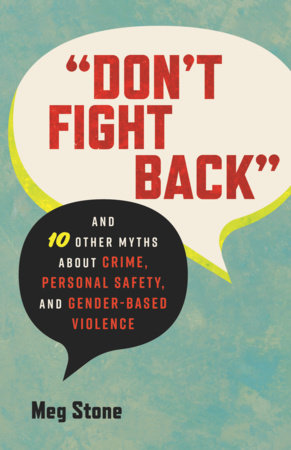
"Don't Fight Back"

And 10 Other Myths About Crime, Personal Safety, and Gender-Based Violence

Author Meg Stone
Look inside
Paperback
$18.95 US
On sale May 05, 2026 | 224 Pages | 9780807016244

See Additional Formats
From a nationally recognized violence-prevention expert, an accessible guide that debunks the most pervasive myths about crime and offers evidence-based strategies that make us safer

A specific image of violence and how to avoid it lives in a lot of our imaginations. What some of us fear most is shaped not by the strongest evidence but by the most viral horror stories.

Meg Stone, a violence prevention expert, traces the origins of these myths and how they are used to scare us into submission. While political leaders and social-media influencers use myths about crime to divide us, this book equips readers with facts and concrete action steps.

Stone breaks down these myths into four parts:
  • “How Attackers Behave: what the research shows about whether fighting back makes attackers more angry
  • “What (or Who) to Fear”: a treatise on the impact of media inaccurately reporting a “crime wave”
  • “What You Should Never Do”: including the myth that an attacker could grab your ponytail—very unlikely!
  • “What You Should Always Do”: should you really always trust your intuition?
Each chapter offers practical strategies for people to keep themselves safer and how to contribute to social change that builds a safer world.

You don’t have to diminish yourself or restrict your life to avoid being attacked. Critical thinking, not following simplistic directives, is the real way to be “smart” about safety.
INTRODUCTION
Dumb Women Who Get Attacked and the Men Who Try to Save Them

PART 1: HOW ATTACKERS BEHAVE

MYTH 1
“Attackers Can Tell Who Makes a Good Victim by the Way They Walk”

MYTH 2
“Don’t Fight Back. It Will Make the Attacker Angry and You’ll Get Hurt Worse.”

PART 2: WHAT (OR WHO) TO FEAR

MYTH 3
”I Read in the News There’s an Attacker on the Loose, So I Need to Be More Careful Out There”

MYTH 4
”Treat Anyone Who Looks Out of Place with Suspicion”

MYTH 5
“Crime Is at an All-Time High and Going Up”

PART 3: WHAT YOU SHOULD NEVER DO

MYTH 6
“Don’t Wear a Ponytail. An Attacker Could Grab It.”

MYTH 7
“Don’t Park Next to a Van (Especially White Vans or Vans with Tinted Windows)”

MYTH 8
“Make Sure People Can’t See Through Your Windows, Especially When You’re Undressed”

MYTH 9
“Don’t Go Shopping Alone. Otherwise You Could Be a Target of Human Traffickers.”

PART 4: WHAT YOU SHOULD ALWAYS DO

MYTH 10
“Always Take the Elevator. Attackers Hide Out in Stairwells.”

MYTH 11
“Always Trust Your Intuition”

CONCLUSION
How to Be Safe(r) in an Evidence-Poor World

Acknowledgments
Notes
Index

Meg Stone is the executive director of IMPACT Boston, an abuse-prevention and empowerment self-defense organization. Her writing has been published in Huffington Post, Newsweek, the Washington Post, the Boston Globe, Dame, and Ms.
“Each debunked myth empowers readers with both individual and social actions that can be taken to protect themselves and to advocate for a better, safer world for everyone, with an emphasis on the most vulnerable. We can fight back.”
Booklist

“Meg Stone debunks the myths about sexual assault with humor, passion and piles of data. This is an essential book for anyone who plans to walk up stairs, wear a ponytail and feel empowered.”
—Pagan Kennedy, author of The Secret History of the Rape Kit

“Finally, a book that empowers rather than weakens, a book that tells women we can and should expect more. We no longer have to be eternal victims. Meg Stone has delivered.”
—Rachel Louise Snyder, author of No Visible Bruises and Women We Buried, Women We Burned

About

From a nationally recognized violence-prevention expert, an accessible guide that debunks the most pervasive myths about crime and offers evidence-based strategies that make us safer

A specific image of violence and how to avoid it lives in a lot of our imaginations. What some of us fear most is shaped not by the strongest evidence but by the most viral horror stories.

Meg Stone, a violence prevention expert, traces the origins of these myths and how they are used to scare us into submission. While political leaders and social-media influencers use myths about crime to divide us, this book equips readers with facts and concrete action steps.

Stone breaks down these myths into four parts:
  • “How Attackers Behave: what the research shows about whether fighting back makes attackers more angry
  • “What (or Who) to Fear”: a treatise on the impact of media inaccurately reporting a “crime wave”
  • “What You Should Never Do”: including the myth that an attacker could grab your ponytail—very unlikely!
  • “What You Should Always Do”: should you really always trust your intuition?
Each chapter offers practical strategies for people to keep themselves safer and how to contribute to social change that builds a safer world.

You don’t have to diminish yourself or restrict your life to avoid being attacked. Critical thinking, not following simplistic directives, is the real way to be “smart” about safety.

Table of Contents

INTRODUCTION
Dumb Women Who Get Attacked and the Men Who Try to Save Them

PART 1: HOW ATTACKERS BEHAVE

MYTH 1
“Attackers Can Tell Who Makes a Good Victim by the Way They Walk”

MYTH 2
“Don’t Fight Back. It Will Make the Attacker Angry and You’ll Get Hurt Worse.”

PART 2: WHAT (OR WHO) TO FEAR

MYTH 3
”I Read in the News There’s an Attacker on the Loose, So I Need to Be More Careful Out There”

MYTH 4
”Treat Anyone Who Looks Out of Place with Suspicion”

MYTH 5
“Crime Is at an All-Time High and Going Up”

PART 3: WHAT YOU SHOULD NEVER DO

MYTH 6
“Don’t Wear a Ponytail. An Attacker Could Grab It.”

MYTH 7
“Don’t Park Next to a Van (Especially White Vans or Vans with Tinted Windows)”

MYTH 8
“Make Sure People Can’t See Through Your Windows, Especially When You’re Undressed”

MYTH 9
“Don’t Go Shopping Alone. Otherwise You Could Be a Target of Human Traffickers.”

PART 4: WHAT YOU SHOULD ALWAYS DO

MYTH 10
“Always Take the Elevator. Attackers Hide Out in Stairwells.”

MYTH 11
“Always Trust Your Intuition”

CONCLUSION
How to Be Safe(r) in an Evidence-Poor World

Acknowledgments
Notes
Index

Author

Meg Stone is the executive director of IMPACT Boston, an abuse-prevention and empowerment self-defense organization. Her writing has been published in Huffington Post, Newsweek, the Washington Post, the Boston Globe, Dame, and Ms.

Praise

“Each debunked myth empowers readers with both individual and social actions that can be taken to protect themselves and to advocate for a better, safer world for everyone, with an emphasis on the most vulnerable. We can fight back.”
Booklist

“Meg Stone debunks the myths about sexual assault with humor, passion and piles of data. This is an essential book for anyone who plans to walk up stairs, wear a ponytail and feel empowered.”
—Pagan Kennedy, author of The Secret History of the Rape Kit

“Finally, a book that empowers rather than weakens, a book that tells women we can and should expect more. We no longer have to be eternal victims. Meg Stone has delivered.”
—Rachel Louise Snyder, author of No Visible Bruises and Women We Buried, Women We Burned

Books for Asian American, Native Hawaiian, and Pacific Islander Heritage Month

Each May, we honor the stories, histories, and cultures of Asian Americans, Native Hawaiians, and Pacific Islanders. Below is a selection of acclaimed fiction and nonfiction books by AANHPI creators to share with your students this month and throughout the year. Find our full collection of titles for Higher Education here.

Read more