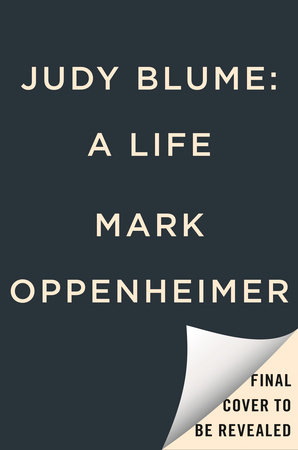
The highly anticipated biography of one of the world’s most treasured literary voices, showcasing a life as triumphant and inspiring as the stories she crafted.

To know the name Judy Blume is to know and love literature. Her influential novels turned classics—including Are You There God? It’s Me, Margaret; Tales of a Fourth Grade Nothing; Deenie; and Summer Sisters—touched the lives of tens of millions of readers. For more than fifty-five years her work has done something revolutionary: it rewired the world’s expectations of what literature for young people can be—frank, candid, earthy, and unafraid to show the messier sides of humanity. But little is known about the real woman behind the iconic persona, and the unlikely journey of her literary ascension, until now.

In Judy Blume, journalist, historian, and longtime Blume aficionado Mark Oppenheimer pens a beautiful, multidimensional portrait of the acclaimed author through extensive interviews with Blume herself, invaluable access to her papers and correspondence, and thoughtful analysis of Blume’s beloved novels, including early, unpublished works that shed light on the pathbreaking writer she would become. Oppenheimer goes deep, exploring Blume’s middle-class 1950s upbringing, complicated childhood, varied relationships and marriages, unabashed sexual experiences, bouts of heartache and loss, and enduring legacy as a champion of free speech and contemporary literature. Oppenheimer peels back the curtain to reveal the woman behind the literary empire in all her complex, multifaceted glory—a true gift for anyone who grew up reading and loving these extraordinary books.
CAUTION: This email originated from outside of Penguin Random House. Please be extra cautious when opening file attachments or clicking on links.

1.

1938-1948

Before she was a writer, before she was a reader, Judy Sussman was a newborn whose birth, as recounted in family lore, was like a scene from a novel she would someday write. The story goes like this:

It was February 12, 1938, a cold winter night, and Essie Sussman, overdue with her second child, went into labor. On the way to the hospital, she and her husband stopped off at her mother's house, on nearby Westfield Avenue, to leave their four-year-old son, David, with his grandmother Ida Rosenfeld, whom he called Nanny Mama.

Because Essie already had a boy, she hoped the baby was a girl. It was a hope that neither she nor her husband would speak out loud, because, as everyone knew, it was bad luck to wish for things. God might punish you for your presumption. But she and Rudy had a name picked out: Linda.

There was one complication, however. Essie's brother-in-law, Rudy's older brother Abe, had died in January, at forty-three. It was an ignominious death: recovering from hernia surgery, he suffered a fatal blood clot while in bed with his married mistress. Still, it would be good and fitting to name a child after him.

Shortly after nine o'clock, as she was watching after her grandson, Nanny Mama heard the phone ring. It was her younger daughter, Frances, calling from New York City, where she and her husband, Herb, were attending a performance of Clifford Odets's Golden Boy. They'd ducked out at intermission to find out if Frances's big sister had gone into labor yet. Frances was thrilled to hear from her mother that, yes, Essie was at the hospital. She hung up the phone and returned to the Belasco Theatre for the second act.

The baby was born shortly before midnight. A baby girl, a daughter. Just what Essie had secretly wanted.

The next morning, in the hospital, Rudy and Essie looked at their baby girl and decided that she wasn't a Linda. They tossed around other names, and they decided that maybe Linda was, in fact, Judith. Judith. That had a nice ring to it.

But what about Rudy's brother Abe? And the Jewish tradition to name a baby after a dead relative?

Sometime in the next couple of days, Rudy visited a rabbi-it may have been Pinchas Teitz, his mother's rabbi, who was one of his patients. Rabbi, Rudy said to him, we want to honor my brother Abe. But we also want to name our baby girl Judith.

Fortunately, the rabbi had a solution. As it happened, Abe's Hebrew name-the name invoked to give him an honor in synagogue, like calling him for a blessing over the Torah-had been Yehudah, the Hebrew of the English name Judah. And the feminine of Yehudah was Yehudis, which Anglicized is Judith. Hence, Judith was an entirely appropriate name to honor her late uncle Abe.

They named her Judith Marcia Sussman. They'd call her Judy.

It's impossible to fact-check a family legend, but really, why should we? There is a reason families tell some stories and not others. It's about the family's sense of itself, how it wants to be seen. Its collective narrative, its identity. As it comes down to us, this family legend is loaded with significance, describing a mash-up of traits, coming from the two sides of her family, that would define Judy's cultural inheritance. For example:

In this legend, the family is close, in multiple ways: they're geographically close, with the Rosenfelds and many of the Sussmans settled in Elizabeth, New Jersey. Children can be dropped off at their grandmother's on a moment's notice. They stick together, do for each other, check in on each other-hence the detail about Frances calling her mother at intermission.

From the Sussman side, there is religious observance, with an ongoing connection to Orthodoxy (Rudy attended Rabbi Teitz's Orthodox shul with his mother, until she died) and a general reverence for tradition, including the Ashkenazi practice of naming a baby for a dead relative. And, for Judy's parents, the rabbi is a figure of some stature, to be consulted at life's milestones.

The family knows sadness, early death. But they aren't so pious that they won't name a child for an uncle who died in his mistress's bed! Perhaps they even enjoy the gallows humor.

And while they live in a relatively small town-in the 1930 census, Elizabeth was home to 115,000 people-the family, the Rosenfeld side at least, is oriented toward the big city. In Judy's origin story, Aunt Frances and her husband are the kind of people who take in a play by Clifford Odets, one produced by the Group Theater, the famous left-wing drama troupe, starring future legends like Frances Farmer, John Garfield, Lee J. Cobb, and Elia Kazan. (Golden Boy had arguably the most august cast of thespians ever in one show.)

This is a family, then, whose cultural sensibility, like their politics, was progressive; whose family ties were strong; whose Jewish identity was enduring.

And that baby-Yehudis, or Judith-grew up to be very much a Sussman. She became a creative, spirited, death-haunted Jewish writer who loved New York and Broadway but whose books almost always placed their young protagonists in smaller towns, over the bridge or through the tunnel. In these books, there are loving grandmothers. The women make the decisions as the men earn a living-when they don't die young. The characters are Jewish, often explicitly so, sometimes by implication. The story of Judy Blume's birth, in other words, is the story she might have written to explain the woman she would someday become.

x


Judy’s parents, Rudolph and Esther, were born into a world of great contingency, of mysterious illness, infant mortality, quick death.

Essie's father, Samuel Rosenfeld, emigrated from Russia to the United States on a cargo ship in 1897; his bride, Ida, came a bit later. Ida was fifteen or sixteen, Samuel was ten years her senior. They were already married. On arriving in New Jersey, they began to have children. Esther, born in 1904, was their third child, but their first to survive. "So my mother was given everything and was treated as a princess by them, so full of joy were they, to have a child at last," Judy wrote in 1991. Settling in Elizabeth, a New Jersey port town a short drive from Newark and a stone's throw, across the water, from Staten Island, Samuel Rosenfeld opened a grocery store, which gave him a respectable living. After Essie, he and Ida would have two more children, both of whom became beloved figures in their niece Judy's life: Bernie, born three years after Essie, and finally Frances, born three years later still. All three Rosenfeld children would spend their lives in Elizabeth.

Judy's father, Rudolph, was the youngest of seven children, born to Barnett Sussman (genealogical records have his original name as David Bertzik Sussman) and Kaila Kerbel Sussman, who emigrated together from Lithuania, in 1898, with their first two children. Already in his thirties when he came to the United States, Barnett got work as a house painter. He never had much money, and what money he had was stretched by the needs of his large family. Although he and Kaila lived "down the port," in the poorest part of town, their children would vault into the middle class. Three of their sons became dentists: Rudy, Judy's father, had a dental practice with two older brothers, Abe and Eddie. When Abe died, Rudy shared the practice with Eddie. When Eddie died, the practice was Rudy's alone.

Rudy and Essie were classmates at Elizabeth's Battin High School, where, according to the class of 1922 yearbook, Esther Rosenfeld was known as "Es," and Rudolph Sussman was known as "Suss." They had in common a lack of extracurricular involvement (she had no clubs listed under her name, and he listed only the debating club), their Jewish heritage (like many of their classmates, to judge from the names in the yearbook), and, it seems, a mutual attraction.

But they did not run in similar circles. "She was an uptown girl," Judy said, "and he was a very poor boy from the Elizabeth port," one who "never had a store-bought toy [so he] made his own out of found materials." They got to know each other when Rudy took an after-school job in the grocery store run by Essie's parents. As Rudy stocked the shelves in the Rosenfelds' small market, he and Essie may have discovered that they shared the same simple goals: children, stability, respectability.

After high school, Rudy spent one year at a college in California-he may have been at the University of California, San Francisco, but nobody is sure. He then returned east, enrolling in dental school at the University of Pittsburgh. He and Essie had stayed close enough that Essie, who worked as a legal secretary, would take the train to Pittsburgh on weekends to visit him. It was on such a visit that they entered into what Judy would call their "secret marriage."

Judy didn't know about her parents' secret marriage until 1959, when she was just weeks away from her own wedding. Sitting around the kitchen table, finishing dinner, she and her parents were discussing the fact that a cousin of her fiancé, John Blume, had once gotten married and not told anyone. Judy said, "Why would anyone get secretly married?" Rudy turned to Essie and said, "I'm going to tell her." Essie pleaded with him not to, but he said it was only right that she know-"She's getting married in a few weeks," he insisted. And he told Judy how, in 1926, near the end of his dental training, he had met Essie at the Pittsburgh train station with a surprise announcement: they were going to get married. He took her to a synagogue, where a rabbi performed the ceremony in his study.

After Rudy had spilled the beans, Essie, mortified, rushed to clarify that the couple didn't start having sex until their official wedding, four years later. "We didn't . . . you know," Essie said to her daughter. At which point Rudy leaned in and said, "Everything but."

Why had they gotten married in a religious ceremony, then waited four years to have a public ceremony-especially if it wasn't to sanctify sexual relations, which they professed to not be having? Years later, Judy would wonder if there had been a pregnancy scare, although Essie implicitly denied that that was the reason. Perhaps because getting married without an income was seen as irresponsible? Or because they felt they owed their families a proper wedding, once they could afford one? Years after this revelation, Judy was in the car with Essie and asked her mother why she'd had a secret wedding. "But instead of answering me," Judy said, "she started to cry, and that ended it."

The big wedding, the one everyone thought of as their first wedding, came on June 8, 1930, at Essie's parents' house. It was the Great Depression, and they waited to have children. Their first child, David, was born in 1934, and Judy four years after that.

The home Rudy and Essie made for their children was warm and safe, but as in every household, there were tensions. "My mother was more controlled than my father," Judy once wrote. "Every now and then my father would explode . . . he had a temper." One of her earliest memories was of her father in the kitchen, "the doors closed, throwing pots and pans, shouting bad words." Judy was sitting halfway up the stairs, listening, scared. "I'm four years old," she wrote, "and I don't want Mommy to cry. She asks if I will go away with her. Away where? Away from Daddy? But I love Daddy. I love him more than anyone. And Daddy loves me." She wondered if her mother would leave without her. "If Mommy goes away without me, who will be my mommy?" But soon the door to the kitchen opened, and Daddy apologized to Mommy, who ran down the stairs, past Judy, and into her husband's arms. "I follow. I hug their legs." Then she noticed that her chair, the one she sat on to eat meals, was lying on its side, broken. "'I'll fix it,' Daddy says. 'I'll make it as good as new.' I know that he will."

Rudy seldom flew into such rages at home-Judy said she remembered only two temper tantrums like the one in the kitchen. But he brought his temper to work. His longtime dental assistant, Miss Fae, bought a set of plaster-of-Paris figurines-"the seven dwarves or something," Judy said-to receive Rudy's temper. "She kept them in a cupboard so that if he felt a temper tantrum coming on in the office, he could smash them, throw them to the floor and smash them."

Most of the time, Rudy was cheery, bluff, affable. Judy saw him as "our rock," a source of comfort for his wife, his family, his patients. Essie, by contrast, was anxious, neurotic, pinched-a temperament possibly exacerbated by her husband's propensity for anger. Hence the typical form of their fights: she sniped, he overreacted. "My mother could set him off with a careless remark, especially if it had to do with his family," Judy said. "He was proud and defensive about them."

Rudy's father had died when Rudy was in college, leaving behind a widow who never fully acculturated to the United States. Judy remembers her paternal grandmother as an old Yiddish speaker who could not pronounce Judy's name, calling her "Jury." And for all his family's success-three dentists out of seven children!-a middle-class existence was precarious. And there was always, of course, the specter of early death: none of the seven Sussman siblings, including Rudy, would live to sixty.

Essie's family, by contrast, had more money but not necessarily more stability. They had moved in and out of the middle class. According to family legend, her father had at one point squandered his first, modest nest egg through "bad deals and generosity," as Judy later put it. But there had been enough cash for Essie to have piano lessons, even elocution lessons. At a time, the 1920s, when a car was still quite a luxury, her family had one, and as a teenager, Essie got to drive it. It seems there were books in the Rosenfeld household, and a reverence for learning: Bernie and Frances both grew up to be English teachers, while Essie would later say that her one regret was not becoming a teacher. Essie loved theater and took Judy to New York to see Finian's Rainbow, Brigadoon, and Annie Get Your Gun, the latter with Ethel Merman. She was a letter writer, too, writing to Judy every day that Judy was away at summer camp.
© 2025 Lu Arie
MARK OPPENHEIMER has been covering American religion for 25 years. He holds a Ph.D. in religious studies from Yale, and has taught at Stanford, Wesleyan, Wellesley, NYU, Boston College, and Yale, where he was the founding director of the Yale Journalism Initiative. From 2010 to 2016, he wrote the "Beliefs" column, about religion, for The New York Times, and he has also written for publications including The New Yorker, The Nation, GQ, Slate, and many more. He created Unorthodox, the world's most popular podcast about Jewish life and culture, with over 7 million downloads to date. More recently, he hosted an eight-part podcast called Gatecrashers, about the history of Jews and antisemitism at Ivy League schools. He is the author of five books, including The Newish Jewish Encyclopedia and, most recently, Squirrel Hill: The Tree of Life Synagogue Shooting and the Soul of a Neighborhood. He lives in Connecticut with his wife, four daughters, one son, and two dogs. View titles by Mark Oppenheimer
One of Washington Post's Most Anticipated Books of 2026
One of W Magazine's Must-Read Nonfiction Books of 2026
One of Zibby Owens's Most Anticipated Books of Spring 2026
One of Book Riot's Most Anticipated Books of 2026
One of LitHub's Most Anticipated Books of 2026

“[A] thoughtful, detailed, and nuanced biography . . . It seems almost inevitable that all evidence points to Blume being the cool, honest, and empathetic ally readers would expect from the creator of characters as memorable as Margaret, Peter, and Fudge. Oppenheimer's first biography is engaging, revealing, satisfying, and a fitting tribute.” Booklist, starred review

“At last— a biography of Judy Blume that is worthy of its subject. Oppenheimer is a masterful chronicler of Blume’s remarkable life and extraordinary impact. Writers and readers alike will leave this work emboldened, inspired, and encouraged.” —Tayari Jones, bestselling author of An American Marriage

“What is she like in real life?” this book is for you. Judy Blume: A Life is charming, candid, thoughtful and funny, and perfectly tuned to the zeitgeist of her time, just like her bestselling novels. Judy Blume fans will love this biography!” —Debby Applegate, winner of the Pulitzer Prize for Biography, author of Madam: The Biography of Polly Adler, Icon of the Jazz Age

“At last, a real Judy Blume biography is here!—and it’s just as warm and interesting and wonderful as you want it to be. Written in a clear and welcoming voice that will sound familiar to anyone who’s ever loved a Judy Blume book, Mark Oppenheimer’s comprehensive and extensively researched biography brings to vivid life the ups—and sometimes downs—of the groundbreaking author who made Sheila and Peter and Margaret and Fudge feel like real people, with real problems, to generations of readers. Deftly written and packed with stories you've never heard before--including tantalizing glimpses of stories that never saw the light of day—Mark Oppenheimer's Judy Blume is thoughtful, often funny, and never afraid to be reflective or critical—just like Judy Blume herself.” —Brian Jay Jones, author of Becoming Dr. Seuss

“This beautiful biography reminded me of the gratitude I always felt reading Judy Blume’s books to my daughters, with their good humored portraits of quirky kids and quirky parents doing their best in a stressful world. Oppenheimer brings an insightful, clear-eyed, generous spirit to his portrait, worthy of its subject.” —Jonathan Rosen, author of The Best Minds: A Story of Friendship, Madness, and the Tragedy of Good Intentions

Judy Blume by Mark Oppenheimer is a masterpiece of biography, brilliantly illuminating the life of a masterful storyteller. Blume held an unflinching light upon the challenges of growing up and a clear-eyed gaze on the adult world around her as she turned life’s trials into literature for multiple generations. Oppenheimer deftly captures Blume’s fearlessness in exposing her own vulnerabilities in her books and opens a wider lens to bring the reader into Blume’s personal life as she transforms from Sheila the Great to Wifey to tireless censorship activist. Oppenheimer holds his own unwavering light at the singular life of this literary icon, and the reader simply can’t look away from this extraordinary and beloved writer.” —Amy Gary, author of In the Great Green Room: The Brilliant and Bold Life of Margaret Wise Brown

“Always engaging, and often surprising, Mark Oppenheimer’s deep dive into the life of one of the most beloved authors of the past century is long overdue. Though Judy Blume will no about draft off of widespread nostalgia for the groundbreaking novelist (it sent me running to my collection of Blume’s books to revisit old favorites) it’s also an inspiring tale of one woman’s abiding belief in herself. An absolute delight.” —Anna Holmes, author of The Book of Jezebel: An Illustrated Encyclopedia of Lady Things

“[P]aints a picture of a diligent, driven writer seeking a unique voice…A buoyant biography of a writer who redefined young people’s literature.” Kirkus Reviews

“There's nothing better than a biography written by someone who not only loves their subject but who has studied it as deeply as possible...What more is there to say about why this book is so exciting for fans of children's and adolescent (and adult!) literature?”Book Riot

“What a lovely, tender, and thoughtful book! As a child of the 1970s, I read this almost as avidly as I once read the works of Judy Blume herself. Mark Oppenheimer has captured not only the story but the spirit of Blume as an author, mentor, mother, and fully realized human being. This pairing of biographer and subject has produced something special.” —Beverly Gage, winner of the Pulitzer Prize for biography for G-Man: J. Edgar Hoover and the Making of the American Century

About

The highly anticipated biography of one of the world’s most treasured literary voices, showcasing a life as triumphant and inspiring as the stories she crafted.

To know the name Judy Blume is to know and love literature. Her influential novels turned classics—including Are You There God? It’s Me, Margaret; Tales of a Fourth Grade Nothing; Deenie; and Summer Sisters—touched the lives of tens of millions of readers. For more than fifty-five years her work has done something revolutionary: it rewired the world’s expectations of what literature for young people can be—frank, candid, earthy, and unafraid to show the messier sides of humanity. But little is known about the real woman behind the iconic persona, and the unlikely journey of her literary ascension, until now.

In Judy Blume, journalist, historian, and longtime Blume aficionado Mark Oppenheimer pens a beautiful, multidimensional portrait of the acclaimed author through extensive interviews with Blume herself, invaluable access to her papers and correspondence, and thoughtful analysis of Blume’s beloved novels, including early, unpublished works that shed light on the pathbreaking writer she would become. Oppenheimer goes deep, exploring Blume’s middle-class 1950s upbringing, complicated childhood, varied relationships and marriages, unabashed sexual experiences, bouts of heartache and loss, and enduring legacy as a champion of free speech and contemporary literature. Oppenheimer peels back the curtain to reveal the woman behind the literary empire in all her complex, multifaceted glory—a true gift for anyone who grew up reading and loving these extraordinary books.

Excerpt

CAUTION: This email originated from outside of Penguin Random House. Please be extra cautious when opening file attachments or clicking on links.

1.

1938-1948

Before she was a writer, before she was a reader, Judy Sussman was a newborn whose birth, as recounted in family lore, was like a scene from a novel she would someday write. The story goes like this:

It was February 12, 1938, a cold winter night, and Essie Sussman, overdue with her second child, went into labor. On the way to the hospital, she and her husband stopped off at her mother's house, on nearby Westfield Avenue, to leave their four-year-old son, David, with his grandmother Ida Rosenfeld, whom he called Nanny Mama.

Because Essie already had a boy, she hoped the baby was a girl. It was a hope that neither she nor her husband would speak out loud, because, as everyone knew, it was bad luck to wish for things. God might punish you for your presumption. But she and Rudy had a name picked out: Linda.

There was one complication, however. Essie's brother-in-law, Rudy's older brother Abe, had died in January, at forty-three. It was an ignominious death: recovering from hernia surgery, he suffered a fatal blood clot while in bed with his married mistress. Still, it would be good and fitting to name a child after him.

Shortly after nine o'clock, as she was watching after her grandson, Nanny Mama heard the phone ring. It was her younger daughter, Frances, calling from New York City, where she and her husband, Herb, were attending a performance of Clifford Odets's Golden Boy. They'd ducked out at intermission to find out if Frances's big sister had gone into labor yet. Frances was thrilled to hear from her mother that, yes, Essie was at the hospital. She hung up the phone and returned to the Belasco Theatre for the second act.

The baby was born shortly before midnight. A baby girl, a daughter. Just what Essie had secretly wanted.

The next morning, in the hospital, Rudy and Essie looked at their baby girl and decided that she wasn't a Linda. They tossed around other names, and they decided that maybe Linda was, in fact, Judith. Judith. That had a nice ring to it.

But what about Rudy's brother Abe? And the Jewish tradition to name a baby after a dead relative?

Sometime in the next couple of days, Rudy visited a rabbi-it may have been Pinchas Teitz, his mother's rabbi, who was one of his patients. Rabbi, Rudy said to him, we want to honor my brother Abe. But we also want to name our baby girl Judith.

Fortunately, the rabbi had a solution. As it happened, Abe's Hebrew name-the name invoked to give him an honor in synagogue, like calling him for a blessing over the Torah-had been Yehudah, the Hebrew of the English name Judah. And the feminine of Yehudah was Yehudis, which Anglicized is Judith. Hence, Judith was an entirely appropriate name to honor her late uncle Abe.

They named her Judith Marcia Sussman. They'd call her Judy.

It's impossible to fact-check a family legend, but really, why should we? There is a reason families tell some stories and not others. It's about the family's sense of itself, how it wants to be seen. Its collective narrative, its identity. As it comes down to us, this family legend is loaded with significance, describing a mash-up of traits, coming from the two sides of her family, that would define Judy's cultural inheritance. For example:

In this legend, the family is close, in multiple ways: they're geographically close, with the Rosenfelds and many of the Sussmans settled in Elizabeth, New Jersey. Children can be dropped off at their grandmother's on a moment's notice. They stick together, do for each other, check in on each other-hence the detail about Frances calling her mother at intermission.

From the Sussman side, there is religious observance, with an ongoing connection to Orthodoxy (Rudy attended Rabbi Teitz's Orthodox shul with his mother, until she died) and a general reverence for tradition, including the Ashkenazi practice of naming a baby for a dead relative. And, for Judy's parents, the rabbi is a figure of some stature, to be consulted at life's milestones.

The family knows sadness, early death. But they aren't so pious that they won't name a child for an uncle who died in his mistress's bed! Perhaps they even enjoy the gallows humor.

And while they live in a relatively small town-in the 1930 census, Elizabeth was home to 115,000 people-the family, the Rosenfeld side at least, is oriented toward the big city. In Judy's origin story, Aunt Frances and her husband are the kind of people who take in a play by Clifford Odets, one produced by the Group Theater, the famous left-wing drama troupe, starring future legends like Frances Farmer, John Garfield, Lee J. Cobb, and Elia Kazan. (Golden Boy had arguably the most august cast of thespians ever in one show.)

This is a family, then, whose cultural sensibility, like their politics, was progressive; whose family ties were strong; whose Jewish identity was enduring.

And that baby-Yehudis, or Judith-grew up to be very much a Sussman. She became a creative, spirited, death-haunted Jewish writer who loved New York and Broadway but whose books almost always placed their young protagonists in smaller towns, over the bridge or through the tunnel. In these books, there are loving grandmothers. The women make the decisions as the men earn a living-when they don't die young. The characters are Jewish, often explicitly so, sometimes by implication. The story of Judy Blume's birth, in other words, is the story she might have written to explain the woman she would someday become.

x


Judy’s parents, Rudolph and Esther, were born into a world of great contingency, of mysterious illness, infant mortality, quick death.

Essie's father, Samuel Rosenfeld, emigrated from Russia to the United States on a cargo ship in 1897; his bride, Ida, came a bit later. Ida was fifteen or sixteen, Samuel was ten years her senior. They were already married. On arriving in New Jersey, they began to have children. Esther, born in 1904, was their third child, but their first to survive. "So my mother was given everything and was treated as a princess by them, so full of joy were they, to have a child at last," Judy wrote in 1991. Settling in Elizabeth, a New Jersey port town a short drive from Newark and a stone's throw, across the water, from Staten Island, Samuel Rosenfeld opened a grocery store, which gave him a respectable living. After Essie, he and Ida would have two more children, both of whom became beloved figures in their niece Judy's life: Bernie, born three years after Essie, and finally Frances, born three years later still. All three Rosenfeld children would spend their lives in Elizabeth.

Judy's father, Rudolph, was the youngest of seven children, born to Barnett Sussman (genealogical records have his original name as David Bertzik Sussman) and Kaila Kerbel Sussman, who emigrated together from Lithuania, in 1898, with their first two children. Already in his thirties when he came to the United States, Barnett got work as a house painter. He never had much money, and what money he had was stretched by the needs of his large family. Although he and Kaila lived "down the port," in the poorest part of town, their children would vault into the middle class. Three of their sons became dentists: Rudy, Judy's father, had a dental practice with two older brothers, Abe and Eddie. When Abe died, Rudy shared the practice with Eddie. When Eddie died, the practice was Rudy's alone.

Rudy and Essie were classmates at Elizabeth's Battin High School, where, according to the class of 1922 yearbook, Esther Rosenfeld was known as "Es," and Rudolph Sussman was known as "Suss." They had in common a lack of extracurricular involvement (she had no clubs listed under her name, and he listed only the debating club), their Jewish heritage (like many of their classmates, to judge from the names in the yearbook), and, it seems, a mutual attraction.

But they did not run in similar circles. "She was an uptown girl," Judy said, "and he was a very poor boy from the Elizabeth port," one who "never had a store-bought toy [so he] made his own out of found materials." They got to know each other when Rudy took an after-school job in the grocery store run by Essie's parents. As Rudy stocked the shelves in the Rosenfelds' small market, he and Essie may have discovered that they shared the same simple goals: children, stability, respectability.

After high school, Rudy spent one year at a college in California-he may have been at the University of California, San Francisco, but nobody is sure. He then returned east, enrolling in dental school at the University of Pittsburgh. He and Essie had stayed close enough that Essie, who worked as a legal secretary, would take the train to Pittsburgh on weekends to visit him. It was on such a visit that they entered into what Judy would call their "secret marriage."

Judy didn't know about her parents' secret marriage until 1959, when she was just weeks away from her own wedding. Sitting around the kitchen table, finishing dinner, she and her parents were discussing the fact that a cousin of her fiancé, John Blume, had once gotten married and not told anyone. Judy said, "Why would anyone get secretly married?" Rudy turned to Essie and said, "I'm going to tell her." Essie pleaded with him not to, but he said it was only right that she know-"She's getting married in a few weeks," he insisted. And he told Judy how, in 1926, near the end of his dental training, he had met Essie at the Pittsburgh train station with a surprise announcement: they were going to get married. He took her to a synagogue, where a rabbi performed the ceremony in his study.

After Rudy had spilled the beans, Essie, mortified, rushed to clarify that the couple didn't start having sex until their official wedding, four years later. "We didn't . . . you know," Essie said to her daughter. At which point Rudy leaned in and said, "Everything but."

Why had they gotten married in a religious ceremony, then waited four years to have a public ceremony-especially if it wasn't to sanctify sexual relations, which they professed to not be having? Years later, Judy would wonder if there had been a pregnancy scare, although Essie implicitly denied that that was the reason. Perhaps because getting married without an income was seen as irresponsible? Or because they felt they owed their families a proper wedding, once they could afford one? Years after this revelation, Judy was in the car with Essie and asked her mother why she'd had a secret wedding. "But instead of answering me," Judy said, "she started to cry, and that ended it."

The big wedding, the one everyone thought of as their first wedding, came on June 8, 1930, at Essie's parents' house. It was the Great Depression, and they waited to have children. Their first child, David, was born in 1934, and Judy four years after that.

The home Rudy and Essie made for their children was warm and safe, but as in every household, there were tensions. "My mother was more controlled than my father," Judy once wrote. "Every now and then my father would explode . . . he had a temper." One of her earliest memories was of her father in the kitchen, "the doors closed, throwing pots and pans, shouting bad words." Judy was sitting halfway up the stairs, listening, scared. "I'm four years old," she wrote, "and I don't want Mommy to cry. She asks if I will go away with her. Away where? Away from Daddy? But I love Daddy. I love him more than anyone. And Daddy loves me." She wondered if her mother would leave without her. "If Mommy goes away without me, who will be my mommy?" But soon the door to the kitchen opened, and Daddy apologized to Mommy, who ran down the stairs, past Judy, and into her husband's arms. "I follow. I hug their legs." Then she noticed that her chair, the one she sat on to eat meals, was lying on its side, broken. "'I'll fix it,' Daddy says. 'I'll make it as good as new.' I know that he will."

Rudy seldom flew into such rages at home-Judy said she remembered only two temper tantrums like the one in the kitchen. But he brought his temper to work. His longtime dental assistant, Miss Fae, bought a set of plaster-of-Paris figurines-"the seven dwarves or something," Judy said-to receive Rudy's temper. "She kept them in a cupboard so that if he felt a temper tantrum coming on in the office, he could smash them, throw them to the floor and smash them."

Most of the time, Rudy was cheery, bluff, affable. Judy saw him as "our rock," a source of comfort for his wife, his family, his patients. Essie, by contrast, was anxious, neurotic, pinched-a temperament possibly exacerbated by her husband's propensity for anger. Hence the typical form of their fights: she sniped, he overreacted. "My mother could set him off with a careless remark, especially if it had to do with his family," Judy said. "He was proud and defensive about them."

Rudy's father had died when Rudy was in college, leaving behind a widow who never fully acculturated to the United States. Judy remembers her paternal grandmother as an old Yiddish speaker who could not pronounce Judy's name, calling her "Jury." And for all his family's success-three dentists out of seven children!-a middle-class existence was precarious. And there was always, of course, the specter of early death: none of the seven Sussman siblings, including Rudy, would live to sixty.

Essie's family, by contrast, had more money but not necessarily more stability. They had moved in and out of the middle class. According to family legend, her father had at one point squandered his first, modest nest egg through "bad deals and generosity," as Judy later put it. But there had been enough cash for Essie to have piano lessons, even elocution lessons. At a time, the 1920s, when a car was still quite a luxury, her family had one, and as a teenager, Essie got to drive it. It seems there were books in the Rosenfeld household, and a reverence for learning: Bernie and Frances both grew up to be English teachers, while Essie would later say that her one regret was not becoming a teacher. Essie loved theater and took Judy to New York to see Finian's Rainbow, Brigadoon, and Annie Get Your Gun, the latter with Ethel Merman. She was a letter writer, too, writing to Judy every day that Judy was away at summer camp.

Author

© 2025 Lu Arie
MARK OPPENHEIMER has been covering American religion for 25 years. He holds a Ph.D. in religious studies from Yale, and has taught at Stanford, Wesleyan, Wellesley, NYU, Boston College, and Yale, where he was the founding director of the Yale Journalism Initiative. From 2010 to 2016, he wrote the "Beliefs" column, about religion, for The New York Times, and he has also written for publications including The New Yorker, The Nation, GQ, Slate, and many more. He created Unorthodox, the world's most popular podcast about Jewish life and culture, with over 7 million downloads to date. More recently, he hosted an eight-part podcast called Gatecrashers, about the history of Jews and antisemitism at Ivy League schools. He is the author of five books, including The Newish Jewish Encyclopedia and, most recently, Squirrel Hill: The Tree of Life Synagogue Shooting and the Soul of a Neighborhood. He lives in Connecticut with his wife, four daughters, one son, and two dogs. View titles by Mark Oppenheimer

Praise

One of Washington Post's Most Anticipated Books of 2026
One of W Magazine's Must-Read Nonfiction Books of 2026
One of Zibby Owens's Most Anticipated Books of Spring 2026
One of Book Riot's Most Anticipated Books of 2026
One of LitHub's Most Anticipated Books of 2026

“[A] thoughtful, detailed, and nuanced biography . . . It seems almost inevitable that all evidence points to Blume being the cool, honest, and empathetic ally readers would expect from the creator of characters as memorable as Margaret, Peter, and Fudge. Oppenheimer's first biography is engaging, revealing, satisfying, and a fitting tribute.” Booklist, starred review

“At last— a biography of Judy Blume that is worthy of its subject. Oppenheimer is a masterful chronicler of Blume’s remarkable life and extraordinary impact. Writers and readers alike will leave this work emboldened, inspired, and encouraged.” —Tayari Jones, bestselling author of An American Marriage

“What is she like in real life?” this book is for you. Judy Blume: A Life is charming, candid, thoughtful and funny, and perfectly tuned to the zeitgeist of her time, just like her bestselling novels. Judy Blume fans will love this biography!” —Debby Applegate, winner of the Pulitzer Prize for Biography, author of Madam: The Biography of Polly Adler, Icon of the Jazz Age

“At last, a real Judy Blume biography is here!—and it’s just as warm and interesting and wonderful as you want it to be. Written in a clear and welcoming voice that will sound familiar to anyone who’s ever loved a Judy Blume book, Mark Oppenheimer’s comprehensive and extensively researched biography brings to vivid life the ups—and sometimes downs—of the groundbreaking author who made Sheila and Peter and Margaret and Fudge feel like real people, with real problems, to generations of readers. Deftly written and packed with stories you've never heard before--including tantalizing glimpses of stories that never saw the light of day—Mark Oppenheimer's Judy Blume is thoughtful, often funny, and never afraid to be reflective or critical—just like Judy Blume herself.” —Brian Jay Jones, author of Becoming Dr. Seuss

“This beautiful biography reminded me of the gratitude I always felt reading Judy Blume’s books to my daughters, with their good humored portraits of quirky kids and quirky parents doing their best in a stressful world. Oppenheimer brings an insightful, clear-eyed, generous spirit to his portrait, worthy of its subject.” —Jonathan Rosen, author of The Best Minds: A Story of Friendship, Madness, and the Tragedy of Good Intentions

Judy Blume by Mark Oppenheimer is a masterpiece of biography, brilliantly illuminating the life of a masterful storyteller. Blume held an unflinching light upon the challenges of growing up and a clear-eyed gaze on the adult world around her as she turned life’s trials into literature for multiple generations. Oppenheimer deftly captures Blume’s fearlessness in exposing her own vulnerabilities in her books and opens a wider lens to bring the reader into Blume’s personal life as she transforms from Sheila the Great to Wifey to tireless censorship activist. Oppenheimer holds his own unwavering light at the singular life of this literary icon, and the reader simply can’t look away from this extraordinary and beloved writer.” —Amy Gary, author of In the Great Green Room: The Brilliant and Bold Life of Margaret Wise Brown

“Always engaging, and often surprising, Mark Oppenheimer’s deep dive into the life of one of the most beloved authors of the past century is long overdue. Though Judy Blume will no about draft off of widespread nostalgia for the groundbreaking novelist (it sent me running to my collection of Blume’s books to revisit old favorites) it’s also an inspiring tale of one woman’s abiding belief in herself. An absolute delight.” —Anna Holmes, author of The Book of Jezebel: An Illustrated Encyclopedia of Lady Things

“[P]aints a picture of a diligent, driven writer seeking a unique voice…A buoyant biography of a writer who redefined young people’s literature.” Kirkus Reviews

“There's nothing better than a biography written by someone who not only loves their subject but who has studied it as deeply as possible...What more is there to say about why this book is so exciting for fans of children's and adolescent (and adult!) literature?”Book Riot

“What a lovely, tender, and thoughtful book! As a child of the 1970s, I read this almost as avidly as I once read the works of Judy Blume herself. Mark Oppenheimer has captured not only the story but the spirit of Blume as an author, mentor, mother, and fully realized human being. This pairing of biographer and subject has produced something special.” —Beverly Gage, winner of the Pulitzer Prize for biography for G-Man: J. Edgar Hoover and the Making of the American Century

Books for Women’s History Month

In honor of Women’s History Month in March, we are sharing books by women who have shaped history and have fought for their communities. Our list includes books about women who fought for racial justice, abortion rights, equality in the workplace, and ranges in topics from women in politics and prominent women in history to

Read more