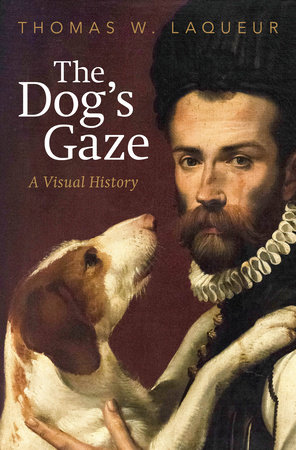
Download high-resolution image
Listen to a clip from the audiobook
audio play button
0:00
0:00

The Dog's Gaze

A Visual History

Author Thomas W. Laqueur On Tour
Listen to a clip from the audiobook
audio play button
0:00
0:00
"It is difficult to think of many other books that are at once so brilliant, so wonderfully entertaining, and so moving . . . The Dog’s Gaze is full of exuberant insights about our canine friends, about art, and about the human condition." —Stephen Greenblatt

“A splendid blend of histories: natural, cultural, and artistic . . . A delight for dog-loving art connoisseurs, and vice versa.” —Kirkus (starred review)

From award-winning cultural historian, an enlightening and unique meditation on the presence of dogs in art, from the Paleolithic era to the present, and what our intertwined human-canine relationship reveals about human nature


Long before the phrase man’s best friend became common parlance, dogs were already standing beside us in art as in life. In The Dog’s Gaze, the historian Thomas W. Laqueur invites us to explore why they feature more than any other animal in the ways in which we picture ourselves and our stories.

Dogs have been ubiquitous in the worldmaking of visual artists as far back as the Paleolithic age. Looking across the Western tradition, from Giotto to Goya and Rubens to Rego, Laqueur shows what their presence—as hunting partners, beloved friends, and even conduits to the afterlife—reveals about our own ways of seeing and how we want to be remembered. Far from being mere motifs, dogs are an integral and intentional element of the images in which they appear: They provide narrative coherence; they look out and bear witness, often on the artist’s behalf; they illuminate our understanding of morality and melancholy and some, like us, become celebrities. Indeed, as Laqueur reveals, dogs in art are our social doppelgängers, our companions in looking and being.

Richly illustrated and lovingly written, The Dog’s Gaze is a unique visual history that examines the remarkable social bond between two species, shedding new light on the human condition through the eyes of our canine companions.
© Hagit Caspi
Thomas W. Laqueur is the Helen Fawcett Distinguished Professor of History Emeritus at the University of California, Berkeley. An internationally renowned cultural historian, he has published books on topics ranging from working class religion and education to the history of sexuality and the body. He is a member of both the American Academy of Arts and Sciences and the American Philosophical Society and recipient of the 2007 Mellon Foundation Distinguished Achievement Award and the 2016 Cundill History Prize. His work has been translated into twenty languages. View titles by Thomas W. Laqueur
“Dogs have been bred over millennia to meet our eyes with their own, offering a gaze of gratitude rather than one of appetite or fear. Laqueur takes this simple proposition and shows how it has been institutionalized in art, chiefly in paintings of the highest order but also in posters, photographs, and marginal illustrations. His is a work of immensely humane scholarship . . . Laqueur also has something rare, though essential to real scholarship, and that is taste . . . Laqueur’s book has no particular thesis to hobbyhorse for, and yet a unified-field theory of aesthetic dogginess might be distilled from its pages. Dogs live within a neat symbolic divide. On the one hand, they represent courage, an intrepid readiness to take risks on behalf of their beloved; on the other, they represent loyalty, a refusal to be removed from the presence of their families. The dog in art both walks ahead with the hunters and stays behind with the gatherers.” —Adam Gopnik, The New Yorker

“In this luminous book, the American cultural historian Thomas Laqueur explores what he calls 'the dog’s gaze'. The dog was the first animal to live companionably with humans, and Laqueur argues that this marks the boundary between nature and culture . . . From this starting point Laqueur takes us on a wonderfully illustrated tour of dogs in art, from the shitting cur in Rembrandt’s etching The Good Samaritan to the Jeff Koons balloon dog, by way of cinema superstar Lassie. . . . By the end of this clever, beautiful book, Laqueur has persuasively made his point that the dog’s function in western art is to provide an entry-point or alter ego for viewers who might otherwise feel overwhelmed or outclassed.” The Guardian

“As long as canines have been an integral feature of the human world, they have been an integral feature of our artistic world. In The Dog’s Gaze, historian Thomas W Laqueur seeks to answer the question of precisely why . . . The way the dog’s gaze directs, judges and mirrors in art is much more than artistic convention. It reflects the deep and unique bond between man and dog.” Financial Times

“Inspiring, educational, moving . . . This is a riveting visual history of man’s best friend. Thomas Laqueur, from a German Jewish family, whose mother owned boxers, introduces us to many hitherto unexplored facts. Who knew that in 1938 guard dogs, using Bedouin herding dogs, were specially bred for ‘the new Zion’? Or that Darwin thought that dogs have a conscience? We are encouraged to scrutinize masterpieces of art with a fresh eye . . . This is a fascinating book with stunning illustrations.” —The Spectator

“A brilliantly wise and engaging book about how dogs have been represented in art and what they represent in life . . . The Dog’s Gaze is in part a history of the intimacy between humans and dogs, which predates by millennia, maybe tens of millennia, our relationship with other domesticated animals, and has persisted on every inhabited continent. Laqueur offers a clear and well-informed account of the genetic and archaeological evidence of domestication, before launching into a thoughtful, erudite account of dogs in art, from prehistoric petroglyphs to Lucian Freud’s whippets, William Wegman’s photographs of Weimaraners and a yellow dog in a painting by Kerry James Marshall . . . A magnificent, generous book.” Apollo

“In this charming and lavishly illustrated book [Thomas Laqueur] sets out to discover what the dogs do for the artists and how they do it . . . The Dog’s Gaze is an enjoyable romp." —The Times (UK)

“A splendid blend of histories: natural, cultural, and artistic . . . [A] sprawling examination of dogs in the history of art, from Neolithic cave paintings to present-day photographs and paintings . . . In a book filled with image after image of dogs in all sorts of artistic contexts, Laqueur provides other meaningful interpretations of the dog as a religious symbol, an avatar of the good home, a hunting companion, a faithful friend—and, in one terrifying instance, as a hellhound chasing runaway enslaved people. Laqueur spins fine anecdotes, such as one concerning Pablo Picasso’s beloved dachshund, Lump, of whom the artist remarked, 'He’s not a dog, he’s not a little man, he’s somebody else;' and his text is full of smart aperçus, such as speculation on why dogs figure so often in stories and images about death, for 'who more than the dead need protection, attention, and guidance?' . . . A delight for dog-loving art connoisseurs, and vice versa.” Kirkus (starred review)

“Historian Laqueur traces in this delightful survey the long history of dogs appearing in artworks . . . A whirlwind tour through centuries of art history . . . Drawing from a staggering wealth of examples, the author successfully uncovers the overlapping uses and meanings of dogs in art, while interspersing the account with charming asides about artists’ relationships with the dogs that appear in their work . . . It’s an eye-catching homage to man’s best friend.” Publishers Weekly

“It is difficult to think of many other books that are at once so brilliant, so wonderfully entertaining, and so moving. I savoured every page and lingered over every illustration. It turns out that a dog’s eye view gives us unique access to some of the deepest longings, needs, and creative powers of our own species. The Dog’s Gaze is full of exuberant insights about our canine friends, about art, and about the human condition.” —Stephen Greenblatt

“The Dog’s Gaze: A Visual History is a treasure trove of fascinating material. There could be no more congenial and erudite guide than Professor Laqueur through centuries of artwork from ancient times to 20th-century America and beyond. Each dog portrait is both unique and emblematic: the dog as a companion of aristocrats, and of the common man; the dog at the periphery of human activity, and the dog as a measure of morality; the dog alone, in extremis, a mirror of human loneliness. We see in these richly varied depictions of our most faithful animal companion something of the evolution of our own humanity but most profoundly we see the dog as a creature of infinite beauty, irresistible to generations of artists.” —Joyce Carol Oates

“In this beautiful book, Laqueur shows that dogs are everywhere in our lives and our art.” —Sally Mann

About

"It is difficult to think of many other books that are at once so brilliant, so wonderfully entertaining, and so moving . . . The Dog’s Gaze is full of exuberant insights about our canine friends, about art, and about the human condition." —Stephen Greenblatt

“A splendid blend of histories: natural, cultural, and artistic . . . A delight for dog-loving art connoisseurs, and vice versa.” —Kirkus (starred review)

From award-winning cultural historian, an enlightening and unique meditation on the presence of dogs in art, from the Paleolithic era to the present, and what our intertwined human-canine relationship reveals about human nature


Long before the phrase man’s best friend became common parlance, dogs were already standing beside us in art as in life. In The Dog’s Gaze, the historian Thomas W. Laqueur invites us to explore why they feature more than any other animal in the ways in which we picture ourselves and our stories.

Dogs have been ubiquitous in the worldmaking of visual artists as far back as the Paleolithic age. Looking across the Western tradition, from Giotto to Goya and Rubens to Rego, Laqueur shows what their presence—as hunting partners, beloved friends, and even conduits to the afterlife—reveals about our own ways of seeing and how we want to be remembered. Far from being mere motifs, dogs are an integral and intentional element of the images in which they appear: They provide narrative coherence; they look out and bear witness, often on the artist’s behalf; they illuminate our understanding of morality and melancholy and some, like us, become celebrities. Indeed, as Laqueur reveals, dogs in art are our social doppelgängers, our companions in looking and being.

Richly illustrated and lovingly written, The Dog’s Gaze is a unique visual history that examines the remarkable social bond between two species, shedding new light on the human condition through the eyes of our canine companions.

Author

© Hagit Caspi
Thomas W. Laqueur is the Helen Fawcett Distinguished Professor of History Emeritus at the University of California, Berkeley. An internationally renowned cultural historian, he has published books on topics ranging from working class religion and education to the history of sexuality and the body. He is a member of both the American Academy of Arts and Sciences and the American Philosophical Society and recipient of the 2007 Mellon Foundation Distinguished Achievement Award and the 2016 Cundill History Prize. His work has been translated into twenty languages. View titles by Thomas W. Laqueur

Praise

“Dogs have been bred over millennia to meet our eyes with their own, offering a gaze of gratitude rather than one of appetite or fear. Laqueur takes this simple proposition and shows how it has been institutionalized in art, chiefly in paintings of the highest order but also in posters, photographs, and marginal illustrations. His is a work of immensely humane scholarship . . . Laqueur also has something rare, though essential to real scholarship, and that is taste . . . Laqueur’s book has no particular thesis to hobbyhorse for, and yet a unified-field theory of aesthetic dogginess might be distilled from its pages. Dogs live within a neat symbolic divide. On the one hand, they represent courage, an intrepid readiness to take risks on behalf of their beloved; on the other, they represent loyalty, a refusal to be removed from the presence of their families. The dog in art both walks ahead with the hunters and stays behind with the gatherers.” —Adam Gopnik, The New Yorker

“In this luminous book, the American cultural historian Thomas Laqueur explores what he calls 'the dog’s gaze'. The dog was the first animal to live companionably with humans, and Laqueur argues that this marks the boundary between nature and culture . . . From this starting point Laqueur takes us on a wonderfully illustrated tour of dogs in art, from the shitting cur in Rembrandt’s etching The Good Samaritan to the Jeff Koons balloon dog, by way of cinema superstar Lassie. . . . By the end of this clever, beautiful book, Laqueur has persuasively made his point that the dog’s function in western art is to provide an entry-point or alter ego for viewers who might otherwise feel overwhelmed or outclassed.” The Guardian

“As long as canines have been an integral feature of the human world, they have been an integral feature of our artistic world. In The Dog’s Gaze, historian Thomas W Laqueur seeks to answer the question of precisely why . . . The way the dog’s gaze directs, judges and mirrors in art is much more than artistic convention. It reflects the deep and unique bond between man and dog.” Financial Times

“Inspiring, educational, moving . . . This is a riveting visual history of man’s best friend. Thomas Laqueur, from a German Jewish family, whose mother owned boxers, introduces us to many hitherto unexplored facts. Who knew that in 1938 guard dogs, using Bedouin herding dogs, were specially bred for ‘the new Zion’? Or that Darwin thought that dogs have a conscience? We are encouraged to scrutinize masterpieces of art with a fresh eye . . . This is a fascinating book with stunning illustrations.” —The Spectator

“A brilliantly wise and engaging book about how dogs have been represented in art and what they represent in life . . . The Dog’s Gaze is in part a history of the intimacy between humans and dogs, which predates by millennia, maybe tens of millennia, our relationship with other domesticated animals, and has persisted on every inhabited continent. Laqueur offers a clear and well-informed account of the genetic and archaeological evidence of domestication, before launching into a thoughtful, erudite account of dogs in art, from prehistoric petroglyphs to Lucian Freud’s whippets, William Wegman’s photographs of Weimaraners and a yellow dog in a painting by Kerry James Marshall . . . A magnificent, generous book.” Apollo

“In this charming and lavishly illustrated book [Thomas Laqueur] sets out to discover what the dogs do for the artists and how they do it . . . The Dog’s Gaze is an enjoyable romp." —The Times (UK)

“A splendid blend of histories: natural, cultural, and artistic . . . [A] sprawling examination of dogs in the history of art, from Neolithic cave paintings to present-day photographs and paintings . . . In a book filled with image after image of dogs in all sorts of artistic contexts, Laqueur provides other meaningful interpretations of the dog as a religious symbol, an avatar of the good home, a hunting companion, a faithful friend—and, in one terrifying instance, as a hellhound chasing runaway enslaved people. Laqueur spins fine anecdotes, such as one concerning Pablo Picasso’s beloved dachshund, Lump, of whom the artist remarked, 'He’s not a dog, he’s not a little man, he’s somebody else;' and his text is full of smart aperçus, such as speculation on why dogs figure so often in stories and images about death, for 'who more than the dead need protection, attention, and guidance?' . . . A delight for dog-loving art connoisseurs, and vice versa.” Kirkus (starred review)

“Historian Laqueur traces in this delightful survey the long history of dogs appearing in artworks . . . A whirlwind tour through centuries of art history . . . Drawing from a staggering wealth of examples, the author successfully uncovers the overlapping uses and meanings of dogs in art, while interspersing the account with charming asides about artists’ relationships with the dogs that appear in their work . . . It’s an eye-catching homage to man’s best friend.” Publishers Weekly

“It is difficult to think of many other books that are at once so brilliant, so wonderfully entertaining, and so moving. I savoured every page and lingered over every illustration. It turns out that a dog’s eye view gives us unique access to some of the deepest longings, needs, and creative powers of our own species. The Dog’s Gaze is full of exuberant insights about our canine friends, about art, and about the human condition.” —Stephen Greenblatt

“The Dog’s Gaze: A Visual History is a treasure trove of fascinating material. There could be no more congenial and erudite guide than Professor Laqueur through centuries of artwork from ancient times to 20th-century America and beyond. Each dog portrait is both unique and emblematic: the dog as a companion of aristocrats, and of the common man; the dog at the periphery of human activity, and the dog as a measure of morality; the dog alone, in extremis, a mirror of human loneliness. We see in these richly varied depictions of our most faithful animal companion something of the evolution of our own humanity but most profoundly we see the dog as a creature of infinite beauty, irresistible to generations of artists.” —Joyce Carol Oates

“In this beautiful book, Laqueur shows that dogs are everywhere in our lives and our art.” —Sally Mann
Books for LGBTQIA+ Pride Month

In June we celebrate Lesbian, Gay, Bisexual, Transgender, Queer, Intersex, and Asexual + (LGBTQIA+) Pride Month, which honors the 1969 Stonewall riots in Manhattan. Pride Month is a time to both celebrate the accomplishments of those in the LGBTQ+ community and recognize the ongoing struggles faced by many across the world who wish to live

Read more