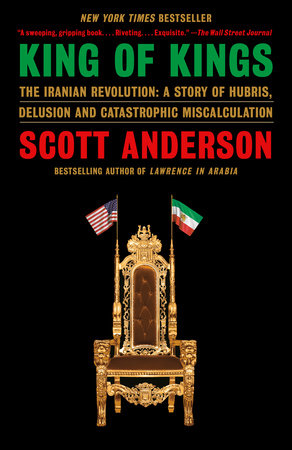
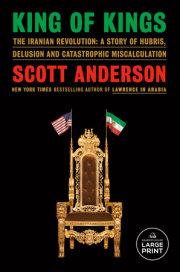
Named a Best Book of the Year by The Wall Street Journal, The Atlantic, and Vanity Fair
“[A] masterly new account of the Iranian revolution, illustrates the stubborn American blindness that hastened the shah’s demise and helped the mullahs prevail. It was an ‘obliviousness’ that ‘became willful, an ignorance to be maintained and defended,’ Anderson writes. . . . This is an exceptional and important book. Scrupulous and enterprising reporting rarely combine with such superb storytelling.” —The New York Times
“Mr. Anderson is a first-rate writer of histories. . . . King of Kings is a sweeping, gripping book, one that makes past times and dead people (often weird, complex and evil) spring to life with its narrative verve and attention to detail. . . . Riveting. . . . Exquisite.” —The Wall Street Journal
“A masterful and propulsive account that chronicles a devastatingly transformative series of events whose aftereffects reverberate to this day.” —The Kirkus Prize 2025 Jury
“Anderson succeeds precisely because he eschews structural, quasi-philosophical queries for an energetic account that concerns itself with, as he puts it, ‘a few core questions’. . . . As a result of this inquiry, Anderson finds an answer at once simpler, more instructive, and truer than those of many scholars. . . . Anderson has also consulted the best scholarship on the revolution. . . . Anderson thus offers a readable page-turner that’s also attuned to those core questions. . . . Anderson’s book [is] one of the best on 1979.” —The Atlantic
“Veteran journalist Anderson takes readers through the final years of Shah Mohammad Reza Pahlavi’s regime in Iran, tracing the political machinations that kept him in power and the corruption that helped turn the Iranian public against him. It is attentive to both the shah’s own oblivious rule and the world-historical mistakes that his American allies made in their attempt to prop him up.” —The Washington Post
“King of Kings reads like a blend of a le Carré novel and a Coen Brothers film in the best possible way.” —Vanity Fair
“Timely. . . . King of Kings is a lively tale of palace intrigue.” —The New Yorker
“Absorbing. . . . Meticulously reported. . . . riveting.” —Air Mail
“The outlines of the Iranian Revolution of 1979 are already seared into the American psyche, but this spellbinding book adds fascinating texture and provides a salutary warning for policymakers today. Drawing on the accounts of major players—both American and Iranian—Anderson, a prize-winning journalist and novelist, reconstructs the missteps that contributed to the fall of Mohammad Reza Shah Pahlavi, the triumph of the Islamic Revolution, and the transformation of a major American ally into an apparently implacable enemy. . . . Absorbing.” —Foreign Affairs
“Rare is the non-fiction work that can be described as gripping, but King of Kings . . . earns the accolade. . . . Hubris, delusion and catastrophic miscalculation are the elements one expects to find in a Cold War spy thriller, perhaps by John Le Carré. Readers will find King of Kings equally enthralling. . . . A brilliant narrative-history that not only provides a thoroughly readable account of one of the seminal events of the past half-century, but also sheds a bright light on how the religio-political Middle East of 2025 came about. It is highly recommended.” —Jerusalem Post
“A masterful dissection of perhaps the most consequential strategic blunder of the late 20th century. . . . The book reads like a political thriller, yet every page is grounded in meticulous research and sharp analytical insight. . . . Prescient. . . . Compelling. . . . A remarkably engaging work of popular history. The book’s contemporary relevance cannot be overstated. . . . It stands as both a gripping historical narrative and a cautionary tale about the dangers of imperial overconfidence.” —The American Conservative
“Scott Anderson’s King of Kings is a riveting, masterfully told account of how the Shah’s downfall became a tragic turning point in history, as America stumbled blindly into a long and costly conflict that shadows the Middle East to this day. Anderson's clear analysis and vivid storytelling unravel one of the great miscalculations in America's postwar foreign policy—a must-read that is both urgent and unforgettable.” —Steve Coll, author of Directorate S, winner of the National Book Critics Circle Award, and Ghost Wars, winner of the Pulitzer Prize
“In his masterful and gripping account of the Iranian revolution, Scott Anderson gives us a page-turning history lesson that is more relevant than ever: A story of American diplomatic blunders and miscalculations that led to the loss of a vital ally and the commencement of hostilities that have roiled the world for nearly four decades. Taking us inside the fortified walls of the shah’s palaces, King of Kings lays bare the folly and hubris that led to the shah’s demise, the hostage crisis and a radical theocracy that would reshape the Middle East.”
—Rajiv Chandrasekaran, author of National Book Award finalist Imperial Life in the Emerald City
“Instantly absorbing, King of Kings is an exhilarating plunge into the psychology of unchecked power, which secludes, blinds, and ultimately betrays its holders. Anderson is a master of the telling detail; he gives us lessons not only from the Shah’s undoing but also from Washington’s weakness for rigid assumptions—until history, as it so often does, shatters the illusion of control.”
—Evan Osnos, author of the National Book Award winner Age of Ambition
“Anderson’s brilliant new account of the events leading to the shah’s fall is both masterful and mesmerizing. With bracing clarity, drawing from interviews with direct participants, King of Kings shows senior Iranian and U.S. officials sleepwalking into a disaster with global consequences—and one that was far from inevitable. A must-read for anyone looking to understand the origins of the Middle East’s most dangerous regime.”
—Joby Warrick, author of Black Flags: The Rise of ISIS, winner of the 2016 Pulitzer Prize for General Nonfiction
“The Iranian Revolution was one of the most momentous events of the Twentieth Century, one whose reverberations continue to shape the Middle East. In this highly readable and probing book, Scott Anderson revisits the events of that critical year, and draws on previously unknown information to chart the course of events that made what seemed improbable to become inevitable: the fall of the monarchy before a triumphant revolution.”
—Vali Nasr, Professor of International Affairs and Middle East Studies at the School of Advanced Studies of Johns Hopkins University and the author of Iran’s Grand Strategy: A Political History
“Scott Anderson’s thrilling, fully authoritative work takes us behind the scenes of US decision-making blunders as the country’s leaders fumbled the Iranian revolution, losing the US’s most critical ally in the Middle East. Nearly a half century later, this is the gold standard account of the Shah’s fall, with fresh dramatic tales and arresting details from the last living players. An epic and heart-breaking tragedy.”
—Azadeh Moaveni, author of Lipstick Jihad: A Memoir of Growing up Iranian in America and American in Iran
“Anderson uses his incomparable prose to crack open the deep story behind one of the most momentous events of the last decades. An important and riveting book.”
—Sebastian Junger, New York Times bestselling author of The Perfect Storm and War
“Written with a journalist’s instincts and the plotlines of a thriller, King of Kings is the most compelling account yet of the revolution in Iran—an event so significant that it continues to shape world affairs today. An outstanding book.”
—Eugene Rogan, author of The Fall of the Ottomans
“King of Kings chronicles the fall of Iran's Shah—a man feared by many but understood by few. This account examines how hubris, Cold War tensions, and revolutionary fervor toppled a monarchy whose ruler pursued modernization while remaining fatally disconnected from his people, the shockwaves of which still reverberate through international relations today.”
—Bradley Hope, bestselling co-author of Billion Dollar Whale and Blood and Oil
“King of Kings delivers remarkable new insights into one of history’s least understood upheavals—the Iranian revolution. Rich in detail and gripping portraits of the individuals at the heart of the tragedy, this book gets to the essence of how this unique revolution succeeded—and why it cannot be replicated.”
—Kim Ghattas, author of Black Wave
“Scott Anderson vividly describes, in unerringly forensic detail, how American foreign policy makers completely misread—as indeed they continue to misread—the Middle East and all its complexities, with consequences that reverberate to this day.”
—Diana Darke, author of Stealing from the Saracens
“Wry, acute, forensically reported, deeply researched, King of Kings is a brilliantly absorbing, page-turning account of the Iranian Revolution. Scott Anderson is one of the very best narrative historians writing today. From the seething streets, to the filigree of Palace intrigue and the politics of American interests, he captures the opportunism, self-delusion and ineptitude that ploughed a furrow across the face of the modern Middle East. It’s a perfect lesson for our times: history has no idea what it’s doing.”
—Wendell Steavenson, author of The Weight of a Mustard Seed
“A clear-eyed account of a difficult, complex man and his self-inflicted fall from grace.” —The Guardian
“An excellent narrative account of the two tumultuous years that resulted in the triumph of Ayatollah Khomeini and the creation of an Islamic republic. . . . [Anderson] has done scrupulous research on the final months of the Shah’s fading rule.” —The Telegraph
“An authoritative, well-reported and elegantly written account of the fall of the Shah of Iran and the rise of the Ayatollah Khomeini. If you want to understand the turmoil in Gaza, Syria and beyond, then the Iranian Revolution of 1979 is a good place to start.” —The Times
“For those seeking to understand this seemingly endless state of conflict between Israel, the US and Iran and the blood-soaked rivalries that drive conflict in the Middle East today, Scott Anderson’s new book is a good place to start. King of Kings recounts how imperial Pahlavi Iran went form a hyper-rich, secular leaning ‘Peacock’ throne, firmly allied to the west, a playground for American oil executives to the dour, repressive Islamist autocracy we know today, locked in perpetual conflict within and without its borders, isolated and seeking a nuclear bomb. . . . Anderson brilliantly tells this tale.” —The Financial Times
“Chaos is strewn by foolhardy leaders acting on bad information in this riveting history of the Iranian revolution. . . . Anderson’s story builds a rushing momentum as one miscalculation after another hurtles the country toward the 1979 ‘revolution few saw coming and no one knew how to stop.’ The result is an illuminating, operatic depiction of the revolution as a farcical cavalcade of arrogant mistakes with dire consequences.”
—Publishers Weekly (starred)
“As Anderson lays out with meticulous reporting and consummate storytelling, many of Iran’s spectacular gains—and along with them, its once-inviolable alliance with the U.S.—came undone with the 1979 Iranian Revolution and the ascent of Ayatollah Khomeini. . . . Though the Iranian Revolution unfolded more than 45 years ago, the now-fraught U.S.-Iran relationship remains front and center, and there are still hard-won lessons to glean about the costs of inattention.”
—Booklist (starred)
“A thoroughgoing history of the last years of the Pahlavi dynasty and the rise of the Islamist theocracy in Iraq. . . . An eye-opening history of how Iran became a point on the ‘axis of evil’ and is considered such a dangerous enemy today.”
—Kirkus Reviews (starred)