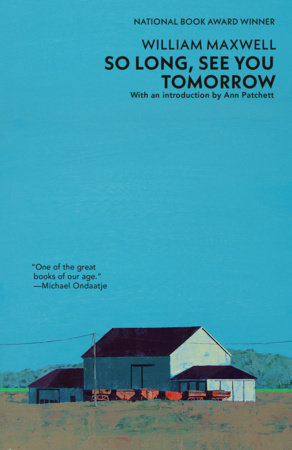
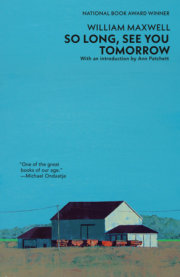




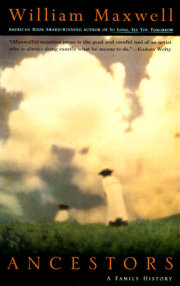
So Long, See You Tomorrow

National Book Award Winner

Introduction by Ann Patchett
Winner of the National Book Award and the William Dean Howells Medal
Finalist for the Pulitzer Prize for Fiction
With a new introduction by Ann Patchett

"A small, perfect novel." ―Washington Post Book World

In this magically evocative novel, William Maxwell explores the enigmatic gravity of the past, which compels us to keep explaining it even as it makes liars out of us every time we try.


On a winter morning in the 1920s, a shot rings out on a farm in rural Illinois. A man named Lloyd Wilson has been killed. And the tenuous friendship between two lonely teen-agers—one privileged yet neglected, the other a troubled farm boy—has been shattered.

Fifty years later, one of those boys—now a grown man—tries to reconstruct the events that led up to the murder. In doing so, he is inevitably drawn back to his lost friend Cletus, who had the misfortune of being the son of Wil-son’s killer and who in the months before witnessed things that William Maxwell’s narrator can only guess at. Out of memory and imagination, the surmises of children and the destructive passions of their parents, Maxwell creates a luminous American classic of youth and loss and explores the enigmatic gravity of the past, which compels us to keep explaining it even as it makes liars out of us every time we try.

"William Maxwell is one of the past half-century's unmistakably great novelists." ―Village Voice

"What a lovely book, utterly unlike any other in shape I have ever read." ―John Updike

William Maxwell was born in 1908 in Lincoln, Illinois. He studied at the University of Illinois at Urbana–Champaign, and after earning a master's at Harvard, returned there to teach freshman composition before turning to writing. He published six novels, three collections of short fiction, an autobiographical memoir, a collection of literary essays and reviews, and a book for children. For 40 years, he was a fiction editor at The New Yorker. From 1969 to 1972 he was president of the National Institute of Arts and Letters. He received the Brandeis Creative Arts Award Medal and, for So Long, See You Tomorrow, the National Book Award and the Howells Medal of the American Academy of Arts and Letters. He died in 2000. View titles by William Maxwell
"One of the great books of of our age." —Michael Ondaatje

"A brief novel that approaches perfection. . . . Not a word or sentence could be changed for the better." —The New York Times

"A masterpiece, a perfect book." —David Nicholls

"The novel comes from a place so deep inside the human soul that I cannot imagine a time when its wisdom would not feel fresh and applicable. . . . A mosaic of human emtion, a singular and spectacular work of art." —from the introduction by Ann Patchett

About

Winner of the National Book Award and the William Dean Howells Medal
Finalist for the Pulitzer Prize for Fiction
With a new introduction by Ann Patchett

"A small, perfect novel." ―Washington Post Book World

In this magically evocative novel, William Maxwell explores the enigmatic gravity of the past, which compels us to keep explaining it even as it makes liars out of us every time we try.


On a winter morning in the 1920s, a shot rings out on a farm in rural Illinois. A man named Lloyd Wilson has been killed. And the tenuous friendship between two lonely teen-agers—one privileged yet neglected, the other a troubled farm boy—has been shattered.

Fifty years later, one of those boys—now a grown man—tries to reconstruct the events that led up to the murder. In doing so, he is inevitably drawn back to his lost friend Cletus, who had the misfortune of being the son of Wil-son’s killer and who in the months before witnessed things that William Maxwell’s narrator can only guess at. Out of memory and imagination, the surmises of children and the destructive passions of their parents, Maxwell creates a luminous American classic of youth and loss and explores the enigmatic gravity of the past, which compels us to keep explaining it even as it makes liars out of us every time we try.

"William Maxwell is one of the past half-century's unmistakably great novelists." ―Village Voice

"What a lovely book, utterly unlike any other in shape I have ever read." ―John Updike

Author

William Maxwell was born in 1908 in Lincoln, Illinois. He studied at the University of Illinois at Urbana–Champaign, and after earning a master's at Harvard, returned there to teach freshman composition before turning to writing. He published six novels, three collections of short fiction, an autobiographical memoir, a collection of literary essays and reviews, and a book for children. For 40 years, he was a fiction editor at The New Yorker. From 1969 to 1972 he was president of the National Institute of Arts and Letters. He received the Brandeis Creative Arts Award Medal and, for So Long, See You Tomorrow, the National Book Award and the Howells Medal of the American Academy of Arts and Letters. He died in 2000. View titles by William Maxwell

Praise

"One of the great books of of our age." —Michael Ondaatje

"A brief novel that approaches perfection. . . . Not a word or sentence could be changed for the better." —The New York Times

"A masterpiece, a perfect book." —David Nicholls

"The novel comes from a place so deep inside the human soul that I cannot imagine a time when its wisdom would not feel fresh and applicable. . . . A mosaic of human emtion, a singular and spectacular work of art." —from the introduction by Ann Patchett

Books for LGBTQIA+ Pride Month

In June we celebrate Lesbian, Gay, Bisexual, Transgender, Queer, Intersex, and Asexual + (LGBTQIA+) Pride Month, which honors the 1969 Stonewall riots in Manhattan. Pride Month is a time to both celebrate the accomplishments of those in the LGBTQ+ community and recognize the ongoing struggles faced by many across the world who wish to live

Read more