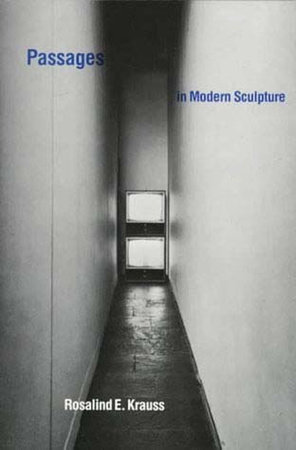
Distinguished art historian and critic Rosalind Krauss analyzes with exceptional clarity and insight the major works that have led 20th century sculpture from the traditional and figurative to the revolutionary conceptual art of the 1970s—an art which has developed a new 'syntax' that discards 'narrative' for instantaneous impact and boldly breaks new ground. Beginning with a penetrating study of Rodin's modernity in rejecting 'narrative' in his 'The Gates of Hell,' she moves successively through detailed examinations of futurism, constructivism, Duchamps' 'readymades,' Brancusi, David Smith's 'Tanktotem,' sculptural realism, and the introduction of light, motion, and theatrical elements into sculpture by Picabia, Calder, Oldenburg, and others right up to younger sculptors like Carl Andre, Blochner, and others [including Robert Morris, Don Judd, Richard Serra, Sol Le Witt, Robert Smithson, and Michael Heizer]. As critic and theorist, Krauss makes demands that will challenge even the most sophisticated.—
Publishers Weekly—
...Krauss's book is undoubtedly the best treatment of its subject yet written. As a textbook, it ought to raise the level of discourse in art history classes, for it is the meaning, not the chronology, of sculpture since Rodin that is the book's central concern. Krauss avoids the conventional plodding survey and divides the book into a sequence of 'case studies' that permit sustained attention to specific works and artists. In so doing, she attempts to trace a 'tradition' to stand behind that portion of American sculpture of the past 15 years which she espouses critically.
—
Art in America—
The book is well illustrated in black and white and is, for an art book, of a convenient and manageable size. The text is rigorously formalistic and analytical and organized around specific sculptural considerations such as the treatment of narrative time, the handling of space, and the game strategies of surrealist sculpture. It is an approach that pays off particularly well in the author's discussions of Rodin and David Smith.
—
Saturday Review—