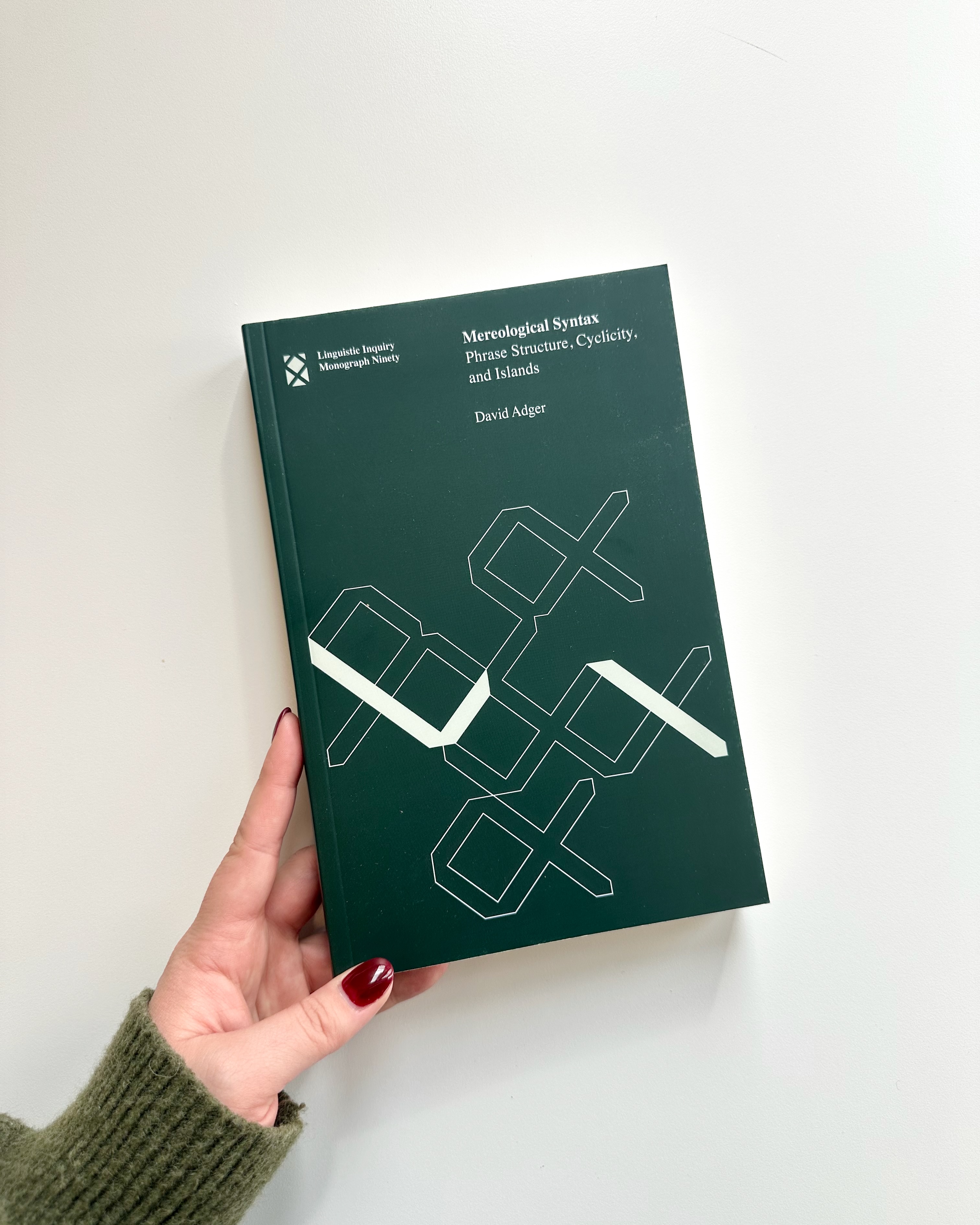




Mereological Syntax

Look inside
Paperback
$65.00 US
On sale Nov 18, 2025 | 288 Pages | 9780262553278

See Additional Formats
An argument for replacing Chomsky’s set-theoretic Merge view of syntax with a theory of syntax based on mereological objects.

Mereology is the study of parthood—what it means for one thing to be part of another. David Adger argues that a theory of syntax based on mereological objects should replace Chomsky’s set-theoretic Merge view of syntax. He shows how this new perspective solves some of the problems that have bedeviled minimalism, while opening a path to a unified approach to islands, one of the central topics in theoretical syntax for the past 50 years. Adger draws on data from across many languages and from experimental work.

Adger focuses on two puzzles—specifically, the so-called Labeling Problem and Copy Problem—that arise from the Merge model of syntax. He adapts ideas from mereology to build a system of phrase structure, using an operation he calls Subjoin, that solves these puzzles. He defines a simple constraint on mereological objects that he calls Angular Locality, which has wide-ranging ramifications for what constitutes a possible structure, derives successive cyclicity as a theorem, and opens a new approach to explaining why certain island phenomena behave as they do.
Contents
1 Introduction
2 Sets
3 Parts
4 Angles
5 Wh Islands
6 Nominal Islands
7 Subject Islands
8 Conclusion
David Adger is Professor of Linguistics at Queen Mary University of London and a former president of the Linguistics Association of Great Britain. He is the author of Core Syntax, A Syntax of Substance (MIT Press), and Language Unlimited.
ENDORSEMENTS

“In this highly original monograph, David Adger reanalyzes the core of human language, hierarchical structure: Subjoin is the organizing principle that builds mereological objects in a part-whole hierarchy. Adger applies his innovative approach to many classical domains of generative syntax, approaches old facts in new light, and explores novel data. Mereological Syntax will undoubtedly make a significant contribution to the field.”
—Kleanthes K. Grohmann, Professor of Biolinguistics and Director of the CAT Lab, University of Cyprus

"This combination of a very innovative and original (but also very simple) theoretical proposal with potentially overarching empirical consequences, and very sophisticated and precise explorations into the intricacies of very rich empirical domains on a vast number of languages, makes this book very readable and very entertaining.”
—Caterina Donati, Laboratoire de Linguistique Formelle; Professor, Paris Cité University; Director, UFR Linguistique
additional book photo

About

An argument for replacing Chomsky’s set-theoretic Merge view of syntax with a theory of syntax based on mereological objects.

Mereology is the study of parthood—what it means for one thing to be part of another. David Adger argues that a theory of syntax based on mereological objects should replace Chomsky’s set-theoretic Merge view of syntax. He shows how this new perspective solves some of the problems that have bedeviled minimalism, while opening a path to a unified approach to islands, one of the central topics in theoretical syntax for the past 50 years. Adger draws on data from across many languages and from experimental work.

Adger focuses on two puzzles—specifically, the so-called Labeling Problem and Copy Problem—that arise from the Merge model of syntax. He adapts ideas from mereology to build a system of phrase structure, using an operation he calls Subjoin, that solves these puzzles. He defines a simple constraint on mereological objects that he calls Angular Locality, which has wide-ranging ramifications for what constitutes a possible structure, derives successive cyclicity as a theorem, and opens a new approach to explaining why certain island phenomena behave as they do.

Table of Contents

Contents
1 Introduction
2 Sets
3 Parts
4 Angles
5 Wh Islands
6 Nominal Islands
7 Subject Islands
8 Conclusion

Author

David Adger is Professor of Linguistics at Queen Mary University of London and a former president of the Linguistics Association of Great Britain. He is the author of Core Syntax, A Syntax of Substance (MIT Press), and Language Unlimited.

Praise

ENDORSEMENTS

“In this highly original monograph, David Adger reanalyzes the core of human language, hierarchical structure: Subjoin is the organizing principle that builds mereological objects in a part-whole hierarchy. Adger applies his innovative approach to many classical domains of generative syntax, approaches old facts in new light, and explores novel data. Mereological Syntax will undoubtedly make a significant contribution to the field.”
—Kleanthes K. Grohmann, Professor of Biolinguistics and Director of the CAT Lab, University of Cyprus

"This combination of a very innovative and original (but also very simple) theoretical proposal with potentially overarching empirical consequences, and very sophisticated and precise explorations into the intricacies of very rich empirical domains on a vast number of languages, makes this book very readable and very entertaining.”
—Caterina Donati, Laboratoire de Linguistique Formelle; Professor, Paris Cité University; Director, UFR Linguistique

Photos

additional book photo

Books for Women’s History Month

In honor of Women’s History Month in March, we are sharing books by women who have shaped history and have fought for their communities. Our list includes books about women who fought for racial justice, abortion rights, equality in the workplace, and ranges in topics from women in politics and prominent women in history to

Read more