


















Books for Arab American Heritage Month
In honor of Arab American Heritage Month in April, we are sharing books by Arab and Arab American authors that share their culture, history, and personal lives.
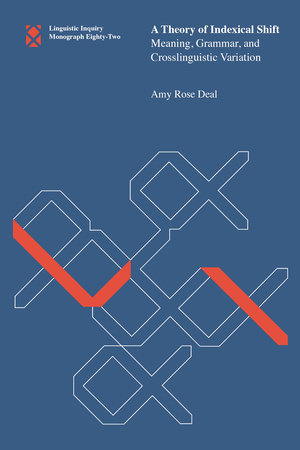
The phenomenon of indexical shift—whereby indexicals embedded in speech or attitude reports draw their meaning from an attitude event rather than the utterance context—has been reported in languages spanning five continents and at least ten language families. In this book, Amy Rose Deal offers a comprehensive overview of the semantics and syntax of indexical shift and develops a constrained typology of the phenomenon across languages—a picture of variation that is both rich enough to capture the known facts and restrictive enough to make predictions about currently unknown data points. Deal draws on studies of indexical shift in a broad range of languages, focusing especially on Nez Perce, Zazaki, Korean, and Uyghur.
Using new data from fieldwork, Deal presents an in-depth case study of indexical shift in the Nez Perce language, and uses this evidence to propose a novel theoretical approach based on the meaning and grammar of shifty operators. She explores several dimensions of variation related to indexical shift across and within languages, showing how the cross-linguistic patterns can be explained (and constrained) within the shifty operator view. Finally, she contrasts indexical shift with surface-similar phenomena, clarifying the controls needed to test the constrained typology on new data sets.
The phenomenon of indexical shift—whereby indexicals embedded in speech or attitude reports draw their meaning from an attitude event rather than the utterance context—has been reported in languages spanning five continents and at least ten language families. In this book, Amy Rose Deal offers a comprehensive overview of the semantics and syntax of indexical shift and develops a constrained typology of the phenomenon across languages—a picture of variation that is both rich enough to capture the known facts and restrictive enough to make predictions about currently unknown data points. Deal draws on studies of indexical shift in a broad range of languages, focusing especially on Nez Perce, Zazaki, Korean, and Uyghur.
Using new data from fieldwork, Deal presents an in-depth case study of indexical shift in the Nez Perce language, and uses this evidence to propose a novel theoretical approach based on the meaning and grammar of shifty operators. She explores several dimensions of variation related to indexical shift across and within languages, showing how the cross-linguistic patterns can be explained (and constrained) within the shifty operator view. Finally, she contrasts indexical shift with surface-similar phenomena, clarifying the controls needed to test the constrained typology on new data sets.
In honor of Arab American Heritage Month in April, we are sharing books by Arab and Arab American authors that share their culture, history, and personal lives.
For National Poetry Month in April, we are sharing poetry collections and books about poetry by authors who have their own stories to tell. These poets delve into history, reimagine the present, examine poetry itself—from traditional poems many know and love to poems and voices that are new and original.