
Books for Jewish American Heritage Month
In celebration of Jewish American Heritage Month in May, we are sharing books by authors who share their individual stories, experiences, and lives. Find our full collection of books here.


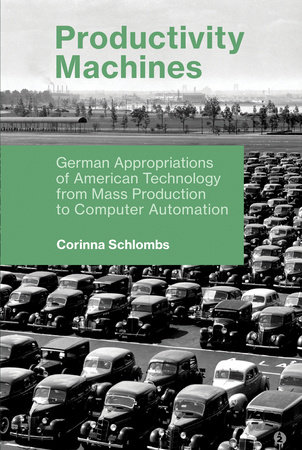
The concept of productivity originated in a statistical measure of output per worker or per work-hour, calculated by the US Bureau of Labor Statistics. A broader productivity culture emerged in 1920s America, as Henry Ford and others linked methods of mass production and consumption to high wages and low prices. These ideas were studied eagerly by a Germany in search of economic recovery after World War I, and, decades later, the Marshall Plan promoted productivity in its efforts to help post–World War II Europe rebuild. In Productivity Machines, Corinna Schlombs examines the transatlantic history of productivity technology and culture in the two decades before and after World War II. She argues for the interpretive flexibility of productivity: different groups viewed productivity differently at different times. Although it began as an objective measure, productivity came to be emblematic of the American economic system; post-World War II West Germany, however, adapted these ideas to its own political and economic values.
Schlombs explains that West German unionists cast a doubtful eye on productivity's embrace of plant-level collective bargaining; unions fought for codetermination—the right to participate in corporate decisions. After describing German responses to US productivity, Schlombs offers an in-depth look at labor relations in one American company in Germany—that icon of corporate America, IBM. Finally, Schlombs considers the emergence of computer technology—seen by some as a new symbol of productivity but by others as the means to automate workers out of their jobs.
The concept of productivity originated in a statistical measure of output per worker or per work-hour, calculated by the US Bureau of Labor Statistics. A broader productivity culture emerged in 1920s America, as Henry Ford and others linked methods of mass production and consumption to high wages and low prices. These ideas were studied eagerly by a Germany in search of economic recovery after World War I, and, decades later, the Marshall Plan promoted productivity in its efforts to help post–World War II Europe rebuild. In Productivity Machines, Corinna Schlombs examines the transatlantic history of productivity technology and culture in the two decades before and after World War II. She argues for the interpretive flexibility of productivity: different groups viewed productivity differently at different times. Although it began as an objective measure, productivity came to be emblematic of the American economic system; post-World War II West Germany, however, adapted these ideas to its own political and economic values.
Schlombs explains that West German unionists cast a doubtful eye on productivity's embrace of plant-level collective bargaining; unions fought for codetermination—the right to participate in corporate decisions. After describing German responses to US productivity, Schlombs offers an in-depth look at labor relations in one American company in Germany—that icon of corporate America, IBM. Finally, Schlombs considers the emergence of computer technology—seen by some as a new symbol of productivity but by others as the means to automate workers out of their jobs.








In celebration of Jewish American Heritage Month in May, we are sharing books by authors who share their individual stories, experiences, and lives. Find our full collection of books here.
For Mental Health Awareness Month in May, we are sharing books to educate and raise awareness about mental health and the various factors that may affect it, and to provide tools and resources for student wellness. Find our full collection of titles here.
Each May, we honor the stories, histories, and cultures of Asian Americans, Native Hawaiians, and Pacific Islanders. Below is a selection of acclaimed fiction and nonfiction books by AANHPI creators to share with your students this month and throughout the year. Find our full collection of titles for Higher Education here.