Books for Jewish American Heritage Month
In celebration of Jewish American Heritage Month in May, we are sharing books by authors who share their individual stories, experiences, and lives. Find our full collection of books here.
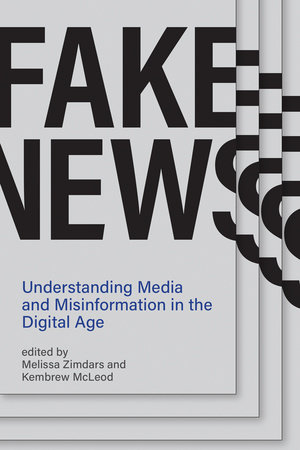
What is fake news? Is it an item on Breitbart, an article in The Onion, an outright falsehood disseminated via Russian bot, or a catchphrase used by a politician to discredit a story he doesn't like? This book examines the real fake news: the constant flow of purposefully crafted, sensational, emotionally charged, misleading or totally fabricated information that mimics the form of mainstream news. Rather than viewing fake news through a single lens, the book maps the various kinds of misinformation through several different disciplinary perspectives, taking into account the overlapping contexts of politics, technology, and journalism.
The contributors consider topics including fake news as “disorganized” propaganda; folkloric falsehood in the “Pizzagate” conspiracy; native advertising as counterfeit news; the limitations of regulatory reform and technological solutionism; Reddit's enabling of fake news; the psychological mechanisms by which people make sense of information; and the evolution of fake news in America. A section on media hoaxes and satire features an oral history of and an interview with prankster-activists the Yes Men, famous for parodies that reveal hidden truths. Finally, contributors consider possible solutions to the complex problem of fake news—ways to mitigate its spread, to teach students to find factually accurate information, and to go beyond fact-checking.
Contributors
Mark Andrejevic, Benjamin Burroughs, Nicholas Bowman, Mark Brewin, Elizabeth Cohen, Colin Doty, Dan Faltesek, Johan Farkas, Cherian George, Tarleton Gillespie, Dawn R. Gilpin, Gina Giotta, Theodore Glasser, Amanda Ann Klein, Paul Levinson, Adrienne Massanari, Sophia A. McClennen, Kembrew McLeod, Panagiotis Takis Metaxas, Paul Mihailidis, Benjamin Peters, Whitney Phillips, Victor Pickard, Danielle Polage, Stephanie Ricker Schulte, Leslie-Jean Thornton, Anita Varma, Claire Wardle, Melissa Zimdars, Sheng Zou

What is fake news? Is it an item on Breitbart, an article in The Onion, an outright falsehood disseminated via Russian bot, or a catchphrase used by a politician to discredit a story he doesn't like? This book examines the real fake news: the constant flow of purposefully crafted, sensational, emotionally charged, misleading or totally fabricated information that mimics the form of mainstream news. Rather than viewing fake news through a single lens, the book maps the various kinds of misinformation through several different disciplinary perspectives, taking into account the overlapping contexts of politics, technology, and journalism.
The contributors consider topics including fake news as “disorganized” propaganda; folkloric falsehood in the “Pizzagate” conspiracy; native advertising as counterfeit news; the limitations of regulatory reform and technological solutionism; Reddit's enabling of fake news; the psychological mechanisms by which people make sense of information; and the evolution of fake news in America. A section on media hoaxes and satire features an oral history of and an interview with prankster-activists the Yes Men, famous for parodies that reveal hidden truths. Finally, contributors consider possible solutions to the complex problem of fake news—ways to mitigate its spread, to teach students to find factually accurate information, and to go beyond fact-checking.
Contributors
Mark Andrejevic, Benjamin Burroughs, Nicholas Bowman, Mark Brewin, Elizabeth Cohen, Colin Doty, Dan Faltesek, Johan Farkas, Cherian George, Tarleton Gillespie, Dawn R. Gilpin, Gina Giotta, Theodore Glasser, Amanda Ann Klein, Paul Levinson, Adrienne Massanari, Sophia A. McClennen, Kembrew McLeod, Panagiotis Takis Metaxas, Paul Mihailidis, Benjamin Peters, Whitney Phillips, Victor Pickard, Danielle Polage, Stephanie Ricker Schulte, Leslie-Jean Thornton, Anita Varma, Claire Wardle, Melissa Zimdars, Sheng Zou
In celebration of Jewish American Heritage Month in May, we are sharing books by authors who share their individual stories, experiences, and lives. Find our full collection of books here.
For Mental Health Awareness Month in May, we are sharing books to educate and raise awareness about mental health and the various factors that may affect it, and to provide tools and resources for student wellness. Find our full collection of titles here.
Each May, we honor the stories, histories, and cultures of Asian Americans, Native Hawaiians, and Pacific Islanders. Below is a selection of acclaimed fiction and nonfiction books by AANHPI creators to share with your students this month and throughout the year. Find our full collection of titles for Higher Education here.