














Books for Jewish American Heritage Month
In celebration of Jewish American Heritage Month in May, we are sharing books by authors who share their individual stories, experiences, and lives. Find our full collection of books here.
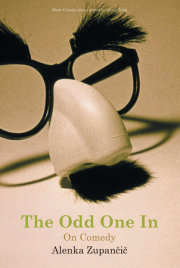
Consider sublimation—conventionally understood as a substitute satisfaction for missing sexual satisfaction. But what if, as Lacan claims, we can get exactly the same satisfaction that we get from sex from talking (or writing, painting, praying, or other activities)? The point is not to explain the satisfaction from talking by pointing to its sexual origin, but that the satisfaction from talking is itself sexual. The satisfaction from talking contains a key to sexual satisfaction (and not the other way around)—even a key to sexuality itself and its inherent contradictions. The Lacanian perspective would make the answer to the simple-seeming question, “What is sex?” rather more complex. In this volume in the Short Circuits series, Alenka Zupančič approaches the question from just this perspective, considering sexuality a properly philosophical problem for psychoanalysis; and by psychoanalysis, she means that of Freud and Lacan, not that of the kind of clinician practitioners called by Lacan “orthopedists of the unconscious.”
Zupančič argues that sexuality is at the point of a “short circuit” between ontology and epistemology. Sexuality and knowledge are structured around a fundamental negativity, which unites them at the point of the unconscious. The unconscious (as linked to sexuality) is the concept of an inherent link between being and knowledge in their very negativity.
Consider sublimation—conventionally understood as a substitute satisfaction for missing sexual satisfaction. But what if, as Lacan claims, we can get exactly the same satisfaction that we get from sex from talking (or writing, painting, praying, or other activities)? The point is not to explain the satisfaction from talking by pointing to its sexual origin, but that the satisfaction from talking is itself sexual. The satisfaction from talking contains a key to sexual satisfaction (and not the other way around)—even a key to sexuality itself and its inherent contradictions. The Lacanian perspective would make the answer to the simple-seeming question, “What is sex?” rather more complex. In this volume in the Short Circuits series, Alenka Zupančič approaches the question from just this perspective, considering sexuality a properly philosophical problem for psychoanalysis; and by psychoanalysis, she means that of Freud and Lacan, not that of the kind of clinician practitioners called by Lacan “orthopedists of the unconscious.”
Zupančič argues that sexuality is at the point of a “short circuit” between ontology and epistemology. Sexuality and knowledge are structured around a fundamental negativity, which unites them at the point of the unconscious. The unconscious (as linked to sexuality) is the concept of an inherent link between being and knowledge in their very negativity.
In celebration of Jewish American Heritage Month in May, we are sharing books by authors who share their individual stories, experiences, and lives. Find our full collection of books here.
For Mental Health Awareness Month in May, we are sharing books to educate and raise awareness about mental health and the various factors that may affect it, and to provide tools and resources for student wellness. Find our full collection of titles here.
Each May, we honor the stories, histories, and cultures of Asian Americans, Native Hawaiians, and Pacific Islanders. Below is a selection of acclaimed fiction and nonfiction books by AANHPI creators to share with your students this month and throughout the year. Find our full collection of titles for Higher Education here.