Books for Jewish American Heritage Month
In celebration of Jewish American Heritage Month in May, we are sharing books by authors who share their individual stories, experiences, and lives. Find our full collection of books here.
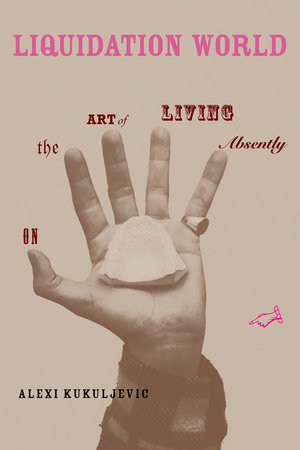
In Liquidation World, Alexi Kukuljevic examines a distinctive form of subjectivity animating the avant-garde: that of the darkly humorous and utterly disoriented subject of modernity, a dissolute figure that makes an art of its own vacancy, an object of its absence. Shorn of the truly rotten illusion that the world is a fulfilling and meaningful place, these subjects identify themselves by a paradoxical disidentification—through the objects that take their places. They have mastered the art of living absently, of making something with nothing. Traversing their own morbid obsessions, they substitute the nonsensical for sense, the ridiculous for the meaningful.
Kukuljevic analyzes a series of artistic practices that illuminate this subjectivity, ranging from Marcel Duchamp's Three Standard Stoppages to Charles Baudelaire's melancholia. He considers the paradox of Duchamp's apparatus in the Stoppages and the strange comedy of Marcel Broodthaers's relation to the readymade; the comic subject in Jacques Vaché and the ridiculous subject in Alfred Jarry; the nihilist in Paul Valéry's Monsieur Teste; Oswald Wiener's interpretation of the dandy; and Charles Baudelaire as a happy melancholic. Along the way, he also touches on the work of Thomas Bernhard, Andy Kaufman, Buster Keaton, and others. Finally, he offers an extended analysis of Danny's escape from his demented father in Stanley Kubrick's The Shining.
Each of these subjects is, in Freud's terms, sick—sick in the specific sense that they assume the absence of meaning and the liquidation of value in the world. They concern themselves with art, without assuming its value or meaning. Utterly debased, fundamentally disoriented, they take the void as their medium.

In Liquidation World, Alexi Kukuljevic examines a distinctive form of subjectivity animating the avant-garde: that of the darkly humorous and utterly disoriented subject of modernity, a dissolute figure that makes an art of its own vacancy, an object of its absence. Shorn of the truly rotten illusion that the world is a fulfilling and meaningful place, these subjects identify themselves by a paradoxical disidentification—through the objects that take their places. They have mastered the art of living absently, of making something with nothing. Traversing their own morbid obsessions, they substitute the nonsensical for sense, the ridiculous for the meaningful.
Kukuljevic analyzes a series of artistic practices that illuminate this subjectivity, ranging from Marcel Duchamp's Three Standard Stoppages to Charles Baudelaire's melancholia. He considers the paradox of Duchamp's apparatus in the Stoppages and the strange comedy of Marcel Broodthaers's relation to the readymade; the comic subject in Jacques Vaché and the ridiculous subject in Alfred Jarry; the nihilist in Paul Valéry's Monsieur Teste; Oswald Wiener's interpretation of the dandy; and Charles Baudelaire as a happy melancholic. Along the way, he also touches on the work of Thomas Bernhard, Andy Kaufman, Buster Keaton, and others. Finally, he offers an extended analysis of Danny's escape from his demented father in Stanley Kubrick's The Shining.
Each of these subjects is, in Freud's terms, sick—sick in the specific sense that they assume the absence of meaning and the liquidation of value in the world. They concern themselves with art, without assuming its value or meaning. Utterly debased, fundamentally disoriented, they take the void as their medium.
In celebration of Jewish American Heritage Month in May, we are sharing books by authors who share their individual stories, experiences, and lives. Find our full collection of books here.
For Mental Health Awareness Month in May, we are sharing books to educate and raise awareness about mental health and the various factors that may affect it, and to provide tools and resources for student wellness. Find our full collection of titles here.
Each May, we honor the stories, histories, and cultures of Asian Americans, Native Hawaiians, and Pacific Islanders. Below is a selection of acclaimed fiction and nonfiction books by AANHPI creators to share with your students this month and throughout the year. Find our full collection of titles for Higher Education here.