
Books for Jewish American Heritage Month
In celebration of Jewish American Heritage Month in May, we are sharing books by authors who share their individual stories, experiences, and lives. Find our full collection of books here.


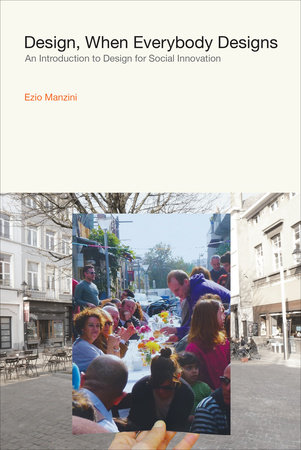
In a changing world everyone designs: each individual person and each collective subject, from enterprises to institutions, from communities to cities and regions, must define and enhance a life project. Sometimes these projects generate unprecedented solutions; sometimes they converge on common goals and realize larger transformations. As Ezio Manzini describes in this book, we are witnessing a wave of social innovations as these changes unfold—an expansive open co-design process in which new solutions are suggested and new meanings are created.
Manzini distinguishes between diffuse design (performed by everybody) and expert design (performed by those who have been trained as designers) and describes how they interact. He maps what design experts can do to trigger and support meaningful social changes, focusing on emerging forms of collaboration. These range from community-supported agriculture in China to digital platforms for medical care in Canada; from interactive storytelling in India to collaborative housing in Milan. These cases illustrate how expert designers can support these collaborations—making their existence more probable, their practice easier, their diffusion and their convergence in larger projects more effective. Manzini draws the first comprehensive picture of design for social innovation: the most dynamic field of action for both expert and nonexpert designers in the coming decades.
In a changing world everyone designs: each individual person and each collective subject, from enterprises to institutions, from communities to cities and regions, must define and enhance a life project. Sometimes these projects generate unprecedented solutions; sometimes they converge on common goals and realize larger transformations. As Ezio Manzini describes in this book, we are witnessing a wave of social innovations as these changes unfold—an expansive open co-design process in which new solutions are suggested and new meanings are created.
Manzini distinguishes between diffuse design (performed by everybody) and expert design (performed by those who have been trained as designers) and describes how they interact. He maps what design experts can do to trigger and support meaningful social changes, focusing on emerging forms of collaboration. These range from community-supported agriculture in China to digital platforms for medical care in Canada; from interactive storytelling in India to collaborative housing in Milan. These cases illustrate how expert designers can support these collaborations—making their existence more probable, their practice easier, their diffusion and their convergence in larger projects more effective. Manzini draws the first comprehensive picture of design for social innovation: the most dynamic field of action for both expert and nonexpert designers in the coming decades.


![Taking [A]part](https://images.penguinrandomhouse.com/cover/9780262552592?width=180)




In celebration of Jewish American Heritage Month in May, we are sharing books by authors who share their individual stories, experiences, and lives. Find our full collection of books here.
For Mental Health Awareness Month in May, we are sharing books to educate and raise awareness about mental health and the various factors that may affect it, and to provide tools and resources for student wellness. Find our full collection of titles here.
Each May, we honor the stories, histories, and cultures of Asian Americans, Native Hawaiians, and Pacific Islanders. Below is a selection of acclaimed fiction and nonfiction books by AANHPI creators to share with your students this month and throughout the year. Find our full collection of titles for Higher Education here.