
Books for Jewish American Heritage Month
In celebration of Jewish American Heritage Month in May, we are sharing books by authors who share their individual stories, experiences, and lives. Find our full collection of books here.


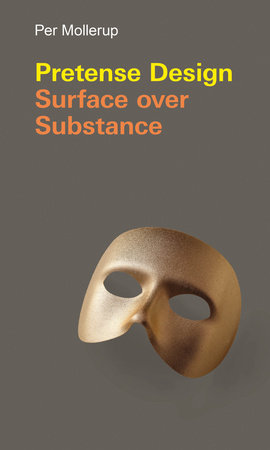
Pretense design pretends to be something that it is not. Pretense design includes all kinds of designed objects: a pair of glasses that looks like a fashion accessory rather than a medical necessity, a hotel in Las Vegas that simulates a Venetian ambience complete with canals and gondolas, boiler plates that look like steel but are vinyl. In this book, Danish designer Per Mollerup defines and describes a ubiquitous design category that until now has not had a name: designed objects with an intentional discrepancy between surface and substance, between appearance and reality. Pretense design, he shows us, is a type of material rhetoric; it is a way for physical objects to speak persuasively, most often to benefit users but sometimes to deceive them.
After explaining the means and the meanings of pretense design, Mollerup describes four pretense design applications, providing a range of examples for each: beautification, amusement, substitution, and deception. Beautification, he explains, includes sunless tanning, high heels, and even sporty accessories for a family car. Amusement includes forms of irrational otherness—columns that don't hold anything up, an old building's façade that hides a new building, a new Chinese town that mimics an old European town. Substitution pretends to be a natural thing: plastic laminate is a substitute for wood, Corian a substitute for marble, and prosthetics substitute for human organs. Deception doesn't just bend the truth; it suspends it. Soldiers wear camouflage to hide; hunters use decoys to attract their prey; malware hides in a harmless program only to wreak havoc on a user's computer. With Pretense Design, Per Mollerup adds a new concept to design thinking.
Pretense design pretends to be something that it is not. Pretense design includes all kinds of designed objects: a pair of glasses that looks like a fashion accessory rather than a medical necessity, a hotel in Las Vegas that simulates a Venetian ambience complete with canals and gondolas, boiler plates that look like steel but are vinyl. In this book, Danish designer Per Mollerup defines and describes a ubiquitous design category that until now has not had a name: designed objects with an intentional discrepancy between surface and substance, between appearance and reality. Pretense design, he shows us, is a type of material rhetoric; it is a way for physical objects to speak persuasively, most often to benefit users but sometimes to deceive them.
After explaining the means and the meanings of pretense design, Mollerup describes four pretense design applications, providing a range of examples for each: beautification, amusement, substitution, and deception. Beautification, he explains, includes sunless tanning, high heels, and even sporty accessories for a family car. Amusement includes forms of irrational otherness—columns that don't hold anything up, an old building's façade that hides a new building, a new Chinese town that mimics an old European town. Substitution pretends to be a natural thing: plastic laminate is a substitute for wood, Corian a substitute for marble, and prosthetics substitute for human organs. Deception doesn't just bend the truth; it suspends it. Soldiers wear camouflage to hide; hunters use decoys to attract their prey; malware hides in a harmless program only to wreak havoc on a user's computer. With Pretense Design, Per Mollerup adds a new concept to design thinking.


![Taking [A]part](https://images.penguinrandomhouse.com/cover/9780262552592?width=180)









In celebration of Jewish American Heritage Month in May, we are sharing books by authors who share their individual stories, experiences, and lives. Find our full collection of books here.
For Mental Health Awareness Month in May, we are sharing books to educate and raise awareness about mental health and the various factors that may affect it, and to provide tools and resources for student wellness. Find our full collection of titles here.
Each May, we honor the stories, histories, and cultures of Asian Americans, Native Hawaiians, and Pacific Islanders. Below is a selection of acclaimed fiction and nonfiction books by AANHPI creators to share with your students this month and throughout the year. Find our full collection of titles for Higher Education here.