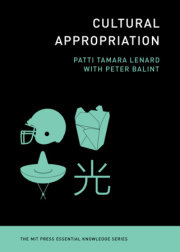

What cultural appropriation is, how it is deployed in public discourse, and if and when it is harmful.

What exactly is cultural appropriation? At one extreme are those commentators who suggest that any borrowing of elements outside of one’s own culture is cultural appropriation, and therefore, always wrong; at the other extreme, are those who argue that the history of human civilization just is cultural exchange, and therefore, never wrong. This book offers a clear and straightforward account of what cultural appropriation is, how it is deployed in public discourse, and if and when it is wrong.

Patti Tamara Lenard and Peter Balint define cultural appropriation as the non-consensual, knowing (or culpably ignorant) taking of something of cultural value, usually a symbol or a practice, to others. Alleged acts of cultural appropriation generate substantial contestation in public discourse. But the fact of contestation, over whether an act is in fact cultural appropriation, is not sufficient to mean that someone has done something wrong and thereby merits criticism. The authors show that there are particular conditions—including power imbalances and potential profit at the expense of the cultural group—under which cultural appropriation is inarguably wrong, and therefore, worthy of criticism.
Patti Tamara Lenard is Professor of Ethics in the Graduate School of Public and International Affairs, University of Ottawa.  She is the author of Democracy and Exclusion; Trust, Democracy and Multicultural Challenges; How Should Democracies Fight Terrorism?; Debating Multiculturalism (with Peter Balint); and Ordinary People, Extraordinary Actions.

Peter Balint was Associate Professor in International & Political Studies at UNSW Canberra. His books include Debating Multiculturalism (with Patti Tamara Lenard) and Respecting Toleration, which was awarded an APSA CRISP Prize in 2018.

About

What cultural appropriation is, how it is deployed in public discourse, and if and when it is harmful.

What exactly is cultural appropriation? At one extreme are those commentators who suggest that any borrowing of elements outside of one’s own culture is cultural appropriation, and therefore, always wrong; at the other extreme, are those who argue that the history of human civilization just is cultural exchange, and therefore, never wrong. This book offers a clear and straightforward account of what cultural appropriation is, how it is deployed in public discourse, and if and when it is wrong.

Patti Tamara Lenard and Peter Balint define cultural appropriation as the non-consensual, knowing (or culpably ignorant) taking of something of cultural value, usually a symbol or a practice, to others. Alleged acts of cultural appropriation generate substantial contestation in public discourse. But the fact of contestation, over whether an act is in fact cultural appropriation, is not sufficient to mean that someone has done something wrong and thereby merits criticism. The authors show that there are particular conditions—including power imbalances and potential profit at the expense of the cultural group—under which cultural appropriation is inarguably wrong, and therefore, worthy of criticism.

Author

Patti Tamara Lenard is Professor of Ethics in the Graduate School of Public and International Affairs, University of Ottawa.  She is the author of Democracy and Exclusion; Trust, Democracy and Multicultural Challenges; How Should Democracies Fight Terrorism?; Debating Multiculturalism (with Peter Balint); and Ordinary People, Extraordinary Actions.

Peter Balint was Associate Professor in International & Political Studies at UNSW Canberra. His books include Debating Multiculturalism (with Patti Tamara Lenard) and Respecting Toleration, which was awarded an APSA CRISP Prize in 2018.

Books for Women’s History Month

In honor of Women’s History Month in March, we are sharing books by women who have shaped history and have fought for their communities. Our list includes books about women who fought for racial justice, abortion rights, equality in the workplace, and ranges in topics from women in politics and prominent women in history to

Read more