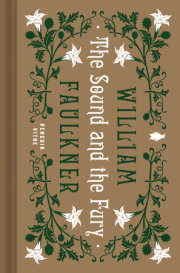

The Sound and the Fury

(Penguin Classics Deluxe Edition)

Introduction by Ayana Mathis
Look inside
Paperback
$19.00 US
On sale Jun 02, 2026 | 288 Pages | 9780143138853

See Additional Formats
The masterpiece of Nobel Prize winner William Faulkner, now in Penguin Classics for the first time, with a new introduction by Ayana Mathis, the New York Times bestselling author of The Twelve Tribes of Hattie

One of The Atlantic’s Great American Novels of the Past 100 Years

A Penguin Classics Deluxe Edition, with flaps and deckle-edged paper


The Sound and the Fury traces the decline of the American South through three generations of the once-powerful Compson family. In Yoknapatawpha County, Mississippi—perhaps the most famous fictional setting in American literature—antiquated ideas of race, class, and sex prevail among the erstwhile landed gentry of the Reconstruction-era South, embodied in the Compson siblings: Benjy, whose mental disability blurs the past and the present; Quentin, who is consumed by his obsession with his family’s honor; Jason, who unleashes his blind rage on the rest of the household, especially their longtime Black servant, Dilsey; and their elusive sister, Caddy, whose tragic estrangement sets in motion the family’s fall from grace. A kaleidoscopic narrative punctuated by haunting interior monologues, The Sound and the Fury brings to life Faulkner’s aristocratic South as a land of decadence and despair, gallantry and greed in the face of financial and moral ruin. What Faulkner once considered his “most splendid failure” was also his favorite of his novels; it now ranks among the greatest novels of the twentieth century, and as one of the cornerstones of American fiction.

Penguin Classics is the leading publisher of classic literature in the English-speaking world, representing a global bookshelf of the best works throughout history and across genres and disciplines. Readers trust the series to provide authoritative texts enhanced by introductions and notes by distinguished scholars and contemporary authors, as well as up-to-date translations by award-winning translators.
William Faulkner, one of the greatest writers of the twentieth century, was born in New Albany, Mississippi, on September 25, 1897. He published his first book, The Marble Faun, in 1924, but it is as a literary chronicler of life in the Deep South—particularly in the fictional Yoknapatawpha County, the setting for several of his novels—that he is most highly regarded. In such novels as The Sound and the FuryAs I Lay DyingLight in August, and Absalom, Absalom! he explored the full range of post–Civil War Southern life, focusing both on the personal histories of his characters and on the moral uncertainties of an increasingly dissolute society. In combining the use of symbolism with a stream-of-consciousness technique, he created a new approach to fiction writing. In 1949 he was awarded the Nobel Prize for Literature. William Faulkner died in Byhalia, Mississippi, on July 6, 1962. View titles by William Faulkner
“Astounding . . . Fiercely singular . . . With every new reading, it rewards my devotion by revealing some previously unseen nuance. . . . It is evergreen, as relevant today as when it was published nearly one hundred years ago. . . . It is beautiful. . . . Faulkner’s beauty is formidable, pugilistic even, it irrupts into our senses and sensibilities. . . . To read Faulkner is to grapple with the endlessly reverberating history described in his pages. . . . [His is] a voice that cuts through the detritus of false narrative, false history, false senses of self. A voice that tells us about who we are and who we have been, and warns us about where we are headed.” —Ayana Mathis, from the Introduction

About

The masterpiece of Nobel Prize winner William Faulkner, now in Penguin Classics for the first time, with a new introduction by Ayana Mathis, the New York Times bestselling author of The Twelve Tribes of Hattie

One of The Atlantic’s Great American Novels of the Past 100 Years

A Penguin Classics Deluxe Edition, with flaps and deckle-edged paper


The Sound and the Fury traces the decline of the American South through three generations of the once-powerful Compson family. In Yoknapatawpha County, Mississippi—perhaps the most famous fictional setting in American literature—antiquated ideas of race, class, and sex prevail among the erstwhile landed gentry of the Reconstruction-era South, embodied in the Compson siblings: Benjy, whose mental disability blurs the past and the present; Quentin, who is consumed by his obsession with his family’s honor; Jason, who unleashes his blind rage on the rest of the household, especially their longtime Black servant, Dilsey; and their elusive sister, Caddy, whose tragic estrangement sets in motion the family’s fall from grace. A kaleidoscopic narrative punctuated by haunting interior monologues, The Sound and the Fury brings to life Faulkner’s aristocratic South as a land of decadence and despair, gallantry and greed in the face of financial and moral ruin. What Faulkner once considered his “most splendid failure” was also his favorite of his novels; it now ranks among the greatest novels of the twentieth century, and as one of the cornerstones of American fiction.

Penguin Classics is the leading publisher of classic literature in the English-speaking world, representing a global bookshelf of the best works throughout history and across genres and disciplines. Readers trust the series to provide authoritative texts enhanced by introductions and notes by distinguished scholars and contemporary authors, as well as up-to-date translations by award-winning translators.

Author

William Faulkner, one of the greatest writers of the twentieth century, was born in New Albany, Mississippi, on September 25, 1897. He published his first book, The Marble Faun, in 1924, but it is as a literary chronicler of life in the Deep South—particularly in the fictional Yoknapatawpha County, the setting for several of his novels—that he is most highly regarded. In such novels as The Sound and the FuryAs I Lay DyingLight in August, and Absalom, Absalom! he explored the full range of post–Civil War Southern life, focusing both on the personal histories of his characters and on the moral uncertainties of an increasingly dissolute society. In combining the use of symbolism with a stream-of-consciousness technique, he created a new approach to fiction writing. In 1949 he was awarded the Nobel Prize for Literature. William Faulkner died in Byhalia, Mississippi, on July 6, 1962. View titles by William Faulkner

Praise

“Astounding . . . Fiercely singular . . . With every new reading, it rewards my devotion by revealing some previously unseen nuance. . . . It is evergreen, as relevant today as when it was published nearly one hundred years ago. . . . It is beautiful. . . . Faulkner’s beauty is formidable, pugilistic even, it irrupts into our senses and sensibilities. . . . To read Faulkner is to grapple with the endlessly reverberating history described in his pages. . . . [His is] a voice that cuts through the detritus of false narrative, false history, false senses of self. A voice that tells us about who we are and who we have been, and warns us about where we are headed.” —Ayana Mathis, from the Introduction

Books for Asian American, Native Hawaiian, and Pacific Islander Heritage Month

Each May, we honor the stories, histories, and cultures of Asian Americans, Native Hawaiians, and Pacific Islanders. Below is a selection of acclaimed fiction and nonfiction books by AANHPI creators to share with your students this month and throughout the year. Find our full collection of titles for Higher Education here.


Read more