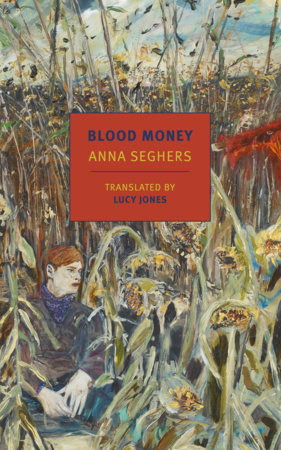

Blood Money

Translated by Lucy Jones
Paperback
$16.95 US
On sale Sep 22, 2026 | 192 Pages | 9798896230489

See Additional Formats
A chilling novel about early Nazism in Germany through the eyes of a wrongfully accused young man, this novel from the 1930s provides a prescient look at the ways ordinary people are seduced by Fascism, to the point of betraying their neighbors.

It’s the summer of 1932, and Yohann Schulz is accused of killing a police officer during a demonstration. Wanted for murder, Schulz leaves the city to seek shelter with his relatives in a small village on the Rhine. But the Nazis are beginning to recruit there, and it’s only a matter of time before the price on his head is too great a temptation for the villagers.

Blood Money, a novel of suspense and political upheaval, tracks the nascent rise of the Hitler movement in a German village. Anna Seghers began the novel in 1932 and completed it in exile a year later, after she was blacklisted in Germany and forced to leave. Her prescience about the destructive power of the ascending party is expressed by her characteristically dispassionate and direct description of the way things were, as if this sea change in society were part of a natural process: the old farmers disinterested, then capitulating; the young entranced by the promise of action and the rare chance at advancement.
Anna Seghers (1900-1983) was born in Mainz, Germany, into an upper-middle-class Jewish family. She published her first story in 1924 and received the Kleist Prize for her first novel, The Revolt of the Fishermen, in 1929. After World War II she moved to East Berlin, where she became an emblematic figure of East German letters, actively championing the work of younger writers from her position as president of the Writers Union and publishing at a steady pace. Transit, The Seventh Cross, and The Dead Girls' Class Trip: Selected Stories are also available from NYRB Classics.

Translator and writer Lucy Jones has lived in Berlin since the late 1990s where she founded the translators’ collective Transfiction in 2008. She has translated the works of Brigitte Reimann, Theresia Enzensberger, and Anke Stelling, among others.

About

A chilling novel about early Nazism in Germany through the eyes of a wrongfully accused young man, this novel from the 1930s provides a prescient look at the ways ordinary people are seduced by Fascism, to the point of betraying their neighbors.

It’s the summer of 1932, and Yohann Schulz is accused of killing a police officer during a demonstration. Wanted for murder, Schulz leaves the city to seek shelter with his relatives in a small village on the Rhine. But the Nazis are beginning to recruit there, and it’s only a matter of time before the price on his head is too great a temptation for the villagers.

Blood Money, a novel of suspense and political upheaval, tracks the nascent rise of the Hitler movement in a German village. Anna Seghers began the novel in 1932 and completed it in exile a year later, after she was blacklisted in Germany and forced to leave. Her prescience about the destructive power of the ascending party is expressed by her characteristically dispassionate and direct description of the way things were, as if this sea change in society were part of a natural process: the old farmers disinterested, then capitulating; the young entranced by the promise of action and the rare chance at advancement.

Author

Anna Seghers (1900-1983) was born in Mainz, Germany, into an upper-middle-class Jewish family. She published her first story in 1924 and received the Kleist Prize for her first novel, The Revolt of the Fishermen, in 1929. After World War II she moved to East Berlin, where she became an emblematic figure of East German letters, actively championing the work of younger writers from her position as president of the Writers Union and publishing at a steady pace. Transit, The Seventh Cross, and The Dead Girls' Class Trip: Selected Stories are also available from NYRB Classics.

Translator and writer Lucy Jones has lived in Berlin since the late 1990s where she founded the translators’ collective Transfiction in 2008. She has translated the works of Brigitte Reimann, Theresia Enzensberger, and Anke Stelling, among others.