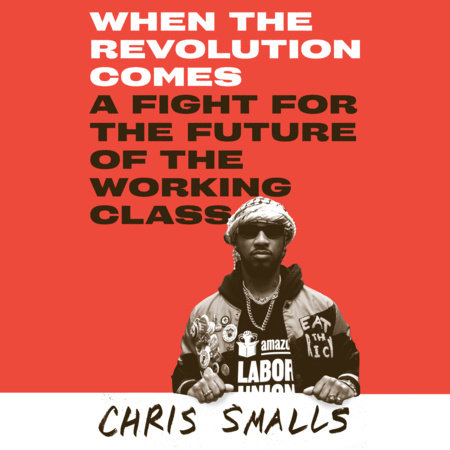
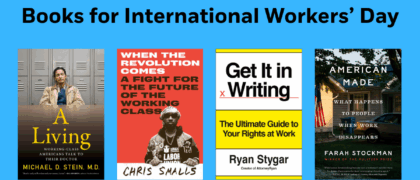
When the Revolution Comes

A Fight for the Future of the Working Class

Author Chris Smalls On Tour
Audiobook Download
On sale Jun 02, 2026 | 9 Hours and 0 Minutes | 9798217340453

See Additional Formats
From one of the most electric and consequential figures to emerge from the contemporary American labor movement, the remarkable story of his battle to create the first Amazon union in the U.S. and a powerful call to arms on behalf of the working class

“With candor and fierce moral clarity, Chris Smalls takes readers behind the scenes of the most consequential labor uprising in modern history—and it’s one hell of a ride.” —Jessica Bruder, author of Nomadland


In the early days of the COVID pandemic, warehouse worker Chris Smalls and his colleagues continued showing up as the rest of the world was shutting down. A dedicated and experienced Amazon employee, increasingly frustrated by the inner workings of the retail giant, Smalls had already felt himself reaching a breaking point. So when coworkers around him began falling ill, and with no transparency or assurances of safety coming from those in charge, he made the only choice left available to him. He staged a walkout with friend Derrick Palmer, eventually finding himself on the picket line without a job. But what began as a demand to keep essential employees safe in a crisis would grow into a movement devoted to achieving dignity and security for the American wageworker, sparking a groundswell of organizers at the most notable companies across the nation—including Starbucks, Trader Joe's, and Apple—and leading to lasting change for labor.

When the Revolution Comes is the riveting inside story of how a young Black man from Hackensack, New Jersey with few to no resources, led a scrappy band of Staten Island warehouse workers in an improbable fight against Amazon, the second largest private employer in the United States, and won. This epic David and Goliath tale follows Smalls from a childhood spent navigating his dad’s stints in and out of prison, to his years of sacrifice and economic uncertainty as a father of three, to his ascension as the leader of a new generation’s labor movement.

A deeply personal and eye-opening account of the creation of the Amazon Labor Union, When the Revolution Comes offers both a searing exposé of what it’s like to be working class in America and inspiring evidence of what is possible when the overworked, underpaid, and disempowered join together, a movement born in community.
Prologue

Jobs

Have you ever been inside a grocery warehouse? I don’t mean a Grocery Outlet or Costco or Sam’s Club. I mean a real grocery warehouse. One of those buildings that’s close to a million square feet, where driving a car from one end to the other would take a few minutes, where the ceiling is so high you would need glasses to see what’s up there and the tempera­ture can vary as much as sixty degrees from one section to the next. A building where tens of thousands of boxes of barbecue sauce, grapes, coconut water, chicken thighs, turbinado sugar, oat milk, cupcakes, soy sauce, jalapeño peppers, fusilli noodles, paper towels, microwave burritos, and everything else you could possibly want from a grocery store is piled on shelves that seem to reach the sky and go on farther than the eye can see? You ever been in one of those? Most people haven’t. Everyone knows that food comes from farms and is carried to stores on trucks. But very few people think about this step of the supply chain, which happens in a room as big as a city block, filled from floor to ceiling with boxes.

I only know about it because I worked in a grocery warehouse once. It was one of many jobs I have had in enormous warehouses and fulfillment centers. This was not the line of work I planned to go into, of course. It’s not really the line of work anyone plans to go into. For a while, I thought I was going to be an athlete. Maybe football or track. I was good at both. Then I was going to be a rapper or a music executive. Now that seemed like the perfect job for me. I was always good at talking, at leading people and connecting. I always had a vision for how things could be bigger, better than they are now. I always loved interacting with people, hearing their stories, cracking jokes, and making friends.

And I was always the kind of person people paid attention to, whether I wanted them to or not. It’s like I would walk into a room and suddenly eyes would be on me. Some people don’t like that about me. But early on I recognized it as a gift that I needed to make the best of. I didn’t necessarily always like it, but I embraced it.

What else can you do? You have to embrace what’s true. I never saw any need to dim my light just for other people to feel better.

But one thing about life is that things don’t always go the way you want. In the end, sports didn’t work out. Rap super­stardom didn’t work out. And eventually, I had a wife and kids at home—a family depending on my paycheck. So, like most people in that situation, I went out and worked any job I could get.

I worked in big-box stores and stadiums and factories and distribution centers and warehouses, and at temp jobs you could get only if you showed up at the agency at five in the morning and waited hours, just hoping and praying that someone would send you out to earn a paycheck that day. And if they didn’t, you just went home and looked your wife and kids in the eye. You told them you didn’t make a single dollar that day and hoped and prayed tomorrow would be different. You hoped it would because it had to be.

It was during this time, somewhere in my mid-twenties, that I got a job as an order selector at a food warehouse. When the orders came in from grocery stores and bodegas, the ware­house supervisor gave them to the selector, whose job it was to go around the big-ass warehouse and gather the food to fulfill them. Grocery stores would place an order with the distribu­tor: fifteen boxes of cat food, ten gallons of milk, thirty-five half gallons, three packs of black beans, twenty-four each, four of red, and so on. It went on and on until there was enough stuff to stock the store.

There are anywhere between sixty and a hundred aisles in these warehouses, and order selectors typically have either a motorized jack or a small forklift, sometimes called a hi-lo, to get around. They ride the lift to whichever aisle has the product they need, hop off, grab the box or boxes—which can be any­where between ten and sixty pounds—stack them on the pallet, and hop back onto the hi-lo before moving on to the next aisle.

Once the pallet is stacked to a little over six feet tall, you walk around the whole thing, wrapping it up with this big roll of plastic tape, almost like industrial-strength Saran wrap. Then you deliver it to the loading dock, where other workers put it on a truck to be delivered to the customer. That’s the job.

Seems easy enough, right?

But the twist is you have to do it at top speed for the entire eight-hour shift. Your job depends on it. You are responsible for a certain number of orders per hour, and shift supervisors track your productivity down to the minute. Running from aisle to aisle takes time, but what most newbies mess up is that they don’t know how to pack the pallet right the first time. They might throw a box of napkins and a few boxes of chips onto the pallet because those are the closest. Then, fifteen minutes later, they realize that there are two twenty-four-pack boxes of ketchup bottles on the manifest that are way heavier. They can’t put those on top of the napkins, so they have to rearrange the pallet. This rearranging costs time, and believe me when I say that every second counts. You are being watched. Meanwhile, you are trying to move as quickly as possible, as efficiently as possible, and stack your pallets as perfectly as possible, because the fuller the pallet gets, the more unstable it becomes, making it likely that it will tip over as you turn corners to the next aisle. In some warehouses, you can fix this by wrapping as you go, but in the one where I worked, there was a limit to how much wrapping tape you were given. You had to make it last the entire shift, so you couldn’t wrap as you went. You had to stack per­fectly. And if you didn’t, if you dropped all or part of an order, that was a problem. Each pallet contained thousands of dollars’ worth of items, and if you broke anything, you paid for it.

That was your day: run through the aisles, grab the boxes, stack them over your head, do it perfectly, and do it fast, over and over again. If your productivity was below 90 percent, you weren’t eligible for union benefits. And if you weren’t eligible for union benefits, you weren’t eligible for things like paid sick leave and health care for you and your family.

It’s an athletic job. I don’t say that lightly. I played basketball, a little football, and I was the captain of my high school track team. So, believe me when I tell you that picking was real ath­letic work. Physical. Repetitive. Dangerous. And because there are supervisors watching your every move and a giant clock in your head tracking every moment, it’s also stressful.

I was one of the youngest dudes in there when I started that job. Maybe twenty-four or twenty-five. Most people were in their thirties or forties. I got stuck on the graveyard shift as most rookies do. I would get off at 7:00 a.m. or 8:30 a.m., if I was assigned mandatory overtime. Then I would go home and take the kids to school. I had another job working with my brother at a tile factory during the day. So, after dropping off the kids, I would go to that job, come back home for a short nap, eat din­ner, and then head to my night shift at the grocery warehouse. Rinse and repeat. It was a brutal schedule, but we didn’t have any other way to make ends meet.

The environment of the graveyard shift was like nothing I had ever seen, and it wasn’t because I hadn’t been around. I’d been working since I was sixteen. I had been in places that were tough, and places where dudes just couldn’t take it, just quit in the middle of a shift in tears because the work was so hard. That part was wild, but it was not new. I had seen that at FedEx. What was wild at this place was the intensity among the work­ers and on the floor.
© Kennedi Carter
Chris Smalls is the co-founder and former president of the Amazon Labor Union. Under his leadership, the ALU successfully unionized an Amazon warehouse: a historic victory for workers' rights in America. A Fortune “40 Under 40” honoree, he was named to the Time 100 list of the most influential people of 2022, alongside his fellow union organizer Derrick Palmer. When the Revolution Comes is his first book. View titles by Chris Smalls
One of Lit Hub’s Most Anticipated Books of the Year

“With candor and fierce moral clarity, Chris Smalls takes readers behind the scenes of the most consequential labor uprising in modern history—and it’s one hell of a ride. What begins as a gripping personal narrative grows into a blueprint for worker-led resistance, full of stubborn hope and a timely reminder of what ordinary people can achieve, if only we come together.”­ —Jessica Bruder, author of Nomadland: Surviving America in the Twenty-First Century

“Reading this wonderful book, I can hear Chris Smalls's powerful voice as he exposes the abominable exploitation of young workers in the online retail sector. This book provides inspiration and hope for so many who have been ground down by corruption and poverty.”—Jeremy Corbyn

When The Revolution Comes is an honest, courageous, painful, and wildly inspiring story of one man's journey to make what seemed impossible, possible. Smalls leaves us with one of the most important lessons of social change—when we refuse to accept injustice, every day, and everywhere, for ourselves and for others, remarkable and transformative change is not only possible, it is inevitable.” —Alicia Garza, author of The Purpose of Power: How We Come Together When We Fall Apart

“Chris Smalls is the everyman: a hard-working American who discovers that his ambition, his Blackness—and even his hope—threaten the multi-billion dollar corporations calling the shots in the U.S. An intimate and heartbreaking account.” —Rachel Slade, author of Making It in America: The Almost Impossible Quest to Manufacture in the U.S.A. (And How It Got That Way)

“Smalls is a tireless advocate for everyday workers, unafraid to speak truth to power: whether it’s standing up to corporate giants or calling out political leaders who fail to make good on their word. His clarity of vision and tenacity of approach are apparent on every page of this galvanizing story, which is nothing short of a clarion call for what we can achieve when we band together.”— Ericka Hart, author of Nasty Work: Resist Systems, Explore Desire, Liberate Yourself

“Chris Smalls has given us one of the best autobiographies in American labor history, revealing with truth and humility the emerging consciousness of a young progressive, then elucidating with care the myriad challenges of a grassroots battle for workers' rights, one that has made him an inspiration to that struggle around the world.”—Philip Dray, author of There is Power in a Union: The Epic Story of Labor in America

When the Revolution Comes is, like its author, vibrant and captivating. This highly readable account braids the story of Smalls' rough but lively youth with fresh insights about being working class and Black in America. The party promoter-turned warehouse worker-turned activist’s twisty memoir culminates with his recent labor organizing, which gave him a new sense of meaning. That feeling—of solidarity and power—is then transmitted to the reader. Smalls’ book is a rare combination—a unionist how-to and a rollicking yarn about finding your true self in unexpected places.”—Alissa Quart, author of Squeezed: Why Our Families Can’t Afford America

“In an age of cloud serfdom, Chris Smalls is Prometheus unbound. His book is our instruction manual for cutting Amazon’s knot and reclaiming hope and dignity.”—Yanis Varoufakis, author of Technofeudalism: What Killed Capitalism

“Delivers a powerful message, highlighting the injustices faced by many workers in large corporations. Smalls’ evolution—from organizing social gatherings to leading a coalition of workers—is both inspiring and significant, making this an important read for anyone interested in labor politics and history and the harsh realities of the workplace.”—Booklist

“Smalls’s plainspoken narrative . . . offers a fascinating glimpse behind the curtain of American labor organizing. It’s an inspiring self-portrait.”Publishers Weekly

“An absorbing account of work—and unlikely organizing victories—at one of the world’s most powerful companies.”Kirkus

“Smalls is a true inspiration.”—Lit Hub

About

From one of the most electric and consequential figures to emerge from the contemporary American labor movement, the remarkable story of his battle to create the first Amazon union in the U.S. and a powerful call to arms on behalf of the working class

“With candor and fierce moral clarity, Chris Smalls takes readers behind the scenes of the most consequential labor uprising in modern history—and it’s one hell of a ride.” —Jessica Bruder, author of Nomadland


In the early days of the COVID pandemic, warehouse worker Chris Smalls and his colleagues continued showing up as the rest of the world was shutting down. A dedicated and experienced Amazon employee, increasingly frustrated by the inner workings of the retail giant, Smalls had already felt himself reaching a breaking point. So when coworkers around him began falling ill, and with no transparency or assurances of safety coming from those in charge, he made the only choice left available to him. He staged a walkout with friend Derrick Palmer, eventually finding himself on the picket line without a job. But what began as a demand to keep essential employees safe in a crisis would grow into a movement devoted to achieving dignity and security for the American wageworker, sparking a groundswell of organizers at the most notable companies across the nation—including Starbucks, Trader Joe's, and Apple—and leading to lasting change for labor.

When the Revolution Comes is the riveting inside story of how a young Black man from Hackensack, New Jersey with few to no resources, led a scrappy band of Staten Island warehouse workers in an improbable fight against Amazon, the second largest private employer in the United States, and won. This epic David and Goliath tale follows Smalls from a childhood spent navigating his dad’s stints in and out of prison, to his years of sacrifice and economic uncertainty as a father of three, to his ascension as the leader of a new generation’s labor movement.

A deeply personal and eye-opening account of the creation of the Amazon Labor Union, When the Revolution Comes offers both a searing exposé of what it’s like to be working class in America and inspiring evidence of what is possible when the overworked, underpaid, and disempowered join together, a movement born in community.

Excerpt

Prologue

Jobs

Have you ever been inside a grocery warehouse? I don’t mean a Grocery Outlet or Costco or Sam’s Club. I mean a real grocery warehouse. One of those buildings that’s close to a million square feet, where driving a car from one end to the other would take a few minutes, where the ceiling is so high you would need glasses to see what’s up there and the tempera­ture can vary as much as sixty degrees from one section to the next. A building where tens of thousands of boxes of barbecue sauce, grapes, coconut water, chicken thighs, turbinado sugar, oat milk, cupcakes, soy sauce, jalapeño peppers, fusilli noodles, paper towels, microwave burritos, and everything else you could possibly want from a grocery store is piled on shelves that seem to reach the sky and go on farther than the eye can see? You ever been in one of those? Most people haven’t. Everyone knows that food comes from farms and is carried to stores on trucks. But very few people think about this step of the supply chain, which happens in a room as big as a city block, filled from floor to ceiling with boxes.

I only know about it because I worked in a grocery warehouse once. It was one of many jobs I have had in enormous warehouses and fulfillment centers. This was not the line of work I planned to go into, of course. It’s not really the line of work anyone plans to go into. For a while, I thought I was going to be an athlete. Maybe football or track. I was good at both. Then I was going to be a rapper or a music executive. Now that seemed like the perfect job for me. I was always good at talking, at leading people and connecting. I always had a vision for how things could be bigger, better than they are now. I always loved interacting with people, hearing their stories, cracking jokes, and making friends.

And I was always the kind of person people paid attention to, whether I wanted them to or not. It’s like I would walk into a room and suddenly eyes would be on me. Some people don’t like that about me. But early on I recognized it as a gift that I needed to make the best of. I didn’t necessarily always like it, but I embraced it.

What else can you do? You have to embrace what’s true. I never saw any need to dim my light just for other people to feel better.

But one thing about life is that things don’t always go the way you want. In the end, sports didn’t work out. Rap super­stardom didn’t work out. And eventually, I had a wife and kids at home—a family depending on my paycheck. So, like most people in that situation, I went out and worked any job I could get.

I worked in big-box stores and stadiums and factories and distribution centers and warehouses, and at temp jobs you could get only if you showed up at the agency at five in the morning and waited hours, just hoping and praying that someone would send you out to earn a paycheck that day. And if they didn’t, you just went home and looked your wife and kids in the eye. You told them you didn’t make a single dollar that day and hoped and prayed tomorrow would be different. You hoped it would because it had to be.

It was during this time, somewhere in my mid-twenties, that I got a job as an order selector at a food warehouse. When the orders came in from grocery stores and bodegas, the ware­house supervisor gave them to the selector, whose job it was to go around the big-ass warehouse and gather the food to fulfill them. Grocery stores would place an order with the distribu­tor: fifteen boxes of cat food, ten gallons of milk, thirty-five half gallons, three packs of black beans, twenty-four each, four of red, and so on. It went on and on until there was enough stuff to stock the store.

There are anywhere between sixty and a hundred aisles in these warehouses, and order selectors typically have either a motorized jack or a small forklift, sometimes called a hi-lo, to get around. They ride the lift to whichever aisle has the product they need, hop off, grab the box or boxes—which can be any­where between ten and sixty pounds—stack them on the pallet, and hop back onto the hi-lo before moving on to the next aisle.

Once the pallet is stacked to a little over six feet tall, you walk around the whole thing, wrapping it up with this big roll of plastic tape, almost like industrial-strength Saran wrap. Then you deliver it to the loading dock, where other workers put it on a truck to be delivered to the customer. That’s the job.

Seems easy enough, right?

But the twist is you have to do it at top speed for the entire eight-hour shift. Your job depends on it. You are responsible for a certain number of orders per hour, and shift supervisors track your productivity down to the minute. Running from aisle to aisle takes time, but what most newbies mess up is that they don’t know how to pack the pallet right the first time. They might throw a box of napkins and a few boxes of chips onto the pallet because those are the closest. Then, fifteen minutes later, they realize that there are two twenty-four-pack boxes of ketchup bottles on the manifest that are way heavier. They can’t put those on top of the napkins, so they have to rearrange the pallet. This rearranging costs time, and believe me when I say that every second counts. You are being watched. Meanwhile, you are trying to move as quickly as possible, as efficiently as possible, and stack your pallets as perfectly as possible, because the fuller the pallet gets, the more unstable it becomes, making it likely that it will tip over as you turn corners to the next aisle. In some warehouses, you can fix this by wrapping as you go, but in the one where I worked, there was a limit to how much wrapping tape you were given. You had to make it last the entire shift, so you couldn’t wrap as you went. You had to stack per­fectly. And if you didn’t, if you dropped all or part of an order, that was a problem. Each pallet contained thousands of dollars’ worth of items, and if you broke anything, you paid for it.

That was your day: run through the aisles, grab the boxes, stack them over your head, do it perfectly, and do it fast, over and over again. If your productivity was below 90 percent, you weren’t eligible for union benefits. And if you weren’t eligible for union benefits, you weren’t eligible for things like paid sick leave and health care for you and your family.

It’s an athletic job. I don’t say that lightly. I played basketball, a little football, and I was the captain of my high school track team. So, believe me when I tell you that picking was real ath­letic work. Physical. Repetitive. Dangerous. And because there are supervisors watching your every move and a giant clock in your head tracking every moment, it’s also stressful.

I was one of the youngest dudes in there when I started that job. Maybe twenty-four or twenty-five. Most people were in their thirties or forties. I got stuck on the graveyard shift as most rookies do. I would get off at 7:00 a.m. or 8:30 a.m., if I was assigned mandatory overtime. Then I would go home and take the kids to school. I had another job working with my brother at a tile factory during the day. So, after dropping off the kids, I would go to that job, come back home for a short nap, eat din­ner, and then head to my night shift at the grocery warehouse. Rinse and repeat. It was a brutal schedule, but we didn’t have any other way to make ends meet.

The environment of the graveyard shift was like nothing I had ever seen, and it wasn’t because I hadn’t been around. I’d been working since I was sixteen. I had been in places that were tough, and places where dudes just couldn’t take it, just quit in the middle of a shift in tears because the work was so hard. That part was wild, but it was not new. I had seen that at FedEx. What was wild at this place was the intensity among the work­ers and on the floor.

Author

© Kennedi Carter
Chris Smalls is the co-founder and former president of the Amazon Labor Union. Under his leadership, the ALU successfully unionized an Amazon warehouse: a historic victory for workers' rights in America. A Fortune “40 Under 40” honoree, he was named to the Time 100 list of the most influential people of 2022, alongside his fellow union organizer Derrick Palmer. When the Revolution Comes is his first book. View titles by Chris Smalls

Praise

One of Lit Hub’s Most Anticipated Books of the Year

“With candor and fierce moral clarity, Chris Smalls takes readers behind the scenes of the most consequential labor uprising in modern history—and it’s one hell of a ride. What begins as a gripping personal narrative grows into a blueprint for worker-led resistance, full of stubborn hope and a timely reminder of what ordinary people can achieve, if only we come together.”­ —Jessica Bruder, author of Nomadland: Surviving America in the Twenty-First Century

“Reading this wonderful book, I can hear Chris Smalls's powerful voice as he exposes the abominable exploitation of young workers in the online retail sector. This book provides inspiration and hope for so many who have been ground down by corruption and poverty.”—Jeremy Corbyn

When The Revolution Comes is an honest, courageous, painful, and wildly inspiring story of one man's journey to make what seemed impossible, possible. Smalls leaves us with one of the most important lessons of social change—when we refuse to accept injustice, every day, and everywhere, for ourselves and for others, remarkable and transformative change is not only possible, it is inevitable.” —Alicia Garza, author of The Purpose of Power: How We Come Together When We Fall Apart

“Chris Smalls is the everyman: a hard-working American who discovers that his ambition, his Blackness—and even his hope—threaten the multi-billion dollar corporations calling the shots in the U.S. An intimate and heartbreaking account.” —Rachel Slade, author of Making It in America: The Almost Impossible Quest to Manufacture in the U.S.A. (And How It Got That Way)

“Smalls is a tireless advocate for everyday workers, unafraid to speak truth to power: whether it’s standing up to corporate giants or calling out political leaders who fail to make good on their word. His clarity of vision and tenacity of approach are apparent on every page of this galvanizing story, which is nothing short of a clarion call for what we can achieve when we band together.”— Ericka Hart, author of Nasty Work: Resist Systems, Explore Desire, Liberate Yourself

“Chris Smalls has given us one of the best autobiographies in American labor history, revealing with truth and humility the emerging consciousness of a young progressive, then elucidating with care the myriad challenges of a grassroots battle for workers' rights, one that has made him an inspiration to that struggle around the world.”—Philip Dray, author of There is Power in a Union: The Epic Story of Labor in America

When the Revolution Comes is, like its author, vibrant and captivating. This highly readable account braids the story of Smalls' rough but lively youth with fresh insights about being working class and Black in America. The party promoter-turned warehouse worker-turned activist’s twisty memoir culminates with his recent labor organizing, which gave him a new sense of meaning. That feeling—of solidarity and power—is then transmitted to the reader. Smalls’ book is a rare combination—a unionist how-to and a rollicking yarn about finding your true self in unexpected places.”—Alissa Quart, author of Squeezed: Why Our Families Can’t Afford America

“In an age of cloud serfdom, Chris Smalls is Prometheus unbound. His book is our instruction manual for cutting Amazon’s knot and reclaiming hope and dignity.”—Yanis Varoufakis, author of Technofeudalism: What Killed Capitalism

“Delivers a powerful message, highlighting the injustices faced by many workers in large corporations. Smalls’ evolution—from organizing social gatherings to leading a coalition of workers—is both inspiring and significant, making this an important read for anyone interested in labor politics and history and the harsh realities of the workplace.”—Booklist

“Smalls’s plainspoken narrative . . . offers a fascinating glimpse behind the curtain of American labor organizing. It’s an inspiring self-portrait.”Publishers Weekly

“An absorbing account of work—and unlikely organizing victories—at one of the world’s most powerful companies.”Kirkus

“Smalls is a true inspiration.”—Lit Hub

Books for Asian American, Native Hawaiian, and Pacific Islander Heritage Month

Each May, we honor the stories, histories, and cultures of Asian Americans, Native Hawaiians, and Pacific Islanders. Below is a selection of acclaimed fiction and nonfiction books by AANHPI creators to share with your students this month and throughout the year. Find our full collection of titles for Higher Education here.

Read more