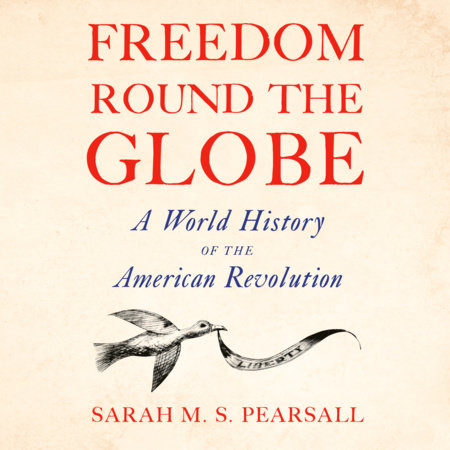
In a groundbreaking global exploration of the ideas that drove the American Revolution, a prize-winning historian shines a light on the defiance of marginalized peoples all over the world.

In her powerful new history of the American Revolution, Sarah M. S. Pearsall argues that the American Founding Fathers did not have a unique claim on the revolutionary spirit. The thirteen colonies that became the United States, she reminds us, were not even half of the British colonies that existed in the eighteenth century. In her sparkling and original Freedom Round the Globe, Pearsall uncovers the insurgents, freedom lovers, and dreamers in India, West Africa, North America, Europe, China, and West Indian islands who shaped the nature of American rebellion and nationhood.

In each fresh and compelling chapter of Freedom Round the Globe, Pearsall plucks a keyword from the Declaration of Independence—security, happiness, respect-- finding its spark in a far-flung place. In an Edinburgh club where women were first invited into philosophical conversations, she explores what the pursuit of happiness meant to women and men of all sorts. She traces how novel forms of slavery provoked a new use of the word liberty in Connecticut petitions as well as in cries of “liberty or death.” On a Kolkata street where Indians protested relentless taxes, Pearsall finds a critique of oppressive imperial government that galvanized Americans in their protests and parties against the tea of the English East India Company. In rural Germany, boy soldiers sent abroad to die for Britain complicate who can lay claim to being civilized in a brutal war.

In telling the extraordinary tales of Friends of Liberty protesting tyranny around the world, Pearsall restores these individuals and movements to their rightful place in the vital story of the American Revolution and the nation it created. The result is a stirring and surprising revisioning of our history.


* This audiobook edition includes a downloadable PDF of the Notes section, as well as images mentioned throughout the book.
Chapter 1

A Gallows in Bkejwanong

Unity

As her world tilted and disappeared, the last buildings she would have seen were the church, the bakery, the artillery magazine, and a few houses along Rue St. Antoine. She would also have seen the crowd. For an enslaved woman who had probably spent much of her life shrinking into the background, trying to avoid attention—a scold or a slap from a mistress, a master’s unwelcome hand (or worse) in places she did not want it—it must have been disconcerting to be thrust into the spotlight. There were so many faces turned toward her. There were women like her—some Indigenous and some African—looking sorrowful in their coarse linen shifts, huddling together. Their masters stood nearby, traders in thick mantle coats with handkerchiefs wrapped round their heads, smoking and chatting in French. Red-coated soldiers, stiff and solemn, called out orders in English. The fathers, faces ruddy, prayed in Latin for her soul, black robes flapping in the wind. Mothers with babies on their backs set down their heavy baskets for a bit, soothing their children with soft words in Potawatomi. A few of the little ones chased the chickens wandering around. No one wanted to stand behind the commanding warriors, draped in blankets and furs, brass hoops in their earlobes, medals and wampum on their strong chests, silver armbands glinting in the light. The feathers on their shaved heads made them even taller, blocking the view. They probably clustered at the back, speaking low in Odawa, glowering at the dogs clothed in red.

Those red-coated officials hanged the woman, but they didn’t bother to record her name. That was British imperial justice in 1763. She had at least one name, probably more, but we don’t know them, and probably never will. She was a daughter, likely a sister—among people for whom siblings mattered a great deal—and perhaps a mother. Yet she lacked the protection of family because her kin ties had already been broken. She was what they called a “Panis” Indian, which meant, more or less, a slave. Her fellow accused Panis had already made his escape “to the Illinois,” leaving her to face the scaffold on her own. The two of them had been convicted of murdering their master, John Clapham, whose headless corpse was found floating in the river. Records include none of her words. If she gave a last dying speech, if she cried out loudly or sealed her lips tightly, it all floated away, down the straits. Yet her death helped to provoke a war that helped usher in a revolution.

The place where this hanging took place had not one but multiple names. Its Anishinaabe inhabitants called it Bkejwanong. The French had named it for the strait (détroit) below. The British pronounced that silent French t at the end: Detroit. There were many names, and just as many distinct visions of what constituted justice. Why did that death in Bkejwanong, and the murder that preceded it, matter so much? This woman’s choices, and those of other Indigenous people, were interconnected. She and others of this place refused to accept coercion, making defiant bids for autonomy. They were willing to risk death for liberty.

Here is a different kind of murder mystery. What do the killing of a trader, the execution of a woman, and the war that followed have to do with the American Revolution? Solving this puzzle illuminates the central theme here: how and why diverse people forged unity in critical ways, as well as how events west of the thirteen colonies influenced the course of events elsewhere. Wars—and peace—shaped unity, pushing people together—and apart—in a complex choreography. These events in Detroit reveal an increasingly burdensome system of empire and slavery, which caused many to push back against it.

There was power in unity. Indigenous people understood this point; so did the authors of the Declaration of Independence. They called themselves the “United Colonies” and also, of course, the “thirteen united States of America” in the document’s very first line. Indigenous citizens of many distinct nations, too, crafted a relatively expansive vision of unity, one nurtured by kinship, diplomacy, and religion. Anishinaabe was a designation like “European” that included many nations (such as Ojibwe and Odawa). Anishinaabe emphasis on unity and autonomy became more important as some settlers developed an increasingly narrow vision of solidarity, one excluding Indigenous people and even British and colonial officials. Both trends, stemming from wars in the 1760s, would shape the dynamics of the 1770s in profound and abiding ways.

Killing this woman rattled imperial officials. There is a whiff of anxiety in the letters that Major Henry Gladwin, in charge of the fort, exchanged with General Jeffrey Amherst, his commander, about this execution. The two men knew it hardly reflected glory on crown and country to hang a woman, especially one as powerless and seemingly inconsequential as an enslaved Indigenous woman. The assumption of British men and law in this period was that a woman criminal in a pair was merely an accomplice led astray by the man. Still, since the man had fled, these officials emphasized the necessity of executing her, even as the whole episode whispered even to them of the dangerous vulnerabilities of their colonial situation. Although “I am always Sorry to Consent to the Sending of any Unhappy Wretch out of this World,” sighed Amherst, her crime was “so very heinous . . . that nothing less than her Life could Atone.” “This Barbarous Act,” he advised, had to be punished “in the most Public Manner, as a Terror to others.”

British leaders like Amherst and Gladwin sought to bring terror and subjection to Indigenous people; their actions had exactly the opposite effect. Indigenous individuals did not see justice here: quite the reverse. It wouldn’t be the last time that officials misread the American situation and misfired, consequences recoiling on them with devastating effect. As one observer later framed it, “at the very time we were representing the Indians to ourselves as completely subdued and perfectly obedient to our power, they were busy in planning the destruction, not only of our most insignificant and remote forts, but our most important and central settlements.” If British officers saw this “Unhappy Wretch” as dispensable, others did not. Her case, within a nexus of other acts of disrespect, provoked the ire of numerous Indigenous Americans, including one of the better-known of the eighteenth century, Pontiac, an Odawa leader who organized resistance against the British. Determined to assert their own vision of justice, Pontiac and others painted themselves for war, picked up their stockpiled arms, and attacked British forts, just two weeks after this hanging.

-

The French had founded the fort of Détroit in 1701, when they concluded a major peace with Indigenous nations in the area. In the 1730s, its French commandant drew plans of individual villages—Odawa, Potawatomi, and Wendat (or Wyandot/Huron)—clustered around the fort. Each of them had “cabins” or houses with three or four fires and two or three families. Cherished by their elders, children ran free in these orderly, protective spaces. The fields extended outward from the villages. Women tilled those fields, growing the wheat, corn, and plants on which life depended, while men hunted and fished. In 1750, a French missionary found Détroit’s “situation . . . charming. A beautiful river runs at the foot of the fort; vast plains . . . extend beyond the sight,” with villages of “Hurons and . . . Outaouas [Odawa]” across the river from the fort. The Anishinaabe villages were interspersed with the French settlers’ “ribbon farms,” long, narrow holdings extending away from the river, each having a small water frontage for ease of transport. By the 1760s, whitewashed houses lined both sides of the river for five miles from the fort. Soldiers arriving there in the 1760s sent reports of “this delightful spot,” with rich fields of wheat, corn, and garden produce, and orchards of trees heavy in their seasons with apples, pears, and peaches.

The Indigenous people who came to Detroit (as the English spelled and pronounced it) for trade identified themselves by clan and kin (and language), but they were identifiable by nation, too: Odawa, Potawatomi, Wendat, Ojibwe, Mississauga, Miami, Kickapoo, Mascouten, Lenni Lenape, Illinois, Shawnee, and even western Seneca. The Indigenous nations arrayed around Detroit had built a world together. It survived for decades. Diplomats exchanged wampum belts—a traditional item of diplomacy made of shells in alternating patterns of light and dark sewn onto leather, often made by women—in ceremonies with eloquent speeches. One Wyandot politician asserted, “All the Indians in this Country are Allies to each other as one People.” While he may have been exaggerating in order to indicate that he was speaking for a group of people larger than his own, a considerable alliance had indeed been forged out of distinct communities. True, it never brought perfect accord; some had been at war with each other in the past. Odawa and Illinois warriors had even sold Fox (Meskwaki) captives to the French at Detroit during wars earlier in the eighteenth century. Pontiac himself was both Odawa and Ojibwe, and this background helped to give him credibility with what the French termed “all the nations of the lakes and rivers of the north.”

Although Anishinaabe people still outnumbered Europeans in the areas around the Great Lakes, by the 1760s, this world was starting to look different. As one diplomat, Benjamin Kokhkewenaunaut, reminded the British in flattering terms in negotiations in 1764, “When the white people came first to this land They were small and we were great and we took them into our bosoms and protected them. . . . now the white people are become great and filled the land and you our father are a great tree under whom the Indians rest and Shade themselves.” The “white people” generally meant French men (and it was mostly men). The French had been traveling and living in this landscape for decades; they started small, with a few eager missionaries, some hardy settlers, and a range of sojourners called voyageurs and coureurs de bois. This latter group included French traders who exchanged goods like kettles, guns, and cloth for fur.

The fur trade underpinned the economy of these northern regions, and it brought men eager to make a profit on European demand for American skins. Beaver in particular made desirable hats. Indigenous individuals shaped this trade. Men hunted and traded, while women transformed the ponderous bodies of dead animals into that most marketable commodity: soft warm fur. That process was laborious and slow, as every bit of fat and flesh had to be scraped from the skins. It required community work, since hunting parties brought in many animals at once. The uptick in European demand in the seventeenth century reshaped the economies and societies in the areas around the St. Lawrence River and the Great Lakes, as Native Americans reoriented what had been a trading system within North America into one that could service a global market, since everyone from Dutch merchants to Chinese intellectuals longed for stylish beaver hats.

Frenchmen in this area knew that Indigenous people had the knowledge and the organizational ability on which they depended. They worked to incorporate themselves into those communities, whether as traders marrying into families and doing business with them or priests baptizing the babies who came from those and other unions. Many Indigenous people converted to Catholicism, but they did not shed their identities as Odawa or Wendat. Indigenous women, used to marrying foreigners, wedded French men, too, and there was a thriving world of Amerindians, French, and what came to be called Métis, or people of shared American and European descent. The French never dominated in terms of numbers, and they often integrated into Indigenous communities. Anishinaabe and French people worked together and accommodated each other’s cultures, religions, and forms of justice. Out of this shared world and its cultural misunderstandings came a “middle ground”—a process, not a place—by which a new kind of world came to be, one with features of both Indigenous and French cultures and politics. Many Anishinaabe people allied with the French against what seemed to be increasing encroachment from the English-speaking settlers who “filled the land” and eyed those rich fields and orchards with envy.

In 1763, Detroit, like the rest of the region the French called le pays d’en haut, or the Upper Country, was a diverse and sometimes contentious community, one changing due to disease, war, and slavery. Smallpox, measles, and influenza struck with deadly force. Indigenous people died in numbers far greater than did European settlers, who had some immunities. As a French official noted of smallpox in 1756, “The Indians fear nothing so much as this disease . . . it treats them cruelly.” A Jesuit observed in passing in 1750 that villages of five thousand persons had been reduced to two thousand: “You may judge by this how much they have diminished in the period of sixty years.” Disease and war wrapped around each other in deadly embrace, as population losses drove people to look for captives by going to war, those wars then rendering them more vulnerable to hunger, malnutrition, and disease.

-

The Seven Years’ War, as Europeans called it, or the French and Indian War, as colonists called it, had altered the North American landscape—and many other places—by its conclusion in 1763. It was the most significant war between enemies who fought throughout the eighteenth century: the British and the French. It started in 1754 in the British colonies, and then it moved to Europe in 1756 (the Seven Years’ War actually lasted nine years in North America). The British went into debt to fight the French in North America, sending tens of thousands of British troops to join local militias in the fighting. This strategy, while costly, was effective. In September 1759, after years of conflict, the British managed to take Québec in the Battle of the Plains of Abraham. This dramatic victory effectively removed the French as major political players in the Upper Country. The British commander Captain Robert Rogers took Fort Détroit in 1760, which is why Major Henry Gladwin found himself sent there. Other officers, including Richard Montgomery, also served there. This state of affairs was confirmed by the Treaty of Paris in 1763, in which France formally ceded its mainland North American colonies to the British and Spanish. The British, exultant, now possessed an altered and enlarged empire, one technically including new kinds of people, including French Catholics and Indigenous nations.
© Nina Subin
Sarah M. S. Pearsall is an award-winning historian with degrees from Yale, Harvard, and Cambridge, where she taught for nearly a decade. She is a professor in, and soon to be Chair of, the Department of History at Johns Hopkins. She wrote this book as both a National Endowment for the Humanities Public Scholar and Distinguished Fellow in the American Revolution at the British Library. View titles by Sarah M. S. Pearsall
“Award-winning scholar Sarah Pearsall accomplishes the incredible: a vibrant, inventive, intricate history of the American Revolution that shows how key ideas and principles were shared around the world even as thirteen diverse colonies on the eastern Atlantic seaboard banded together to forge a future born of context, contradiction, and contingency. This extraordinary history offers thrilling narrative, sharp analysis, and encouragement to liberty’s defenders while presenting a carrousel of fascinating figures – some familiar, most refreshingly new.”
—Tiya Miles, author of All That She Carried: The Journey of Ashley’s Sack, a Black Family Keepsake, winner of the National Book Award

“No place on earth was unaffected by an age of revolutions, as the intrepid Sarah Pearsall reveals. With sparkling narrative and research ingenuity, this book takes us to all manner of people in taverns, villages, castles, cornfields, and far away havens of imperialism to show that the cause of the American Revolution was taken up, ideologically, politically, and militarily all over the globe. An amazing and beautifully crafted book.”
—David W. Blight, Yale University, author of Frederick Douglass: Prophet of Freedom, winner of the Pulitzer Prize

“Freedom Round the Globe is a joy and achievement. Exhibiting great familiarity with the new literatures of early America as well as a sweeping expanse of new sites of analysis, the book's characters and narrative jump off the page.”
—Ned Blackhawk, author of The Rediscovery of America, winner of the National Book Award

“In this risky, energizing reimagining of the American Revolution, Pearsall shows how ordinary people spanning the globe understood empire's brutal costs and dared to rebel. Her brilliant history reveals that the very conditions of empire—slavery, exile, military violence, and dispossession—created the worldwide community of people who could challenge it.”
—Anne Hyde, author of Empires, Nations and Families, Pulitzer Prize finalist and winner of the Bancroft Prize

“Sarah Pearsall’s study of revolutionary words heard around the world is a syncopated dance of ideas delivered with a poetic touch. Global in scope and local in depth, it is chock full of unexpected insights. This book not only opens up our understanding of the American Revolution, it challenges how we think about the past itself.”
—Jefferson Cowie, author of Freedom’s Dominion: A Saga of White Resistance to Federal Power, winner of the Pulitzer Prize

“Weaving together events from far and near, Pearsall has crafted a stunning narrative of the American Revolution and made visible the interconnected world of that era.”
—Andrés Reséndez, author of The Other Slavery, National Book Award finalist and winner of the Bancroft Prize

“This book is FANTASTIC. So giddy and interesting is the journey. The best and most enthralling thing may be the way in which Pearsall makes strange this familiar subject, pulling deep insights like beautiful silken handkerchiefs from a pocket no one had even noticed. What a triumph. I loved it.”
—Sir Christopher Clark, Regius Professor of History at the University of Cambridge and author of The Sleepwalkers

"This sprawling, immersive account . . . explores “the effect of the world on the American Revolution” rather than the “too often” emphasized opposite. . . . In a roving narrative that ranges from European power politics to resistance movements of Indigenous and enslaved peoples, Pearsall spotlights many fascinating figures and milieus. . . . The result is a remarkably clarifying picture of the revolutionary spirit that swept the world in the 1770s."
Publishers Weekly (starred review)

“Pearsall herself does good work in chronicling that “a revolutionary spirit was alive across the British Empire,” one that accused the empire’s leaders of being enslavers—and that would play out in later abolitionist movements. . . . A revealing study of the global dimensions of America’s war for independence.”
Kirkus Reviews

"Pearsall creates unique slices of life in each place, focusing on the history of each location, its culture, and the individuals involved in the uprising. The connections she reveals to the American Revolution are surprising and intriguing and will greatly alter readers' understanding of the ideas that fueled American independence and the emerging nation's influence on other lands."
Booklist

About

In a groundbreaking global exploration of the ideas that drove the American Revolution, a prize-winning historian shines a light on the defiance of marginalized peoples all over the world.

In her powerful new history of the American Revolution, Sarah M. S. Pearsall argues that the American Founding Fathers did not have a unique claim on the revolutionary spirit. The thirteen colonies that became the United States, she reminds us, were not even half of the British colonies that existed in the eighteenth century. In her sparkling and original Freedom Round the Globe, Pearsall uncovers the insurgents, freedom lovers, and dreamers in India, West Africa, North America, Europe, China, and West Indian islands who shaped the nature of American rebellion and nationhood.

In each fresh and compelling chapter of Freedom Round the Globe, Pearsall plucks a keyword from the Declaration of Independence—security, happiness, respect-- finding its spark in a far-flung place. In an Edinburgh club where women were first invited into philosophical conversations, she explores what the pursuit of happiness meant to women and men of all sorts. She traces how novel forms of slavery provoked a new use of the word liberty in Connecticut petitions as well as in cries of “liberty or death.” On a Kolkata street where Indians protested relentless taxes, Pearsall finds a critique of oppressive imperial government that galvanized Americans in their protests and parties against the tea of the English East India Company. In rural Germany, boy soldiers sent abroad to die for Britain complicate who can lay claim to being civilized in a brutal war.

In telling the extraordinary tales of Friends of Liberty protesting tyranny around the world, Pearsall restores these individuals and movements to their rightful place in the vital story of the American Revolution and the nation it created. The result is a stirring and surprising revisioning of our history.


* This audiobook edition includes a downloadable PDF of the Notes section, as well as images mentioned throughout the book.

Excerpt

Chapter 1

A Gallows in Bkejwanong

Unity

As her world tilted and disappeared, the last buildings she would have seen were the church, the bakery, the artillery magazine, and a few houses along Rue St. Antoine. She would also have seen the crowd. For an enslaved woman who had probably spent much of her life shrinking into the background, trying to avoid attention—a scold or a slap from a mistress, a master’s unwelcome hand (or worse) in places she did not want it—it must have been disconcerting to be thrust into the spotlight. There were so many faces turned toward her. There were women like her—some Indigenous and some African—looking sorrowful in their coarse linen shifts, huddling together. Their masters stood nearby, traders in thick mantle coats with handkerchiefs wrapped round their heads, smoking and chatting in French. Red-coated soldiers, stiff and solemn, called out orders in English. The fathers, faces ruddy, prayed in Latin for her soul, black robes flapping in the wind. Mothers with babies on their backs set down their heavy baskets for a bit, soothing their children with soft words in Potawatomi. A few of the little ones chased the chickens wandering around. No one wanted to stand behind the commanding warriors, draped in blankets and furs, brass hoops in their earlobes, medals and wampum on their strong chests, silver armbands glinting in the light. The feathers on their shaved heads made them even taller, blocking the view. They probably clustered at the back, speaking low in Odawa, glowering at the dogs clothed in red.

Those red-coated officials hanged the woman, but they didn’t bother to record her name. That was British imperial justice in 1763. She had at least one name, probably more, but we don’t know them, and probably never will. She was a daughter, likely a sister—among people for whom siblings mattered a great deal—and perhaps a mother. Yet she lacked the protection of family because her kin ties had already been broken. She was what they called a “Panis” Indian, which meant, more or less, a slave. Her fellow accused Panis had already made his escape “to the Illinois,” leaving her to face the scaffold on her own. The two of them had been convicted of murdering their master, John Clapham, whose headless corpse was found floating in the river. Records include none of her words. If she gave a last dying speech, if she cried out loudly or sealed her lips tightly, it all floated away, down the straits. Yet her death helped to provoke a war that helped usher in a revolution.

The place where this hanging took place had not one but multiple names. Its Anishinaabe inhabitants called it Bkejwanong. The French had named it for the strait (détroit) below. The British pronounced that silent French t at the end: Detroit. There were many names, and just as many distinct visions of what constituted justice. Why did that death in Bkejwanong, and the murder that preceded it, matter so much? This woman’s choices, and those of other Indigenous people, were interconnected. She and others of this place refused to accept coercion, making defiant bids for autonomy. They were willing to risk death for liberty.

Here is a different kind of murder mystery. What do the killing of a trader, the execution of a woman, and the war that followed have to do with the American Revolution? Solving this puzzle illuminates the central theme here: how and why diverse people forged unity in critical ways, as well as how events west of the thirteen colonies influenced the course of events elsewhere. Wars—and peace—shaped unity, pushing people together—and apart—in a complex choreography. These events in Detroit reveal an increasingly burdensome system of empire and slavery, which caused many to push back against it.

There was power in unity. Indigenous people understood this point; so did the authors of the Declaration of Independence. They called themselves the “United Colonies” and also, of course, the “thirteen united States of America” in the document’s very first line. Indigenous citizens of many distinct nations, too, crafted a relatively expansive vision of unity, one nurtured by kinship, diplomacy, and religion. Anishinaabe was a designation like “European” that included many nations (such as Ojibwe and Odawa). Anishinaabe emphasis on unity and autonomy became more important as some settlers developed an increasingly narrow vision of solidarity, one excluding Indigenous people and even British and colonial officials. Both trends, stemming from wars in the 1760s, would shape the dynamics of the 1770s in profound and abiding ways.

Killing this woman rattled imperial officials. There is a whiff of anxiety in the letters that Major Henry Gladwin, in charge of the fort, exchanged with General Jeffrey Amherst, his commander, about this execution. The two men knew it hardly reflected glory on crown and country to hang a woman, especially one as powerless and seemingly inconsequential as an enslaved Indigenous woman. The assumption of British men and law in this period was that a woman criminal in a pair was merely an accomplice led astray by the man. Still, since the man had fled, these officials emphasized the necessity of executing her, even as the whole episode whispered even to them of the dangerous vulnerabilities of their colonial situation. Although “I am always Sorry to Consent to the Sending of any Unhappy Wretch out of this World,” sighed Amherst, her crime was “so very heinous . . . that nothing less than her Life could Atone.” “This Barbarous Act,” he advised, had to be punished “in the most Public Manner, as a Terror to others.”

British leaders like Amherst and Gladwin sought to bring terror and subjection to Indigenous people; their actions had exactly the opposite effect. Indigenous individuals did not see justice here: quite the reverse. It wouldn’t be the last time that officials misread the American situation and misfired, consequences recoiling on them with devastating effect. As one observer later framed it, “at the very time we were representing the Indians to ourselves as completely subdued and perfectly obedient to our power, they were busy in planning the destruction, not only of our most insignificant and remote forts, but our most important and central settlements.” If British officers saw this “Unhappy Wretch” as dispensable, others did not. Her case, within a nexus of other acts of disrespect, provoked the ire of numerous Indigenous Americans, including one of the better-known of the eighteenth century, Pontiac, an Odawa leader who organized resistance against the British. Determined to assert their own vision of justice, Pontiac and others painted themselves for war, picked up their stockpiled arms, and attacked British forts, just two weeks after this hanging.

-

The French had founded the fort of Détroit in 1701, when they concluded a major peace with Indigenous nations in the area. In the 1730s, its French commandant drew plans of individual villages—Odawa, Potawatomi, and Wendat (or Wyandot/Huron)—clustered around the fort. Each of them had “cabins” or houses with three or four fires and two or three families. Cherished by their elders, children ran free in these orderly, protective spaces. The fields extended outward from the villages. Women tilled those fields, growing the wheat, corn, and plants on which life depended, while men hunted and fished. In 1750, a French missionary found Détroit’s “situation . . . charming. A beautiful river runs at the foot of the fort; vast plains . . . extend beyond the sight,” with villages of “Hurons and . . . Outaouas [Odawa]” across the river from the fort. The Anishinaabe villages were interspersed with the French settlers’ “ribbon farms,” long, narrow holdings extending away from the river, each having a small water frontage for ease of transport. By the 1760s, whitewashed houses lined both sides of the river for five miles from the fort. Soldiers arriving there in the 1760s sent reports of “this delightful spot,” with rich fields of wheat, corn, and garden produce, and orchards of trees heavy in their seasons with apples, pears, and peaches.

The Indigenous people who came to Detroit (as the English spelled and pronounced it) for trade identified themselves by clan and kin (and language), but they were identifiable by nation, too: Odawa, Potawatomi, Wendat, Ojibwe, Mississauga, Miami, Kickapoo, Mascouten, Lenni Lenape, Illinois, Shawnee, and even western Seneca. The Indigenous nations arrayed around Detroit had built a world together. It survived for decades. Diplomats exchanged wampum belts—a traditional item of diplomacy made of shells in alternating patterns of light and dark sewn onto leather, often made by women—in ceremonies with eloquent speeches. One Wyandot politician asserted, “All the Indians in this Country are Allies to each other as one People.” While he may have been exaggerating in order to indicate that he was speaking for a group of people larger than his own, a considerable alliance had indeed been forged out of distinct communities. True, it never brought perfect accord; some had been at war with each other in the past. Odawa and Illinois warriors had even sold Fox (Meskwaki) captives to the French at Detroit during wars earlier in the eighteenth century. Pontiac himself was both Odawa and Ojibwe, and this background helped to give him credibility with what the French termed “all the nations of the lakes and rivers of the north.”

Although Anishinaabe people still outnumbered Europeans in the areas around the Great Lakes, by the 1760s, this world was starting to look different. As one diplomat, Benjamin Kokhkewenaunaut, reminded the British in flattering terms in negotiations in 1764, “When the white people came first to this land They were small and we were great and we took them into our bosoms and protected them. . . . now the white people are become great and filled the land and you our father are a great tree under whom the Indians rest and Shade themselves.” The “white people” generally meant French men (and it was mostly men). The French had been traveling and living in this landscape for decades; they started small, with a few eager missionaries, some hardy settlers, and a range of sojourners called voyageurs and coureurs de bois. This latter group included French traders who exchanged goods like kettles, guns, and cloth for fur.

The fur trade underpinned the economy of these northern regions, and it brought men eager to make a profit on European demand for American skins. Beaver in particular made desirable hats. Indigenous individuals shaped this trade. Men hunted and traded, while women transformed the ponderous bodies of dead animals into that most marketable commodity: soft warm fur. That process was laborious and slow, as every bit of fat and flesh had to be scraped from the skins. It required community work, since hunting parties brought in many animals at once. The uptick in European demand in the seventeenth century reshaped the economies and societies in the areas around the St. Lawrence River and the Great Lakes, as Native Americans reoriented what had been a trading system within North America into one that could service a global market, since everyone from Dutch merchants to Chinese intellectuals longed for stylish beaver hats.

Frenchmen in this area knew that Indigenous people had the knowledge and the organizational ability on which they depended. They worked to incorporate themselves into those communities, whether as traders marrying into families and doing business with them or priests baptizing the babies who came from those and other unions. Many Indigenous people converted to Catholicism, but they did not shed their identities as Odawa or Wendat. Indigenous women, used to marrying foreigners, wedded French men, too, and there was a thriving world of Amerindians, French, and what came to be called Métis, or people of shared American and European descent. The French never dominated in terms of numbers, and they often integrated into Indigenous communities. Anishinaabe and French people worked together and accommodated each other’s cultures, religions, and forms of justice. Out of this shared world and its cultural misunderstandings came a “middle ground”—a process, not a place—by which a new kind of world came to be, one with features of both Indigenous and French cultures and politics. Many Anishinaabe people allied with the French against what seemed to be increasing encroachment from the English-speaking settlers who “filled the land” and eyed those rich fields and orchards with envy.

In 1763, Detroit, like the rest of the region the French called le pays d’en haut, or the Upper Country, was a diverse and sometimes contentious community, one changing due to disease, war, and slavery. Smallpox, measles, and influenza struck with deadly force. Indigenous people died in numbers far greater than did European settlers, who had some immunities. As a French official noted of smallpox in 1756, “The Indians fear nothing so much as this disease . . . it treats them cruelly.” A Jesuit observed in passing in 1750 that villages of five thousand persons had been reduced to two thousand: “You may judge by this how much they have diminished in the period of sixty years.” Disease and war wrapped around each other in deadly embrace, as population losses drove people to look for captives by going to war, those wars then rendering them more vulnerable to hunger, malnutrition, and disease.

-

The Seven Years’ War, as Europeans called it, or the French and Indian War, as colonists called it, had altered the North American landscape—and many other places—by its conclusion in 1763. It was the most significant war between enemies who fought throughout the eighteenth century: the British and the French. It started in 1754 in the British colonies, and then it moved to Europe in 1756 (the Seven Years’ War actually lasted nine years in North America). The British went into debt to fight the French in North America, sending tens of thousands of British troops to join local militias in the fighting. This strategy, while costly, was effective. In September 1759, after years of conflict, the British managed to take Québec in the Battle of the Plains of Abraham. This dramatic victory effectively removed the French as major political players in the Upper Country. The British commander Captain Robert Rogers took Fort Détroit in 1760, which is why Major Henry Gladwin found himself sent there. Other officers, including Richard Montgomery, also served there. This state of affairs was confirmed by the Treaty of Paris in 1763, in which France formally ceded its mainland North American colonies to the British and Spanish. The British, exultant, now possessed an altered and enlarged empire, one technically including new kinds of people, including French Catholics and Indigenous nations.

Author

© Nina Subin
Sarah M. S. Pearsall is an award-winning historian with degrees from Yale, Harvard, and Cambridge, where she taught for nearly a decade. She is a professor in, and soon to be Chair of, the Department of History at Johns Hopkins. She wrote this book as both a National Endowment for the Humanities Public Scholar and Distinguished Fellow in the American Revolution at the British Library. View titles by Sarah M. S. Pearsall

Praise

“Award-winning scholar Sarah Pearsall accomplishes the incredible: a vibrant, inventive, intricate history of the American Revolution that shows how key ideas and principles were shared around the world even as thirteen diverse colonies on the eastern Atlantic seaboard banded together to forge a future born of context, contradiction, and contingency. This extraordinary history offers thrilling narrative, sharp analysis, and encouragement to liberty’s defenders while presenting a carrousel of fascinating figures – some familiar, most refreshingly new.”
—Tiya Miles, author of All That She Carried: The Journey of Ashley’s Sack, a Black Family Keepsake, winner of the National Book Award

“No place on earth was unaffected by an age of revolutions, as the intrepid Sarah Pearsall reveals. With sparkling narrative and research ingenuity, this book takes us to all manner of people in taverns, villages, castles, cornfields, and far away havens of imperialism to show that the cause of the American Revolution was taken up, ideologically, politically, and militarily all over the globe. An amazing and beautifully crafted book.”
—David W. Blight, Yale University, author of Frederick Douglass: Prophet of Freedom, winner of the Pulitzer Prize

“Freedom Round the Globe is a joy and achievement. Exhibiting great familiarity with the new literatures of early America as well as a sweeping expanse of new sites of analysis, the book's characters and narrative jump off the page.”
—Ned Blackhawk, author of The Rediscovery of America, winner of the National Book Award

“In this risky, energizing reimagining of the American Revolution, Pearsall shows how ordinary people spanning the globe understood empire's brutal costs and dared to rebel. Her brilliant history reveals that the very conditions of empire—slavery, exile, military violence, and dispossession—created the worldwide community of people who could challenge it.”
—Anne Hyde, author of Empires, Nations and Families, Pulitzer Prize finalist and winner of the Bancroft Prize

“Sarah Pearsall’s study of revolutionary words heard around the world is a syncopated dance of ideas delivered with a poetic touch. Global in scope and local in depth, it is chock full of unexpected insights. This book not only opens up our understanding of the American Revolution, it challenges how we think about the past itself.”
—Jefferson Cowie, author of Freedom’s Dominion: A Saga of White Resistance to Federal Power, winner of the Pulitzer Prize

“Weaving together events from far and near, Pearsall has crafted a stunning narrative of the American Revolution and made visible the interconnected world of that era.”
—Andrés Reséndez, author of The Other Slavery, National Book Award finalist and winner of the Bancroft Prize

“This book is FANTASTIC. So giddy and interesting is the journey. The best and most enthralling thing may be the way in which Pearsall makes strange this familiar subject, pulling deep insights like beautiful silken handkerchiefs from a pocket no one had even noticed. What a triumph. I loved it.”
—Sir Christopher Clark, Regius Professor of History at the University of Cambridge and author of The Sleepwalkers

"This sprawling, immersive account . . . explores “the effect of the world on the American Revolution” rather than the “too often” emphasized opposite. . . . In a roving narrative that ranges from European power politics to resistance movements of Indigenous and enslaved peoples, Pearsall spotlights many fascinating figures and milieus. . . . The result is a remarkably clarifying picture of the revolutionary spirit that swept the world in the 1770s."
Publishers Weekly (starred review)

“Pearsall herself does good work in chronicling that “a revolutionary spirit was alive across the British Empire,” one that accused the empire’s leaders of being enslavers—and that would play out in later abolitionist movements. . . . A revealing study of the global dimensions of America’s war for independence.”
Kirkus Reviews

"Pearsall creates unique slices of life in each place, focusing on the history of each location, its culture, and the individuals involved in the uprising. The connections she reveals to the American Revolution are surprising and intriguing and will greatly alter readers' understanding of the ideas that fueled American independence and the emerging nation's influence on other lands."
Booklist

Books for Asian American, Native Hawaiian, and Pacific Islander Heritage Month

Each May, we honor the stories, histories, and cultures of Asian Americans, Native Hawaiians, and Pacific Islanders. Below is a selection of acclaimed fiction and nonfiction books by AANHPI creators to share with your students this month and throughout the year. Find our full collection of titles for Higher Education here.

Read more