

Download high-resolution image
Listen to a clip from the audiobook
audio play button
0:00
0:00

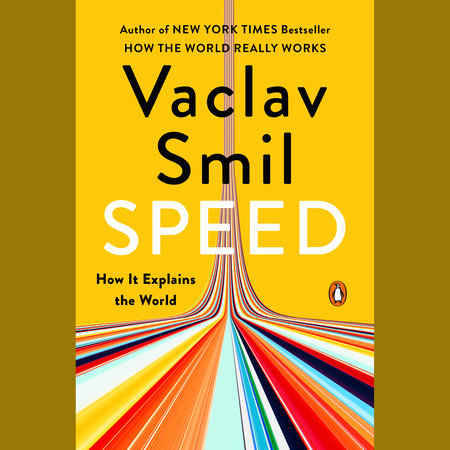
Speed

How It Explains the World

Read by Joe Jameson
Listen to a clip from the audiobook
audio play button
0:00
0:00
A data-driven, scientific account of our need for speed—exploring a wide range of topics including evolution, transportation, and technology

In a world obsessed with efficiency, perhaps nothing is valued as highly as being fast. Some of our greatest achievements include building planes that break the sound barrier and creating computers that process data at the touch of a button. With signature clarity, Smil offers accessible explanations of every major speed category, from wind erosion to hunting cheetahs, from Boeing 747s to America’s war time industrial mobilization to the speed of global energy decarbonization.

But as Smil argues in this paradigm-shifting book, speed isn’t just a metric to optimize. In Speed, Smil expands on our traditional, human-centric understanding of speed to explore phenomena of space and time, evolution, and human achievement. What was the speed of planet formation? Of the development of different life forms? What happened in the collision of humans and the limits of natural speed, and what has emerged from our incessant desire to push those boundaries?

Lauded for his“compelling, fascinating, realistic” (Steven Pinker) portraits of the modern world, Smil knows that we can’t, won’t, and shouldn’t abandon our collective need for speed. But as good devotees of speed’s eminence, we must understand it, its value, and its cost. Rich in historical and contemporary data, the latest work by Smil is a comprehensive, interdisciplinary guidebook for science readers living in the fast lane.
Preface: From Speed’s Absence to Singularity

Introduction— Universe of Speeds: Variables and measurements

1. Evolution: Non-intuitive time spans and speeds

2. Organisms: Life’s strategies and capabilities

3. Speed Limits in Premodern Societies

4. The Fast Lane: How modern societies accelerate

5. Parting Musings: Obverses, limits, aspirations

Coda
Vaclav Smil is distinguished professor emeritus at the University of Manitoba. He is the author of How to Feed the World, Numbers Don’t Lie, Size, and the New York Times bestselling How the World Really Works, as well as over forty books on topics including energy, environmental and population change, food production and nutrition, technical innovation, risk assessment, and public policy. He is a fellow of the Royal Society of Canada and a member of the Order of Canada. View titles by Vaclav Smil
“An intriguing account of the role of speed in evolution and human civilization . . . Packed with accessible analogies and nuanced analyses, this is a well-rounded, interdisciplinary view of efficiency.”
Publishers Weekly

About

A data-driven, scientific account of our need for speed—exploring a wide range of topics including evolution, transportation, and technology

In a world obsessed with efficiency, perhaps nothing is valued as highly as being fast. Some of our greatest achievements include building planes that break the sound barrier and creating computers that process data at the touch of a button. With signature clarity, Smil offers accessible explanations of every major speed category, from wind erosion to hunting cheetahs, from Boeing 747s to America’s war time industrial mobilization to the speed of global energy decarbonization.

But as Smil argues in this paradigm-shifting book, speed isn’t just a metric to optimize. In Speed, Smil expands on our traditional, human-centric understanding of speed to explore phenomena of space and time, evolution, and human achievement. What was the speed of planet formation? Of the development of different life forms? What happened in the collision of humans and the limits of natural speed, and what has emerged from our incessant desire to push those boundaries?

Lauded for his“compelling, fascinating, realistic” (Steven Pinker) portraits of the modern world, Smil knows that we can’t, won’t, and shouldn’t abandon our collective need for speed. But as good devotees of speed’s eminence, we must understand it, its value, and its cost. Rich in historical and contemporary data, the latest work by Smil is a comprehensive, interdisciplinary guidebook for science readers living in the fast lane.

Table of Contents

Preface: From Speed’s Absence to Singularity

Introduction— Universe of Speeds: Variables and measurements

1. Evolution: Non-intuitive time spans and speeds

2. Organisms: Life’s strategies and capabilities

3. Speed Limits in Premodern Societies

4. The Fast Lane: How modern societies accelerate

5. Parting Musings: Obverses, limits, aspirations

Coda

Author

Vaclav Smil is distinguished professor emeritus at the University of Manitoba. He is the author of How to Feed the World, Numbers Don’t Lie, Size, and the New York Times bestselling How the World Really Works, as well as over forty books on topics including energy, environmental and population change, food production and nutrition, technical innovation, risk assessment, and public policy. He is a fellow of the Royal Society of Canada and a member of the Order of Canada. View titles by Vaclav Smil

Praise

“An intriguing account of the role of speed in evolution and human civilization . . . Packed with accessible analogies and nuanced analyses, this is a well-rounded, interdisciplinary view of efficiency.”
Publishers Weekly

Books for Asian American, Native Hawaiian, and Pacific Islander Heritage Month

Each May, we honor the stories, histories, and cultures of Asian Americans, Native Hawaiians, and Pacific Islanders. Below is a selection of acclaimed fiction and nonfiction books by AANHPI creators to share with your students this month and throughout the year. Find our full collection of titles for Higher Education here.

Read more