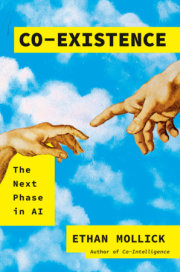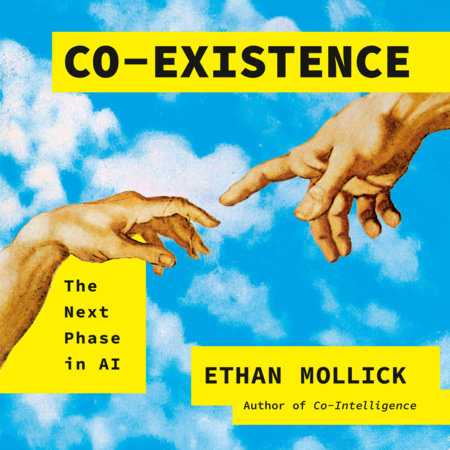

Co-Existence

The Next Phase of AI

How do we live alongside machines that are sometimes smarter than us?

We are entering a new era. AI systems can already outperform humans in some domains while failing spectacularly in others. They can act as tutors, collaborators, researchers, strategists, and creators—yet they can also produce falsehoods, generate convincing nonsense, and fail unpredictably. The challenge is no longer simply adopting new technology. It is learning how to think, work, and live in a world where machines are sometimes smarter than us.

In Co-Existence, Ethan Mollick—a Wharton professor and author of the widely read One Useful Thing newsletter—argues that the future of AI will not be defined by replacement, but by interaction.

Drawing on years of research, experimentation, and frontline experience with rapidly evolving AI systems, Mollick shows readers how to:
• work productively with AI while retaining judgment and autonomy;
• distinguish where human insight matters most;
• avoid becoming overly dependent on systems designed to persuade and imitate;
• adapt creatively as AI reshapes education, business, and everyday life; and
• build a durable human advantage in a world of intelligent machines.

Clear-eyed, practical, and written with warmth and humor, Co-Existence is your guide to navigating the next phase of the AI revolution.
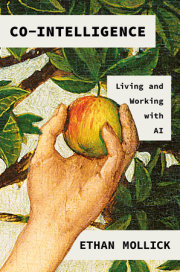
Ethan Mollick is the bestselling author of Co-Intelligence, a New York Times bestseller and a Best Book of the Year from The Economist and the Financial Times.  He is the Ralph J. Roberts Distinguished Faculty Scholar, a Rowan Fellow, and an associate professor at the Wharton School, where he directs the Generative AI Lab and studies the effects of AI on work, entrepreneurship, and education. He was named one of Time magazine’s Most Influential People in Artificial Intelligence. View titles by Ethan Mollick

About

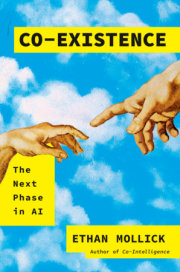
How do we live alongside machines that are sometimes smarter than us?

We are entering a new era. AI systems can already outperform humans in some domains while failing spectacularly in others. They can act as tutors, collaborators, researchers, strategists, and creators—yet they can also produce falsehoods, generate convincing nonsense, and fail unpredictably. The challenge is no longer simply adopting new technology. It is learning how to think, work, and live in a world where machines are sometimes smarter than us.

In Co-Existence, Ethan Mollick—a Wharton professor and author of the widely read One Useful Thing newsletter—argues that the future of AI will not be defined by replacement, but by interaction.

Drawing on years of research, experimentation, and frontline experience with rapidly evolving AI systems, Mollick shows readers how to:
• work productively with AI while retaining judgment and autonomy;
• distinguish where human insight matters most;
• avoid becoming overly dependent on systems designed to persuade and imitate;
• adapt creatively as AI reshapes education, business, and everyday life; and
• build a durable human advantage in a world of intelligent machines.

Clear-eyed, practical, and written with warmth and humor, Co-Existence is your guide to navigating the next phase of the AI revolution.

Author

Ethan Mollick is the bestselling author of Co-Intelligence, a New York Times bestseller and a Best Book of the Year from The Economist and the Financial Times.  He is the Ralph J. Roberts Distinguished Faculty Scholar, a Rowan Fellow, and an associate professor at the Wharton School, where he directs the Generative AI Lab and studies the effects of AI on work, entrepreneurship, and education. He was named one of Time magazine’s Most Influential People in Artificial Intelligence. View titles by Ethan Mollick

Books for Asian American, Native Hawaiian, and Pacific Islander Heritage Month

Each May, we honor the stories, histories, and cultures of Asian Americans, Native Hawaiians, and Pacific Islanders. Below is a selection of acclaimed fiction and nonfiction books by AANHPI creators to share with your students this month and throughout the year. Find our full collection of titles for Higher Education here.

Read more