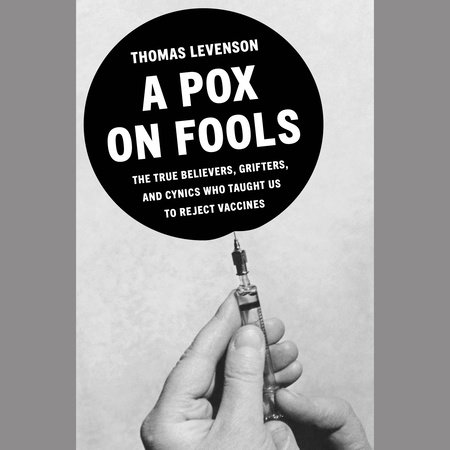
A Pox on Fools

The True Believers, Grifters, and Cynics Who Convinced Us to Reject Vaccines

Read by Mike Cooper
Audiobook Download
On sale Jun 09, 2026 | 5 Hours and 0 Minutes | 9798217286645

See Additional Formats
An urgent and profound history of vaccine skepticism, seeking to understand how our three most common fears about vaccines hardened into a lethal ideology—from a leading science writer

“Brimming with righteous anger, this book should infuriate you for all the right reasons, and arm you to take on the grifters and their war against science.”—Adam Rutherford, author of A Brief History of Everyone Who Ever Lived: The Human Story Retold Through Our Genes


Since the advent of smallpox inoculation in the eighteenth century, the idea that a disease introduced to the body in some lesser, weakened form might prevent full-blown infection has been one of the greatest public health insights of the modern era, inspiring the invention of numerous vaccines and saving countless human lives. But, just as humanity acquired the god-like power to stop infectious disease in its tracks, some feared we had gone too far, leading to the skepticism that has hijacked public health discourse today.

In three sweeping essays written for our current moment of scientific mistrust, Thomas Levenson searches for the origins of the most common arguments against vaccines: that they are unnatural; that they are more dangerous than the illnesses they claim to prevent; and that they are an affront to freedom. Each arose from the earliest development of particular vaccines and the campaigns to distribute them. Even as the pattern repeats, Levenson reveals how innocent that skepticism initially was and, in each case, how very human fears and questions ultimately turned into something darker, where no truth would be enough to overcome the doubt.

Searing but ultimately empathetic, A Pox on Fools explores the human impulse to question and wonder—sometimes past the point at which the very act of questioning turns deadly.
Prologue

The Gift

We don’t know their names. We almost certainly never will. But beginning on February 11, 2022, 108 healthy adults from across the United States performed an act of selfless generosity. Twelve went first. They were the guinea pigs, those willing to ensure the safety of others by taking the risk of whatever might go wrong.

Nothing did, so three times over the course of twelve weeks the group bared their arms and allowed strangers to poke them with a needle, through which flowed something new, a substance never before inserted into human bodies. A handful of them reacted to those injections—­most often experiencing a bout of hives—­but, on the whole, the study subjects handled the experimental compound well.

These were ordinary people. As near as possible, they were a cross section of the US population. Some were as young as eighteen, some were sufficiently ancient to have made it to fifty-­five. Just over half were men; one in six were Hispanic or Latino. They put up with a lot from the team of researchers: multiple blood draws, the last coming nine months into the study. Finally, in 2025, the work was done, and on July 30, the research team published its results.

The study had tested three different formulations of its new shot. One didn’t work, but the other two did: for 80 percent of the study subjects they induced significant immune responses. This was a preliminary, phase one clinical trial, so there was still a long way to go to confirm that this approach really could achieve what its inventors hoped—­stopping an invader dead in its tracks.

So far, this reads like just another incremental advance in the usual process of medical research. But the target was the human immunodeficiency virus, or HIV—­the pathogen that causes AIDS, which, left untreated, kills virtually everyone it strikes; that has already taken over 40 million lives; and that still finds more than a million new victims each year.

That’s the gift the hundred or so regular folks who volunteered for the study have given the world: they’ve advanced the prospect that humankind may free itself from the threat of HIV/AIDS, a half a century after the disease first appeared. If—­when—­this comes to pass, it will be because these people, and countless others to come, will have helped invent, test, refine, and finally deliver the ultimate defense against infectious disease: a vaccine.

Vaccines are a secular miracle, or, as futurist and author Arthur C. Clarke might have said, “are indistinguishable from magic.” Something invisible dissolved in a syringe confronts something invisible inside someone—­and an event doesn’t happen. That person won’t suffer measles or polio or typhoid, or a host of other conditions. Magic!

Or better, not the work of sorcery but an unmatched triumph of human inquiry and technical skill—­over death itself. Consider what life was like before humankind learned to induce immunity to infectious diseases: often nasty, sometimes brutal, and definitely short. In 1800, just as the first true vaccine—­against smallpox—­came into use, life expectancy at birth hovered around thirty years worldwide. Infectious disease was the leading cause of death, as it had been for centuries. Before its vaccine became available, smallpox by itself accounted for eight out of every hundred deaths in some of the wealthiest and healthiest nations, and more where conditions were worse.

As the decades passed, the crowding and filth in the rapidly growing cities in the industrializing nations of Europe and North America created perfect conditions to fuel epidemic outbreaks that could steal the lives of those of any age or rank, but were most dangerous for the very young. In those years, the concept of specifically “childhood diseases’—­diphtheria, pertussis (whooping cough), measles and some others—­took shape.

By 1900 that landscape of disease was beginning to change—­but slowly. Richer parts of the world were doing better: the US and England saw life expectancy at birth rise to about forty-­seven or a little more. Then everything changed. By the middle of the century, the global population could expect to live on average about fifty years. Seven decades later that number has climbed to seventy-­three, while those in the richest nations have surpassed an average of over fourscore years, a number the Bible reserves for only the most vigorous among us.

Thank vaccination. It wasn’t the only driver of this radical shift in human possibility, but as the modern suite of vaccines emerged, rendering harmless (or at a minimum, much less harmful) each malady in sequence, they caged one prolific killer after another. Perhaps most important, they have saved our babies. For much of history, before humans learned how to engineer immunity, almost every parent had to bury at least one of their children, and often more. In the middle of the eighteenth century, a few decades before the first true vaccine (against smallpox) emerged, as many as seventy-­five out of every hundred infants baptized in any given year would perish before they reached their fifth birthday.

The full suite of vaccines against childhood diseases was almost complete by 1970. In that year in the United States the number of lost kids had dropped to just over two per hundred. By 2020, it became necessary to move the decimal point on that calculation. Only four out of every thousand babies born would not make it to five. For humanity as a whole, the World Health Organization has calculated6 that over the last fifty years alone vaccines have delivered 10.2 billion years of healthy life that would otherwise have been lost to various infections. Almost all of those lives reclaimed were children. It is no longer routine, just part of the business of living, to outlive one’s own child.

To paraphrase what is said every year at the Jewish holiday of Passover: all of us once were slaves—­not to Pharaoh, but to infectious disease. Now, especially in the richer half of the world, we are (mostly) free from that scourge. But that freedom has always been fragile, utterly dependent on access to and willingness to use the instrument of our liberation: vaccines, those already here and the ones yet to be invented. As I write this in the summer of 2025, vaccination is under existential threat in the United States—­and increasingly so throughout the world.

The face of the immediate crisis is Robert F. Kennedy Jr., who in 2021 was found by a group of independent researchers to be one of the top sources of misinformation on the pandemic vaccines and treatments. Four years later Donald Trump appointed and fifty-­two Republican senators confirmed him as secretary of health and human services. In his first few months in that office Kennedy steamrolled every facet of American vaccine infrastructure. Weeks into his tenure, he fired the entire outside panel of experts who guide CDC vaccine policy, replacing them with a group that included anti-­vaccination activists and contained no one with expertise in the relevant fields. At the same time, he revived false claims about a connection between vaccination and autism. Then, he moved swiftly to restrict approval of the pandemic vaccines to those over sixty-­five or who suffer other conditions that increase their risk. A week after that move, he withdrew recommendations (effectively, approval) for their use for pregnant women and otherwise healthy kids.

There’s more: he closed agencies that prepare for novel pandemics; appointed “skeptics” to key vaccine regulatory positions; hired someone who had previously been disciplined for practicing medicine without a license to run a new vaccine-­autism “study,” while promising to identify the causes of that condition within six months. All this while presiding over the largest outbreak of measles in the US in more than two decades, which by June 2025 had killed three people in a wholly vaccine-­preventable tragedy. Labelling vaccines a “personal choice,” he lied about the rate of side effects from the measles vaccine, while suggesting that those who do fall ill can be successfully treated with cod liver oil, antibiotics, and steroids. (They can’t.)

With each passing month, his assault has deepened. In early August, after welching on a half-billion-­dollar commitment in May that would have paid for a vaccine against bird flu—­a relative of the virus behind the devastating 1918 pandemic—­Kennedy canceled grants and contracts worth another $500 million that were intended to develop a range of vaccines using mRNA technology. That biochemical tool made it possible to create the pandemic vaccines within less than a year. As former Trump health official Rick Bright told The New York Times, killing off US mRNA research undermines “our ability to rapidly counter future biological threats,” a decision, according to Chris Mee­kins, another first-­term Trump public-­health appointee, that amounts to a “national security vulnerability.”
© Joel Benjamin
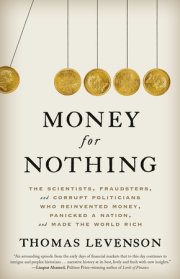
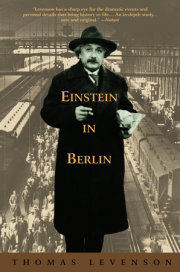
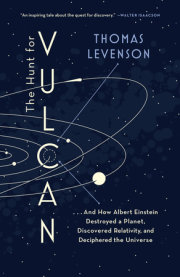
Thomas Levenson is a professor of science writing at the Massachusetts Institute of Technology. He is the author of several books, including Money for Nothing, The Hunt for Vulcan, Einstein in Berlin, and Newton and the Counterfeiter. He has also made ten feature-length documentaries (including a two-hour Nova program on Albert Einstein), for which he has won numerous awards. View titles by Thomas Levenson
“This is a passionate book, on a subject that deservedly raises passions. Lethal epidemics of smallpox, polio, measles, and pertussis have been parallelled by memetic epidemics of anti-vaccine scare-mongering. Thomas Levenson documents the history, from honestly mistaken sceptics of previous centuries (Alfred Russell Wallace, Herbert Spencer) to today’s villains (Andrew Wakefield, Donald Trump) and charlatans (Robert Kennedy Jr). At a time when vaccine science should be celebrating its greatest triumphs, this book could hardly be more important.”—Richard Dawkins, bestselling author of The Selfish Gene

“Since the 1800 dawn of the age of vaccines, the life-saving miracles have had their opponents, decrying immunization to its public health advocates. The anti-vax arguments aren’t new, as Tom Levenson shows. Only the fear-mongering voices have changed, now led by RFK Jr. A Pox of Fools is your go-to guide for countering the mendacity and conspiratorial thinking.”—Laurie Garrett, bestselling author of The Coming Plague

A Pox on Fools is a triumph—a tiny, mighty book and a stark reminder that vaccines have made us victims of our own success. Levenson’s book shows how far we have come and calls out the lies and hypocrisy of anti-vaccine politicians who exploit our collective amnesia and endanger public health. It should be required reading for anyone living in this absurd and perilous time.”—Adam Ratner, MD, MPH, author of Booster Shots

“Levenson serves up this powerful, timely, and important book about a technology that has extended and saved hundreds of millions of lives, and the incredible story of why we’ve begun to turn our backs on it.”—Kevin Fong, MD, author of Extreme Medicine

“This highly readable account of how vaccines have saved millions of lives is a call to arms for anyone who cares about the future of vaccine confidence.”—Meredith Wadman, author of The Vaccine Race

“In this desperately urgent book, Tom Levenson masterfully weaves science and history to explain why no health measure has saved quite so many lives as vaccines, and why it flies in the face of reason for health officials to turn their backs on them now. I hope absolutely everyone reads this.”—Angela Saini, author of Superior

“A full-throated attack on ‘Make America Healthy Again’ and Robert Kennedy Jr. . . . lively . . . An impassioned but reasoned look at the culture and commerce of vaccine denial.”—Kirkus Reviews

“In this enlightening account, science writer Levenson (So Very Small) surveys 300 years of vaccine opposition. Noting that much of today’s antivax rhetoric is in fact centuries old, he starts with the first smallpox inoculations in the 18th century, finding that vaccine skepticism has long taken the same few approaches. . . . Indeed, the similarities to today’s antivax movement that Levenson surfaces are often uncanny . . . a trenchant demonstration of how contemporary antivax ideology is not only inaccurate but rooted in outmoded, antimodern sentiments.”Publishers Weekly

About

An urgent and profound history of vaccine skepticism, seeking to understand how our three most common fears about vaccines hardened into a lethal ideology—from a leading science writer

“Brimming with righteous anger, this book should infuriate you for all the right reasons, and arm you to take on the grifters and their war against science.”—Adam Rutherford, author of A Brief History of Everyone Who Ever Lived: The Human Story Retold Through Our Genes


Since the advent of smallpox inoculation in the eighteenth century, the idea that a disease introduced to the body in some lesser, weakened form might prevent full-blown infection has been one of the greatest public health insights of the modern era, inspiring the invention of numerous vaccines and saving countless human lives. But, just as humanity acquired the god-like power to stop infectious disease in its tracks, some feared we had gone too far, leading to the skepticism that has hijacked public health discourse today.

In three sweeping essays written for our current moment of scientific mistrust, Thomas Levenson searches for the origins of the most common arguments against vaccines: that they are unnatural; that they are more dangerous than the illnesses they claim to prevent; and that they are an affront to freedom. Each arose from the earliest development of particular vaccines and the campaigns to distribute them. Even as the pattern repeats, Levenson reveals how innocent that skepticism initially was and, in each case, how very human fears and questions ultimately turned into something darker, where no truth would be enough to overcome the doubt.

Searing but ultimately empathetic, A Pox on Fools explores the human impulse to question and wonder—sometimes past the point at which the very act of questioning turns deadly.

Excerpt

Prologue

The Gift

We don’t know their names. We almost certainly never will. But beginning on February 11, 2022, 108 healthy adults from across the United States performed an act of selfless generosity. Twelve went first. They were the guinea pigs, those willing to ensure the safety of others by taking the risk of whatever might go wrong.

Nothing did, so three times over the course of twelve weeks the group bared their arms and allowed strangers to poke them with a needle, through which flowed something new, a substance never before inserted into human bodies. A handful of them reacted to those injections—­most often experiencing a bout of hives—­but, on the whole, the study subjects handled the experimental compound well.

These were ordinary people. As near as possible, they were a cross section of the US population. Some were as young as eighteen, some were sufficiently ancient to have made it to fifty-­five. Just over half were men; one in six were Hispanic or Latino. They put up with a lot from the team of researchers: multiple blood draws, the last coming nine months into the study. Finally, in 2025, the work was done, and on July 30, the research team published its results.

The study had tested three different formulations of its new shot. One didn’t work, but the other two did: for 80 percent of the study subjects they induced significant immune responses. This was a preliminary, phase one clinical trial, so there was still a long way to go to confirm that this approach really could achieve what its inventors hoped—­stopping an invader dead in its tracks.

So far, this reads like just another incremental advance in the usual process of medical research. But the target was the human immunodeficiency virus, or HIV—­the pathogen that causes AIDS, which, left untreated, kills virtually everyone it strikes; that has already taken over 40 million lives; and that still finds more than a million new victims each year.

That’s the gift the hundred or so regular folks who volunteered for the study have given the world: they’ve advanced the prospect that humankind may free itself from the threat of HIV/AIDS, a half a century after the disease first appeared. If—­when—­this comes to pass, it will be because these people, and countless others to come, will have helped invent, test, refine, and finally deliver the ultimate defense against infectious disease: a vaccine.

Vaccines are a secular miracle, or, as futurist and author Arthur C. Clarke might have said, “are indistinguishable from magic.” Something invisible dissolved in a syringe confronts something invisible inside someone—­and an event doesn’t happen. That person won’t suffer measles or polio or typhoid, or a host of other conditions. Magic!

Or better, not the work of sorcery but an unmatched triumph of human inquiry and technical skill—­over death itself. Consider what life was like before humankind learned to induce immunity to infectious diseases: often nasty, sometimes brutal, and definitely short. In 1800, just as the first true vaccine—­against smallpox—­came into use, life expectancy at birth hovered around thirty years worldwide. Infectious disease was the leading cause of death, as it had been for centuries. Before its vaccine became available, smallpox by itself accounted for eight out of every hundred deaths in some of the wealthiest and healthiest nations, and more where conditions were worse.

As the decades passed, the crowding and filth in the rapidly growing cities in the industrializing nations of Europe and North America created perfect conditions to fuel epidemic outbreaks that could steal the lives of those of any age or rank, but were most dangerous for the very young. In those years, the concept of specifically “childhood diseases’—­diphtheria, pertussis (whooping cough), measles and some others—­took shape.

By 1900 that landscape of disease was beginning to change—­but slowly. Richer parts of the world were doing better: the US and England saw life expectancy at birth rise to about forty-­seven or a little more. Then everything changed. By the middle of the century, the global population could expect to live on average about fifty years. Seven decades later that number has climbed to seventy-­three, while those in the richest nations have surpassed an average of over fourscore years, a number the Bible reserves for only the most vigorous among us.

Thank vaccination. It wasn’t the only driver of this radical shift in human possibility, but as the modern suite of vaccines emerged, rendering harmless (or at a minimum, much less harmful) each malady in sequence, they caged one prolific killer after another. Perhaps most important, they have saved our babies. For much of history, before humans learned how to engineer immunity, almost every parent had to bury at least one of their children, and often more. In the middle of the eighteenth century, a few decades before the first true vaccine (against smallpox) emerged, as many as seventy-­five out of every hundred infants baptized in any given year would perish before they reached their fifth birthday.

The full suite of vaccines against childhood diseases was almost complete by 1970. In that year in the United States the number of lost kids had dropped to just over two per hundred. By 2020, it became necessary to move the decimal point on that calculation. Only four out of every thousand babies born would not make it to five. For humanity as a whole, the World Health Organization has calculated6 that over the last fifty years alone vaccines have delivered 10.2 billion years of healthy life that would otherwise have been lost to various infections. Almost all of those lives reclaimed were children. It is no longer routine, just part of the business of living, to outlive one’s own child.

To paraphrase what is said every year at the Jewish holiday of Passover: all of us once were slaves—­not to Pharaoh, but to infectious disease. Now, especially in the richer half of the world, we are (mostly) free from that scourge. But that freedom has always been fragile, utterly dependent on access to and willingness to use the instrument of our liberation: vaccines, those already here and the ones yet to be invented. As I write this in the summer of 2025, vaccination is under existential threat in the United States—­and increasingly so throughout the world.

The face of the immediate crisis is Robert F. Kennedy Jr., who in 2021 was found by a group of independent researchers to be one of the top sources of misinformation on the pandemic vaccines and treatments. Four years later Donald Trump appointed and fifty-­two Republican senators confirmed him as secretary of health and human services. In his first few months in that office Kennedy steamrolled every facet of American vaccine infrastructure. Weeks into his tenure, he fired the entire outside panel of experts who guide CDC vaccine policy, replacing them with a group that included anti-­vaccination activists and contained no one with expertise in the relevant fields. At the same time, he revived false claims about a connection between vaccination and autism. Then, he moved swiftly to restrict approval of the pandemic vaccines to those over sixty-­five or who suffer other conditions that increase their risk. A week after that move, he withdrew recommendations (effectively, approval) for their use for pregnant women and otherwise healthy kids.

There’s more: he closed agencies that prepare for novel pandemics; appointed “skeptics” to key vaccine regulatory positions; hired someone who had previously been disciplined for practicing medicine without a license to run a new vaccine-­autism “study,” while promising to identify the causes of that condition within six months. All this while presiding over the largest outbreak of measles in the US in more than two decades, which by June 2025 had killed three people in a wholly vaccine-­preventable tragedy. Labelling vaccines a “personal choice,” he lied about the rate of side effects from the measles vaccine, while suggesting that those who do fall ill can be successfully treated with cod liver oil, antibiotics, and steroids. (They can’t.)

With each passing month, his assault has deepened. In early August, after welching on a half-billion-­dollar commitment in May that would have paid for a vaccine against bird flu—­a relative of the virus behind the devastating 1918 pandemic—­Kennedy canceled grants and contracts worth another $500 million that were intended to develop a range of vaccines using mRNA technology. That biochemical tool made it possible to create the pandemic vaccines within less than a year. As former Trump health official Rick Bright told The New York Times, killing off US mRNA research undermines “our ability to rapidly counter future biological threats,” a decision, according to Chris Mee­kins, another first-­term Trump public-­health appointee, that amounts to a “national security vulnerability.”

Author

© Joel Benjamin
Thomas Levenson is a professor of science writing at the Massachusetts Institute of Technology. He is the author of several books, including Money for Nothing, The Hunt for Vulcan, Einstein in Berlin, and Newton and the Counterfeiter. He has also made ten feature-length documentaries (including a two-hour Nova program on Albert Einstein), for which he has won numerous awards. View titles by Thomas Levenson

Praise

“This is a passionate book, on a subject that deservedly raises passions. Lethal epidemics of smallpox, polio, measles, and pertussis have been parallelled by memetic epidemics of anti-vaccine scare-mongering. Thomas Levenson documents the history, from honestly mistaken sceptics of previous centuries (Alfred Russell Wallace, Herbert Spencer) to today’s villains (Andrew Wakefield, Donald Trump) and charlatans (Robert Kennedy Jr). At a time when vaccine science should be celebrating its greatest triumphs, this book could hardly be more important.”—Richard Dawkins, bestselling author of The Selfish Gene

“Since the 1800 dawn of the age of vaccines, the life-saving miracles have had their opponents, decrying immunization to its public health advocates. The anti-vax arguments aren’t new, as Tom Levenson shows. Only the fear-mongering voices have changed, now led by RFK Jr. A Pox of Fools is your go-to guide for countering the mendacity and conspiratorial thinking.”—Laurie Garrett, bestselling author of The Coming Plague

A Pox on Fools is a triumph—a tiny, mighty book and a stark reminder that vaccines have made us victims of our own success. Levenson’s book shows how far we have come and calls out the lies and hypocrisy of anti-vaccine politicians who exploit our collective amnesia and endanger public health. It should be required reading for anyone living in this absurd and perilous time.”—Adam Ratner, MD, MPH, author of Booster Shots

“Levenson serves up this powerful, timely, and important book about a technology that has extended and saved hundreds of millions of lives, and the incredible story of why we’ve begun to turn our backs on it.”—Kevin Fong, MD, author of Extreme Medicine

“This highly readable account of how vaccines have saved millions of lives is a call to arms for anyone who cares about the future of vaccine confidence.”—Meredith Wadman, author of The Vaccine Race

“In this desperately urgent book, Tom Levenson masterfully weaves science and history to explain why no health measure has saved quite so many lives as vaccines, and why it flies in the face of reason for health officials to turn their backs on them now. I hope absolutely everyone reads this.”—Angela Saini, author of Superior

“A full-throated attack on ‘Make America Healthy Again’ and Robert Kennedy Jr. . . . lively . . . An impassioned but reasoned look at the culture and commerce of vaccine denial.”—Kirkus Reviews

“In this enlightening account, science writer Levenson (So Very Small) surveys 300 years of vaccine opposition. Noting that much of today’s antivax rhetoric is in fact centuries old, he starts with the first smallpox inoculations in the 18th century, finding that vaccine skepticism has long taken the same few approaches. . . . Indeed, the similarities to today’s antivax movement that Levenson surfaces are often uncanny . . . a trenchant demonstration of how contemporary antivax ideology is not only inaccurate but rooted in outmoded, antimodern sentiments.”Publishers Weekly

Books for Asian American, Native Hawaiian, and Pacific Islander Heritage Month

Each May, we honor the stories, histories, and cultures of Asian Americans, Native Hawaiians, and Pacific Islanders. Below is a selection of acclaimed fiction and nonfiction books by AANHPI creators to share with your students this month and throughout the year. Find our full collection of titles for Higher Education here.

Read more