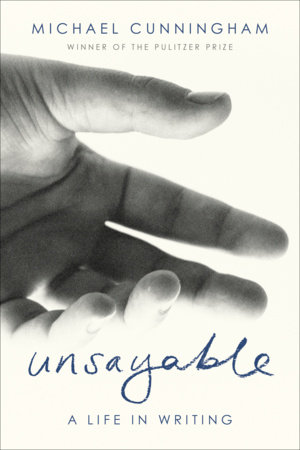
Unsayable

A Life in Writing

Look inside
Hardcover
$30.00 US
On sale Jul 21, 2026 | 304 Pages | 9798217198337

See Additional Formats
An intimate memoir portraying a life spent trying to describe the indescribable, from the Pulitzer Prize–winning author of The Hours and Day

Go ahead. Try using language to slit the skin of mortality to see what’s on the other side.

At the age of three, Michael Cunningham began obsessively collecting the names of things: oak, Chevrolet, finch, tulip, Tupperware. . . . Each word rendered the world ever so slightly more understandable, more describable, kicking off a lifelong love affair with language—one that would, eventually, maybe inevitably, lead him to become a writer.

In Unsayable, Cunningham’s memories spill forth, and with them reflections on the craft of writing. He is fifteen, in a swimming pool at night, gazing at the first boy he ever fell in love with, who is lost in contemplative silence. He is a new college graduate, setting off for nowhere in a Dodge Dart, hoping to pull meaning (and a novel) from the expanse of America. He is on Cape Cod, regaling an elderly couple with invented tales of sexual escapades. He is in an art gallery, unwittingly having the first in a lifetime of conversations with the man he would marry. A thread ties each beautifully wrought moment to the next: what is unspoken, what won’t yield to language, what is embellished beyond recognition, what is still left to say.

Luminous, perceptive, and powerful, Unsayable is an ode to literature, a meditation on craft, and an intimate account of a life spent trying to put into words that which resists depiction. This, it turns out, is the lifeblood of the fiction writer: the impossibility of capturing the human experience, and the relentless desire to try.
Names

My earliest memory is a lack of language.

I would have been about three years old. I wanted a piece of Tupperware that sat on a kitchen counter, above my reach.

I was in love with Tupperware. I took endless delight in the tiny suction sound each piece emitted when I pried off its lid, and in what I believed to be the Tupperware’s satisfaction when I put the lids back on. I’d line them up on the kitchen floor, according to their rank. They all had names, and personalities. I’ll spare you the particulars.

The pieces of Tupperware were beautiful, in their way—their whitish translucence, the creamy colors of their lids—cobalt, emerald, scarlet, once the colors of heraldry, of kingly victories, now harmless domesticated versions of those colors—with their implications of soaring hawks, of fields blanketed with the bodies of enemy dead—their volumes turned down now to subtler, more muted levels but retaining some hint of righteous victory.

They were containers but they were also contained, and (a feature I appreciated in particular) each fit inside its slightly larger sibling. They were orderly. They were utterly unfrightening, as opposed to my jack-in-the-box and my stuffed dinosaur. They neither jumped out, grinning maliciously, nor stared with hungry green eyes from the far corner of my room.

The Tupperware was kept in a low kitchen drawer, easy access for me. But somehow one of them had found its way to the countertop, which was all the more distressing because that one—a big round beauty with an aqua lid—was the queen, who ruled the rest of the Tupperware with benevolence, punctuated by scoldings for crimes that were not always clear, to her subjects or to me.

Sometimes I put a few of my most venerated possessions inside her: toy cars, marbles, a tiny stuffed bear that was me in the form of a little yellow bear. When I took them back out, their preciousness was slightly enhanced. They had been somewhere.

On that day, I needed my mother to take the Tupperware queen down to my level.

I did not, however, know the word “Tupperware.” I could have called it a bowl, but I knew it wasn’t a bowl, not exactly a bowl, and I maintained a fierce sense of what I’ll call toddler dignity. I hated to be wrong.

Until that day, the Tupperware hadn’t needed a name, because I could always reach it so easily. It was itself; it was its own name. But suddenly, on an afternoon in suburban Los Angeles, it had to be called something.

I don’t remember how the queen and I were reunited. I suspect my mother simply came into the kitchen, understood my plight, and lifted it from countertop to floor. I don’t think we spoke—we understood, even then, that some of my desires could be satisfied but were better left unnamed. That said, I took a vow—I’m not sure a child that age is capable of making vows, but I do identify, in retrospect, that brief interlude as the moment I first became determined to learn the names of everything, for practical purposes as well as a subtler conviction that the names of things were integral to their being. That which was unnamed didn’t fully exist outside of my imagination, in more or less the way I myself would have been rendered spectral if my parents hadn’t named me.

As a child, I became intent on learning the names of everything, from cars (that was a Chevrolet going by; our car was a Ford) to the fact that the tree in our front yard was an oak. I was fascinated by the revelation that a car could have many names—it could also be a Buick or a Pontiac or a Chrysler. Our tree was an oak, but the tree in our neighbors’ yard was a maple. They looked the same to me, but they had different names, and for a while it seemed that every individual tree must have its own name, which would be a lot to remember.

I went so far as to believe that my parents, in giving me all those names, were passing along secrets. Other people were unaware of the names within the names. They knew the word “tree” but only my parents and I were able to call this tree oak and that tree maple. I felt like an insider, a secret comrade to trees and cars, birds and flowers, and shoes and books.

You are a tulip, you are a rose, you are a lily. I know that about you, and others do not. Not to mention the comprehension that words like “Honey” and “Mommy” were sisters, who bore a strong familial resemblance but were not identical. She could call me Honey and refer to herself as Mommy (Honey, Mommy will be back in a few minutes), but I could only call her Mommy. When I tried calling her Honey, she laughed, but in a way that told me it wasn’t a name for me to use with her.

Many children are curious about language. Relatively few of us are so fixated as to become writers. If, beginning in childhood, almost everyone sets about the complicated work of discovering the world and inventing it for themselves, writers are the only ones who attempt to make a career out of it.

You could say that writing is a continuation of that effort to render and recognize everything and everyone by naming its qualities, ideally from an illuminating angle—by naming them in ways that are both recognizable and unfamiliar, by combining words unconventionally so that, coming into contact, they emit new sparks of meaning. You attempt to invigorate the names of objects and beings and emotions by finding new variations. You try to imbue them with a vitality that may have faded by being called by the same name, over and over, throughout the centuries.

If you as a writer can conjure a person or a room or a landscape in unexpected ways, while honoring its fundamental nature, you help to revive it. You realize, too, that the names by which we call everything and everyone are a convenience intended only for us, the way a population comes to recognize itself by way of its myths and stories. The world is sufficient unto itself. It neither knows nor cares if anyone writes about it. We write about the world to make it more real for ourselves, and only for ourselves. We break it down into words and sentences so we can travel across its surfaces without getting any more lost than necessary.

We who write fiction know how language both amplifies and simplifies. Stories are, by definition, experiences about experiences, and we who write them know that any story, even the greatest of them, is an approximation of the unsayable—that which we all know but can’t express in language.
© Richard Phibbs
Michael Cunningham is a novelist, screenwriter, and educator. His novel The Hours received the PEN/Faulkner Award and the Pulitzer Prize for Fiction in 1999. He has taught at Columbia University and Brooklyn College. He is currently a professor in the practice at Yale University. View titles by Michael Cunningham
Unsayable made me want to live (really live) and write (really write)—not by glamorizing either, but by taking such mesmerizing care with the humiliations, passions, accidents, and subtleties of both. This is such a generous book, essential for anyone wanting to relearn the arts of curiosity and devotion.”—Miranda July, New York Times bestselling author of All Fours

“As I read these pages, I felt I’d taken up residence behind Michael Cunningham’s uniquely sensitive retinas and seen the world as a great writer has seen it, from age three to age seventy-three. So this is how love and longing, imagination and wonder are transmuted into fiction! Unsayable is a mind-opening, heart-expanding, and insanely useful book.”—Anne Fadiman, author of The Wine Lover’s Daughter

“Gorgeous, engaging, and heartfelt, Cunningham’s book manages to move gracefully between memoir and craft talk. The result feels like an intimate and deeply honest conversation with one of the great writers of our time, revealing who he is and how he writes. It’s a joy to read.”—Susan Orlean, author of Joyride

“What a shimmering memory lane we readers get to walk down in this book, led by one of the most enchanting stylists of our time. Any moment we stretch a mind’s hand out, our fingertips meet the weightless touch of a hummingbird. Is that hummingbird Michael Cunningham’s memory or our own? It doesn’t matter. The joy is for everyone who reads with memory and imagination.”—Yiyun Li, PEN/Faulkner Award–winning author of The Book of Goose

“Pulitzer winner Cunningham (Day) offers eloquent reflections on life, love, and literature, as well as valuable pointers on craft and storytelling, in this sterling memoir. . . . Fans curious about the source of Cunningham’s ideas, writers seeking inspiration, and readers hungry for gorgeous prose will find all three here. . . . This is a treasure.”Publishers Weekly, starred review


About

An intimate memoir portraying a life spent trying to describe the indescribable, from the Pulitzer Prize–winning author of The Hours and Day

Go ahead. Try using language to slit the skin of mortality to see what’s on the other side.

At the age of three, Michael Cunningham began obsessively collecting the names of things: oak, Chevrolet, finch, tulip, Tupperware. . . . Each word rendered the world ever so slightly more understandable, more describable, kicking off a lifelong love affair with language—one that would, eventually, maybe inevitably, lead him to become a writer.

In Unsayable, Cunningham’s memories spill forth, and with them reflections on the craft of writing. He is fifteen, in a swimming pool at night, gazing at the first boy he ever fell in love with, who is lost in contemplative silence. He is a new college graduate, setting off for nowhere in a Dodge Dart, hoping to pull meaning (and a novel) from the expanse of America. He is on Cape Cod, regaling an elderly couple with invented tales of sexual escapades. He is in an art gallery, unwittingly having the first in a lifetime of conversations with the man he would marry. A thread ties each beautifully wrought moment to the next: what is unspoken, what won’t yield to language, what is embellished beyond recognition, what is still left to say.

Luminous, perceptive, and powerful, Unsayable is an ode to literature, a meditation on craft, and an intimate account of a life spent trying to put into words that which resists depiction. This, it turns out, is the lifeblood of the fiction writer: the impossibility of capturing the human experience, and the relentless desire to try.

Excerpt

Names

My earliest memory is a lack of language.

I would have been about three years old. I wanted a piece of Tupperware that sat on a kitchen counter, above my reach.

I was in love with Tupperware. I took endless delight in the tiny suction sound each piece emitted when I pried off its lid, and in what I believed to be the Tupperware’s satisfaction when I put the lids back on. I’d line them up on the kitchen floor, according to their rank. They all had names, and personalities. I’ll spare you the particulars.

The pieces of Tupperware were beautiful, in their way—their whitish translucence, the creamy colors of their lids—cobalt, emerald, scarlet, once the colors of heraldry, of kingly victories, now harmless domesticated versions of those colors—with their implications of soaring hawks, of fields blanketed with the bodies of enemy dead—their volumes turned down now to subtler, more muted levels but retaining some hint of righteous victory.

They were containers but they were also contained, and (a feature I appreciated in particular) each fit inside its slightly larger sibling. They were orderly. They were utterly unfrightening, as opposed to my jack-in-the-box and my stuffed dinosaur. They neither jumped out, grinning maliciously, nor stared with hungry green eyes from the far corner of my room.

The Tupperware was kept in a low kitchen drawer, easy access for me. But somehow one of them had found its way to the countertop, which was all the more distressing because that one—a big round beauty with an aqua lid—was the queen, who ruled the rest of the Tupperware with benevolence, punctuated by scoldings for crimes that were not always clear, to her subjects or to me.

Sometimes I put a few of my most venerated possessions inside her: toy cars, marbles, a tiny stuffed bear that was me in the form of a little yellow bear. When I took them back out, their preciousness was slightly enhanced. They had been somewhere.

On that day, I needed my mother to take the Tupperware queen down to my level.

I did not, however, know the word “Tupperware.” I could have called it a bowl, but I knew it wasn’t a bowl, not exactly a bowl, and I maintained a fierce sense of what I’ll call toddler dignity. I hated to be wrong.

Until that day, the Tupperware hadn’t needed a name, because I could always reach it so easily. It was itself; it was its own name. But suddenly, on an afternoon in suburban Los Angeles, it had to be called something.

I don’t remember how the queen and I were reunited. I suspect my mother simply came into the kitchen, understood my plight, and lifted it from countertop to floor. I don’t think we spoke—we understood, even then, that some of my desires could be satisfied but were better left unnamed. That said, I took a vow—I’m not sure a child that age is capable of making vows, but I do identify, in retrospect, that brief interlude as the moment I first became determined to learn the names of everything, for practical purposes as well as a subtler conviction that the names of things were integral to their being. That which was unnamed didn’t fully exist outside of my imagination, in more or less the way I myself would have been rendered spectral if my parents hadn’t named me.

As a child, I became intent on learning the names of everything, from cars (that was a Chevrolet going by; our car was a Ford) to the fact that the tree in our front yard was an oak. I was fascinated by the revelation that a car could have many names—it could also be a Buick or a Pontiac or a Chrysler. Our tree was an oak, but the tree in our neighbors’ yard was a maple. They looked the same to me, but they had different names, and for a while it seemed that every individual tree must have its own name, which would be a lot to remember.

I went so far as to believe that my parents, in giving me all those names, were passing along secrets. Other people were unaware of the names within the names. They knew the word “tree” but only my parents and I were able to call this tree oak and that tree maple. I felt like an insider, a secret comrade to trees and cars, birds and flowers, and shoes and books.

You are a tulip, you are a rose, you are a lily. I know that about you, and others do not. Not to mention the comprehension that words like “Honey” and “Mommy” were sisters, who bore a strong familial resemblance but were not identical. She could call me Honey and refer to herself as Mommy (Honey, Mommy will be back in a few minutes), but I could only call her Mommy. When I tried calling her Honey, she laughed, but in a way that told me it wasn’t a name for me to use with her.

Many children are curious about language. Relatively few of us are so fixated as to become writers. If, beginning in childhood, almost everyone sets about the complicated work of discovering the world and inventing it for themselves, writers are the only ones who attempt to make a career out of it.

You could say that writing is a continuation of that effort to render and recognize everything and everyone by naming its qualities, ideally from an illuminating angle—by naming them in ways that are both recognizable and unfamiliar, by combining words unconventionally so that, coming into contact, they emit new sparks of meaning. You attempt to invigorate the names of objects and beings and emotions by finding new variations. You try to imbue them with a vitality that may have faded by being called by the same name, over and over, throughout the centuries.

If you as a writer can conjure a person or a room or a landscape in unexpected ways, while honoring its fundamental nature, you help to revive it. You realize, too, that the names by which we call everything and everyone are a convenience intended only for us, the way a population comes to recognize itself by way of its myths and stories. The world is sufficient unto itself. It neither knows nor cares if anyone writes about it. We write about the world to make it more real for ourselves, and only for ourselves. We break it down into words and sentences so we can travel across its surfaces without getting any more lost than necessary.

We who write fiction know how language both amplifies and simplifies. Stories are, by definition, experiences about experiences, and we who write them know that any story, even the greatest of them, is an approximation of the unsayable—that which we all know but can’t express in language.

Author

© Richard Phibbs
Michael Cunningham is a novelist, screenwriter, and educator. His novel The Hours received the PEN/Faulkner Award and the Pulitzer Prize for Fiction in 1999. He has taught at Columbia University and Brooklyn College. He is currently a professor in the practice at Yale University. View titles by Michael Cunningham

Praise

Unsayable made me want to live (really live) and write (really write)—not by glamorizing either, but by taking such mesmerizing care with the humiliations, passions, accidents, and subtleties of both. This is such a generous book, essential for anyone wanting to relearn the arts of curiosity and devotion.”—Miranda July, New York Times bestselling author of All Fours

“As I read these pages, I felt I’d taken up residence behind Michael Cunningham’s uniquely sensitive retinas and seen the world as a great writer has seen it, from age three to age seventy-three. So this is how love and longing, imagination and wonder are transmuted into fiction! Unsayable is a mind-opening, heart-expanding, and insanely useful book.”—Anne Fadiman, author of The Wine Lover’s Daughter

“Gorgeous, engaging, and heartfelt, Cunningham’s book manages to move gracefully between memoir and craft talk. The result feels like an intimate and deeply honest conversation with one of the great writers of our time, revealing who he is and how he writes. It’s a joy to read.”—Susan Orlean, author of Joyride

“What a shimmering memory lane we readers get to walk down in this book, led by one of the most enchanting stylists of our time. Any moment we stretch a mind’s hand out, our fingertips meet the weightless touch of a hummingbird. Is that hummingbird Michael Cunningham’s memory or our own? It doesn’t matter. The joy is for everyone who reads with memory and imagination.”—Yiyun Li, PEN/Faulkner Award–winning author of The Book of Goose

“Pulitzer winner Cunningham (Day) offers eloquent reflections on life, love, and literature, as well as valuable pointers on craft and storytelling, in this sterling memoir. . . . Fans curious about the source of Cunningham’s ideas, writers seeking inspiration, and readers hungry for gorgeous prose will find all three here. . . . This is a treasure.”Publishers Weekly, starred review