Download high-resolution image Look inside
Listen to a clip from the audiobook
audio play button
0:00
0:00

The Long Run

Steve Prefontaine, Frank Shorter, Joan Benoit, Grete Waitz, and the Decade That Made the Marathon Cool

Look inside
Listen to a clip from the audiobook
audio play button
0:00
0:00
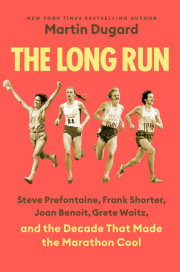
The dramatic story behind the running and marathon boom of the 1970s and early 1980s, featuring the stories of Steve Prefontaine, Frank Shorter, Joan Benoit, Grete Waitz, and many others, about how a generation of runners turned the marathon into a national obsession

On September 3, 1970, the New York City Marathon was run for the first time. One hundred
twenty-seven runners paid a one-dollar entry fee, and only one woman competed. Fifty-four years later, nearly fifty thousand runners from all over the world finished the same race. Almost half were women. More than three times as many runners applied, and over two million spectators watched. Marathons are inclusive, fully global, and still exploding in popularity.

How did we get from there to here? As Martin Dugard, longtime runner, running coach,
and #1 New York Times bestselling author, explains, it was thanks to four very special runners who changed the way America, and the world, saw running. The Long Run celebrates these athletes— Frank Shorter, Steve Prefontaine, Joan Benoit, and Grete Waitz—and many more, sharing stories of the specific races and social movements that transformed running from a niche sport to a national obsession. It follows Shorter through his early training and his triumph in Munich; Prefontaine in his legendary races, disappointing Olympics, and tragic death; and Benoit and Waitz in their eleven hardwon duels before Benoit won the first women’s Olympic Marathon and Waitz broke the tape in the first of five New York City Marathon victories.

It is a story with big characters, enormous moments, and a historical arc that has never been completely explored. The Long Run will reveal how the sport of running, and the race that we all know and love, became iconic—and how “finishing a marathon” became a top bucket-list
goal for runners and non-runners alike.
Marathon

September 10, 490 BC

Marathon, Greece

6:30 a.m.

The legend begins this morning.

"At them," commands Miltiades, the compact Athenian general. Sixty. Wellborn. Hails from a family renowned for winning Olympic chariot races. The average Greek male of the time is five feet, five inches. Nothing in the history books suggests Miltiades is much taller.

Eleven thousand soldiers begin marching briskly across this coastal plane. Battle formation. Sunrise in their eyes. Gentle wind blowing in from the sea. Clad in leather battle armor, bronze helmets, togas, sandals. Spear in one hand and circular wooden shield in the other. The air smells of body odor, cooking fires, and a faint hint of licorice. In Greek, marathon means "fields of fennel." The aroma of those plentiful herbs carries on the morning breeze.

These "hoplites" are greatly outnumbered. There are no hippeis, as Greek cavalry is known. Just foot soldiers. The fate of Athens rests in their hands. For the past decade, Hellenic city-states have revolted against Persian rule, eager to copy the Athenian experiment in democracy. City-state by city-state, King Darius of Persia has sent his army to rape, burn, and pillage, forcing these rebels to once again submit.

The only other Greek holdout is Sparta-Athens' philosophical opposite. One is known for wisdom, and the other for war. Unfortunately for the hoplites, their home is the city-state lacking in military tradition. Every man of fighting age has been summoned to Marathon. Slaves promised freedom if they fight. Should Miltiades fail, nothing will stop the Persians from marching twenty-five miles inland to level Athens.

One mile from the attacking hoplites, backs to the narrow beach, forces loyal to Darius look forward to the smell of spilled Athenian blood: 15,000 foot soldiers, 1,000 horses and riders, 800 ships that carried them across the Aegean, and more than 100,000 sailors and oarsmen who guided this conquering force over the narrow sea. Their weapons of choice are bow, arrow, dagger, short spear.

The foreigners mill on the light brown sand, awaiting the order to attack. Unworried warriors wander to the nearby marshes for a last prebattle constitutional. They take their time getting into formation, a confusion of shouted commands, milling bodies, and sharp pointy weapons. Led by the able commanders Datis and Artaphernes, the Persians have just conquered and burned the Greek city of Eretrea. Nothing can stop them. The outcome is so assured, their cavalry is already loading back onto the ships to attack Athens from a different direction.

Meanwhile, hoplites march faster.

The Athenians have ten generals in the field. Miltiades is commander in chief. He is one year away from a dungeon, disgrace, a sword flaying open his meaty horseman's thigh, and death by gangrene. Yet on this summer morning, the general is brilliant. He orders his outnumbered hoplites to close on the Persians. Their march turns into a trot. Then a run. Speed is vital. The eight-foot-long Athenian spears are for thrusting, not throwing. Blade on one end and bronze spike on the other. Only good in tight combat.

Miltiades's strategy is unusual. He keeps the center column weak, strengthening the right and left flanks. This risky proposition makes his army extremely vulnerable.

The second unique aspect is running.

This is not done. No one charges headlong into the Persian army. Foolish. Suicidal. Hails of Persian arrows can kill from two hundred meters away. The notion of a lightly armed opposing force surviving arrows falling from the sky like rain and then engaging in hand-to-hand combat is absurd.

That's exactly what the Athenians are doing. Weighted down by forty pounds of kit, the hoplites charge like they have everything to lose.

Persian archers slowly kneel or stand, getting into position. To their amazement, Athenians blitz the final hundred meters into their lines. Greek historian Herodotus will write about this moment through enemy eyes, stating, "In their minds they charged the Athenians with madness which must be fatal, seeing that they were few and yet were pressing forwards at a run, having neither cavalry nor archers."

Spears extended. Shields over heads deflect falling arrows. Bare hoplite arms and legs glisten with sweat from the mile of running. Breath comes in ragged bursts. Muscles burn.

Then the crash of two armies colliding. Imagine the sound of a modern NFL football game as offensive and defensive lines hurl themselves into one other. A thud of bodies smashing into one another so loud it is heard a hundred yards away. Profanity. Snorts, grunts, groans. Cries of exhaustion and pain. Men trampled. Limbs contorted. A clatter of that unique body armor known as shoulder pads.

Now multiply that brutish tumult times thousands.

And make it life or death.

Persian and Athenian lines are thirty and forty deep as they clash. More mob than army. No chance for men to maneuver once they're stuck in the scrum. They just stand in place, spears swinging right and left, looking for the next man to kill, often impaled themselves by a blindside. For every man who falls, another moves forward, standing on the dead and dying as they wade into the fight.

Metallic scent of blood as spears plunge through bodies. Clang of swords on armor and shields. Stench of men soiling themselves as they die. Screams of surprise, terror, agony. Face-to-face combat means they smell their opposite's breath, body odor, and that breakfast of dates and dried fish. The Athenians have a tradition of hand-to-hand fighting, yet numbers favor their opponent. The Persians push the hoplites back, hoping to overrun the Athenians. There, they make a great mistake, born of Miltiades's genius: The weak center is a trap. Each time an attack is made, the strong flanks descend and slaughter.

The battle lasts four hours. Athens loses 192 men. Persian archers finally turn and sprint for their ships, leaving behind 6,400 dead on the Marathon plain. Many more drown escaping through coastal swamps.

Athenians spend the afternoon cremating their fallen and covering the ashes with earth. Though exhausted from a long morning of battle and saying farewell, they march seven hours home to prevent the escaped Persian fleet from attacking Athens by sea.

Today's victory has a lasting effect on world history. It's how democracy grows and spreads, just like the running movement 2,500 years later. This belief in equality and freedom would not be possible had a triumphant Persia installed yet another autocratic dictatorship. The Greeks still consider it the greatest battle in their history.

Incredibly, that's not why we remember this day.

We remember it for a legendary hero who never donned battle armor.

All he did was run.

Supposedly.

Pheidippides

September 10, 490 BC

Marathon, Greece

Afternoon

The legend has a name.

Pheidippides. Forty when the Battle of Marathon is waged. Old even for ancient times but capable of running 150 miles in less than two days. He makes his living as a professional hemerodrome-"day-long runner." Athens's secret weapons. Carry information from city to city and general to general. Clad in toga and sandals, these professional distance runners travel faster over rugged mountainous terrain than a man on horseback.

Miltiades needs someone to tell Athenians about the amazing victory. He chooses Pheidippides. The courier immediately runs the uphill twenty-five miles from Marathon to Athens. Most hemerodromes are young men, barely older than a teenager. For Pheidippides to continue this job into early middle age is an indication of great prowess. He is also comfortable being alone, self-reliant, perseverant, disciplined, in tune with his body, familiar with discomfort, sustaining an interior dialogue on the run that often takes him out of the moment and into a realm of faraway thought, a man who finds great pleasure in the simple act of putting one foot in front of the other for miles on end, and has no problem whatsoever relieving himself in the great outdoors.

Just like every distance runner the world has known before and since.

The best route from battlefield to Acropolis begins with a short jog south along the coast. A right turn. A long steady climb through the foothills of Mount Penteli and Mount Hymettus that will light a fire inside Pheidippides's quadriceps muscles. Then a gentle downhill into the teeming streets of cosmopolitan Athens. Perversely, this transition from climbing to descent alters muscle movement from extension to compression. Sudden eccentric contractions cause upper leg muscles to cramp. The last miles will be an exercise in pain management.

The afternoon of the battle is warm. Sun reflects heat off the boulders lining the wide mountain trail. Pheidippides grinds through the uphill miles, pace smooth and steady. Energy comes from a small pouch of figs, olives, dried meats, and a sesame seed and honey paste. Water is slurped greedily from streams. He already ran 150 miles to Sparta and back this week; this is known to be fact. So, Pheidippides is at his limit as he runs the 25 miles from Marathon after the battle.

Athens is a large city in 490. Population 140,000. Sunset is 6:32 p.m. on this particular summer evening. Even starting in midafternoon, Pheidippides is swift enough to arrive by dusk. Given the legendary stamina of hemerodromes, crowds of citizens and slaves make a path for him as the exhausted runner enters the city from the east, following the dirt streets past the pillars of Ναὸς τοῦὈλυμπίου Διός, Naós tou Olympíou Diós-roughly, "Temple of the Olympian Zeus"-then staggers up the smooth limestone steps of the Acropolis. There, at the highest point in Athens, he shouts, "Nike! Nike!"-victory, victory.

Then drops dead.

In this moment, a hero is born. In one fell swoop, Pheidippides runs the first-ever "marathon" and dies at the finish line. From this day forward, the distance will be synonymous with ultimate sacrifice.

Some modern researchers explain cause of death as takotsubo syndrome, or broken heart, for the ailment's occurrence during a tumultuous incident. The traumatized muscle simply stops beating.

It's the ultimate hero legend-war, triumph, perseverance, death. The only thing missing is a love interest. An epic saga perfect for passing from generation to generation to generation, never losing its narrative power and inspiration.

Only, none of it happened.

Pheidippides was a real man. We know of him through Herodotus. In his seminal Histories the Greek scholar describes the Battle of Marathon in vivid detail. He writes sixty-five years after the fight, basing his story on eyewitness accounts. The historian mentions Pheidippides by name, stating that this hemerodrome ran that incredibly long distance to Sparta on the eve of battle. The courier's purpose was to convince them to aid the Athenians. The Spartans said yes, but wait a week, when an important religious festival will be over. Then we'll help.

So Pheidippides runs all the way back to Athens to give Miltiades the bad news. Here, Herodotus steps away from historical rigor to assert that Pheidippides takes a detour to visit the god Pan. Ancient Greek writing commonly blends myth and fact to add a supernatural feel. Pan is half man and half goat, with a male torso, rough beard, and prominent genitals, as well as cloven hooves, horns, and a tail. He loves to dance, play the pipe, and slay beasts. His hallmarks are laughter and sexual vitality. Early Christians base their physical description of the devil on this licentious god. Edwardians immortalized him as the eternal boy: Peter Pan.

By the time Herodotus writes Histories, Athenians believe Pan is why they won at Marathon. Leaving the beloved deity out of something as momentous as the world's first history book would be a glaring omission. So, Herodotus writes of Pheidippides and Pan having a conversation before the courier goes on his way.

This fantastical addition underscores the one thing Herodotus does not mention: Pheidippides running from Marathon to Athens. Nor does he mention a courier-any courier-crying "Nike." Or anyone dropping dead.

Herodotus is the Father of History. So dedicated to his craft that he attempted to travel the length of the Nile searching for its source. The journey ended six hundred miles south of Cairo at the impassable waterfall known as the First Cataract, whereupon the historian was forced to turn around and travel all the way back downriver. Pan notwithstanding, Herodotus possessed great professional discipline. He would have mentioned such a dramatic moment. Particularly one witnessed by crowds of Athenians as an exhausted and sunburned Pheidippides runs the final uphill mile to the Acropolis.

Herodotus's version of events goes like this:

Pheidippides runs to Sparta.

Pheidippides runs back from Sparta, stopping to speak with a god who loves laughter and music, inspires such fear in his enemies that mild-mannered souls turn into carnivorous beasts, and has lots of sex. Pheidippides is a great runner.


This is where legend and myth diverge.

A legend is a historical tale that may or may not be true.

A myth is pure fiction posturing as truth to explain a social phenomenon.

The marathon myth starts five hundred years after Herodotus and one hundred years following the birth of Christ. Plutarch writes an essay dramatizing the story of Pheidippides. This Greek historian is in his mid-fifties. Father of five. Greek by birth but a Roman citizen. He seeks to answer a prominent question of his time: whether Athens is still better known for wisdom over war.

Plutarch lands on the side of wisdom. To explain why, he also discusses great battles. So, as part of his thesis, Plutarch's "On the Glory of Athens" (De Gloria Atheniensium) revives the marathon story. The historian writes of a courier running from Marathon to cry news of victory. His name is Thersippus. For good measure, Plutarch also mentions a runner named Eukles.

Both hemerodromes complete the journey.

No Nike. No dying.

No Pheidippides.
© Joe Latter
Martin Dugard is the author of a dozen #1 New York Times bestsellers. Among these works of running and history is the international sensation Into Africa. He is a Fellow of Great Britain’s Royal Geographical Society, Board Member of the USA Track and Field Foundation, and high school distance running coach of more than two decades with multiple California state championships to his credit. Mr. Dugard blogs weekly as The Paper Kenyan on martindugard.com. Martin Dugard and wife Calene live on a hill in Southern California. View titles by Martin Dugard
"[The joy of running] pulsates through Martin Dugard’s “The Long Run.” A breezy mix of history, profiles and memoir.... Dugard emerges as its most endearing character." —Wall Street Journal

"Dugard’s compelling narrative about a transformative decade that catapulted jogging into today’s popular long-distance events with mass participation is sure to be popular with runners of all ages.” —Booklist

"A fittingly fast-moving account of the rise of modern marathon and distance running... A welcome book for running fans, and an inspiration to lace up and get moving." —Kirkus

"[Dugard] offers affecting stories of the sport’s brightest stars. Runners will be delighted."
—Publishers Weekly

"To best appreciate the current boom in distance running, it's necessary to peek back at its history. Martin Dugard's The Long Run is an entertaining look at the roots of the sport, a celebration of its heroes, and a beautiful reminder that, while distance running hasn’t always been the most popular sport, it's always been pretty dang cool." —Des Linden, Boston Marathon Champion and New York Times bestselling author of Choosing to Run

“The Long Run goes beyond recounting America’s running boom, showing how Steve Prefontaine, Frank Shorter, Joan Benoit Samuelson and Grete Waitz helped turn running—and the marathon—into a national force. With a historian’s eye and a runner’s heart, Martin Dugard delivers racing accounts that put you in the shoes of these legends, infused with his own passion for the sport. It’s a reminder not just of how running got cool (and keeps getting cooler), but why we keep doing it.” —Chris Chavez, founder of Citius Mag and author of the forthcoming The Marathon Book

“Martin Dugard’s The Long Run unearths and relates many fascinating, long-forgotten stories of the first running boom. Dugard’s love of the sport infuses every page, while his rapid-fire narrative style makes every chapter a readable feast. From Bowerman to Pre, Shorter to Rodgers, Waitz to Benoit, it’s all here. A marathon tour-de-force that moves at sub-4 mile pace.” —Amby Burfoot, winner, 1968 Boston Marathon, author of Run Forever, and longtime editor of Runner’s World

The Long Run is a brilliantly written education of the most mass-participated sport in the world, the marathon. It is a must read for the millions of people who take on the distance each year.” —Deena Kastor, Olympic bronze medalist and New York Times bestselling author of Let Your Mind Run

“In The Long Run Martin takes us back to when running started and how it inspires to this day. Every runner should be a student of the sport and learn from Martin Dugard's amazing book."
—Meb Keflezighi, 2004 Olympic silver medalist, Boston Marathon champion, and New York Times bestselling author of 26 Marathons


“This just may be the best book on running that I have read. Combining the research skills of an historian with the powerful storytelling of a novelist, Martin Dugard gives us a thrilling narrative. He tells the incredible history of long distance running, it’s larger than life personalities, the dramatic events that brought running to millions around the globe and why it all matters so much.” —George A. Hirsch, chairman emeritus of the New York Road Runners, co-founder of the five borough New York City Marathon, founding publisher of Runner’s World

"More than a sports history, The Long Run is the story of a cultural phenomenon. Dugard shows how a perfect storm of charismatic figures and cultural anxiety transformed running from an obscure activity into a global phenomenon. It's a powerful exploration of how we learned to embrace endurance, not just as a physical test, but as a defining part of our modern identity. A must read!" —Steve Magness, author of Do Hard Things

“Reading The Long Run is like pounding out some miles with a great friend on a Sunday morning. Pure joy. And most importantly, it will make you want to run — as far and as fast as you can.” —Matthew Futterman, author of Running to the Edge

"Is there anything more pure than a foot race? In The Long Run, Martin Dugard captures both the passion of the hardcore runner and the curiosity of the beginner, taking readers on a journey from the mythic contests of ancient times to the boom of the 1970s and the electrifying competitions that define running today. The Long Run explores why people continue to be drawn to a seemingly simple sport and to a distance so iconic that it is sometimes used as a metaphor for life itself: the marathon." —Grant Fisher, Team USA. 2024 Olympic Medalist in the 5,000 and 10,000 meters

"The Long Run is required reading for anyone who loves the marathon. It gave me a greater appreciation of the legends in the sport who came before me and created the momentum for the running movement that I benefit from today. It reminded me how truly special our sport it." —Sara Hall, pro marathon runner and author of For the Love of the Grind

"I simply can't stop reading Martin Dugard's new masterpiece, The Long Run. I guarantee that if you have ever laced up a pair of running shoes, you will simply love this book. What a great read!" —Bob Babbitt, co-founder of Competitor Magazine and inductee into the USA Triathlon Hall of Fame and Ironman Hall of Fame

"Martin Dugard skillfully shares an unprecedented account of the wonderful sport of distance running through his peerless ability to depict historical legends, running pioneers, unrecognized influencers, iconic coaches, and competitors. The Long Run is an extremely special opportunity to personally connect with and to uniquely appreciate one of the world's greatest sports." —Jeff Messer, distance coach, exercise physiologist, and top coaching clinician

“A swift, totally engrossing narrative about the men and women who turned distance
running into an American obsession. As I read, I didn’t feel like I was holding a book.
I felt like I was on the side of the road, cheering in Boston, New York, Los Angeles,
Munich, Eugene. It’s a story for people who lived through the first running boom,
but even more for those discovering the one happening now.” —Nicholas Thompson, CEO of The Atlantic and author of the national bestseller The Running Ground

"As an aspiration, a peak accomplishment, or a foundation for more, we have no more universal symbol of human potential than the marathon. The Long Run tells the story of how this came to be true. It does this with gripping narratives of pivotal moments." —Rush of It All

About

The dramatic story behind the running and marathon boom of the 1970s and early 1980s, featuring the stories of Steve Prefontaine, Frank Shorter, Joan Benoit, Grete Waitz, and many others, about how a generation of runners turned the marathon into a national obsession

On September 3, 1970, the New York City Marathon was run for the first time. One hundred
twenty-seven runners paid a one-dollar entry fee, and only one woman competed. Fifty-four years later, nearly fifty thousand runners from all over the world finished the same race. Almost half were women. More than three times as many runners applied, and over two million spectators watched. Marathons are inclusive, fully global, and still exploding in popularity.

How did we get from there to here? As Martin Dugard, longtime runner, running coach,
and #1 New York Times bestselling author, explains, it was thanks to four very special runners who changed the way America, and the world, saw running. The Long Run celebrates these athletes— Frank Shorter, Steve Prefontaine, Joan Benoit, and Grete Waitz—and many more, sharing stories of the specific races and social movements that transformed running from a niche sport to a national obsession. It follows Shorter through his early training and his triumph in Munich; Prefontaine in his legendary races, disappointing Olympics, and tragic death; and Benoit and Waitz in their eleven hardwon duels before Benoit won the first women’s Olympic Marathon and Waitz broke the tape in the first of five New York City Marathon victories.

It is a story with big characters, enormous moments, and a historical arc that has never been completely explored. The Long Run will reveal how the sport of running, and the race that we all know and love, became iconic—and how “finishing a marathon” became a top bucket-list
goal for runners and non-runners alike.

Excerpt

Marathon

September 10, 490 BC

Marathon, Greece

6:30 a.m.

The legend begins this morning.

"At them," commands Miltiades, the compact Athenian general. Sixty. Wellborn. Hails from a family renowned for winning Olympic chariot races. The average Greek male of the time is five feet, five inches. Nothing in the history books suggests Miltiades is much taller.

Eleven thousand soldiers begin marching briskly across this coastal plane. Battle formation. Sunrise in their eyes. Gentle wind blowing in from the sea. Clad in leather battle armor, bronze helmets, togas, sandals. Spear in one hand and circular wooden shield in the other. The air smells of body odor, cooking fires, and a faint hint of licorice. In Greek, marathon means "fields of fennel." The aroma of those plentiful herbs carries on the morning breeze.

These "hoplites" are greatly outnumbered. There are no hippeis, as Greek cavalry is known. Just foot soldiers. The fate of Athens rests in their hands. For the past decade, Hellenic city-states have revolted against Persian rule, eager to copy the Athenian experiment in democracy. City-state by city-state, King Darius of Persia has sent his army to rape, burn, and pillage, forcing these rebels to once again submit.

The only other Greek holdout is Sparta-Athens' philosophical opposite. One is known for wisdom, and the other for war. Unfortunately for the hoplites, their home is the city-state lacking in military tradition. Every man of fighting age has been summoned to Marathon. Slaves promised freedom if they fight. Should Miltiades fail, nothing will stop the Persians from marching twenty-five miles inland to level Athens.

One mile from the attacking hoplites, backs to the narrow beach, forces loyal to Darius look forward to the smell of spilled Athenian blood: 15,000 foot soldiers, 1,000 horses and riders, 800 ships that carried them across the Aegean, and more than 100,000 sailors and oarsmen who guided this conquering force over the narrow sea. Their weapons of choice are bow, arrow, dagger, short spear.

The foreigners mill on the light brown sand, awaiting the order to attack. Unworried warriors wander to the nearby marshes for a last prebattle constitutional. They take their time getting into formation, a confusion of shouted commands, milling bodies, and sharp pointy weapons. Led by the able commanders Datis and Artaphernes, the Persians have just conquered and burned the Greek city of Eretrea. Nothing can stop them. The outcome is so assured, their cavalry is already loading back onto the ships to attack Athens from a different direction.

Meanwhile, hoplites march faster.

The Athenians have ten generals in the field. Miltiades is commander in chief. He is one year away from a dungeon, disgrace, a sword flaying open his meaty horseman's thigh, and death by gangrene. Yet on this summer morning, the general is brilliant. He orders his outnumbered hoplites to close on the Persians. Their march turns into a trot. Then a run. Speed is vital. The eight-foot-long Athenian spears are for thrusting, not throwing. Blade on one end and bronze spike on the other. Only good in tight combat.

Miltiades's strategy is unusual. He keeps the center column weak, strengthening the right and left flanks. This risky proposition makes his army extremely vulnerable.

The second unique aspect is running.

This is not done. No one charges headlong into the Persian army. Foolish. Suicidal. Hails of Persian arrows can kill from two hundred meters away. The notion of a lightly armed opposing force surviving arrows falling from the sky like rain and then engaging in hand-to-hand combat is absurd.

That's exactly what the Athenians are doing. Weighted down by forty pounds of kit, the hoplites charge like they have everything to lose.

Persian archers slowly kneel or stand, getting into position. To their amazement, Athenians blitz the final hundred meters into their lines. Greek historian Herodotus will write about this moment through enemy eyes, stating, "In their minds they charged the Athenians with madness which must be fatal, seeing that they were few and yet were pressing forwards at a run, having neither cavalry nor archers."

Spears extended. Shields over heads deflect falling arrows. Bare hoplite arms and legs glisten with sweat from the mile of running. Breath comes in ragged bursts. Muscles burn.

Then the crash of two armies colliding. Imagine the sound of a modern NFL football game as offensive and defensive lines hurl themselves into one other. A thud of bodies smashing into one another so loud it is heard a hundred yards away. Profanity. Snorts, grunts, groans. Cries of exhaustion and pain. Men trampled. Limbs contorted. A clatter of that unique body armor known as shoulder pads.

Now multiply that brutish tumult times thousands.

And make it life or death.

Persian and Athenian lines are thirty and forty deep as they clash. More mob than army. No chance for men to maneuver once they're stuck in the scrum. They just stand in place, spears swinging right and left, looking for the next man to kill, often impaled themselves by a blindside. For every man who falls, another moves forward, standing on the dead and dying as they wade into the fight.

Metallic scent of blood as spears plunge through bodies. Clang of swords on armor and shields. Stench of men soiling themselves as they die. Screams of surprise, terror, agony. Face-to-face combat means they smell their opposite's breath, body odor, and that breakfast of dates and dried fish. The Athenians have a tradition of hand-to-hand fighting, yet numbers favor their opponent. The Persians push the hoplites back, hoping to overrun the Athenians. There, they make a great mistake, born of Miltiades's genius: The weak center is a trap. Each time an attack is made, the strong flanks descend and slaughter.

The battle lasts four hours. Athens loses 192 men. Persian archers finally turn and sprint for their ships, leaving behind 6,400 dead on the Marathon plain. Many more drown escaping through coastal swamps.

Athenians spend the afternoon cremating their fallen and covering the ashes with earth. Though exhausted from a long morning of battle and saying farewell, they march seven hours home to prevent the escaped Persian fleet from attacking Athens by sea.

Today's victory has a lasting effect on world history. It's how democracy grows and spreads, just like the running movement 2,500 years later. This belief in equality and freedom would not be possible had a triumphant Persia installed yet another autocratic dictatorship. The Greeks still consider it the greatest battle in their history.

Incredibly, that's not why we remember this day.

We remember it for a legendary hero who never donned battle armor.

All he did was run.

Supposedly.

Pheidippides

September 10, 490 BC

Marathon, Greece

Afternoon

The legend has a name.

Pheidippides. Forty when the Battle of Marathon is waged. Old even for ancient times but capable of running 150 miles in less than two days. He makes his living as a professional hemerodrome-"day-long runner." Athens's secret weapons. Carry information from city to city and general to general. Clad in toga and sandals, these professional distance runners travel faster over rugged mountainous terrain than a man on horseback.

Miltiades needs someone to tell Athenians about the amazing victory. He chooses Pheidippides. The courier immediately runs the uphill twenty-five miles from Marathon to Athens. Most hemerodromes are young men, barely older than a teenager. For Pheidippides to continue this job into early middle age is an indication of great prowess. He is also comfortable being alone, self-reliant, perseverant, disciplined, in tune with his body, familiar with discomfort, sustaining an interior dialogue on the run that often takes him out of the moment and into a realm of faraway thought, a man who finds great pleasure in the simple act of putting one foot in front of the other for miles on end, and has no problem whatsoever relieving himself in the great outdoors.

Just like every distance runner the world has known before and since.

The best route from battlefield to Acropolis begins with a short jog south along the coast. A right turn. A long steady climb through the foothills of Mount Penteli and Mount Hymettus that will light a fire inside Pheidippides's quadriceps muscles. Then a gentle downhill into the teeming streets of cosmopolitan Athens. Perversely, this transition from climbing to descent alters muscle movement from extension to compression. Sudden eccentric contractions cause upper leg muscles to cramp. The last miles will be an exercise in pain management.

The afternoon of the battle is warm. Sun reflects heat off the boulders lining the wide mountain trail. Pheidippides grinds through the uphill miles, pace smooth and steady. Energy comes from a small pouch of figs, olives, dried meats, and a sesame seed and honey paste. Water is slurped greedily from streams. He already ran 150 miles to Sparta and back this week; this is known to be fact. So, Pheidippides is at his limit as he runs the 25 miles from Marathon after the battle.

Athens is a large city in 490. Population 140,000. Sunset is 6:32 p.m. on this particular summer evening. Even starting in midafternoon, Pheidippides is swift enough to arrive by dusk. Given the legendary stamina of hemerodromes, crowds of citizens and slaves make a path for him as the exhausted runner enters the city from the east, following the dirt streets past the pillars of Ναὸς τοῦὈλυμπίου Διός, Naós tou Olympíou Diós-roughly, "Temple of the Olympian Zeus"-then staggers up the smooth limestone steps of the Acropolis. There, at the highest point in Athens, he shouts, "Nike! Nike!"-victory, victory.

Then drops dead.

In this moment, a hero is born. In one fell swoop, Pheidippides runs the first-ever "marathon" and dies at the finish line. From this day forward, the distance will be synonymous with ultimate sacrifice.

Some modern researchers explain cause of death as takotsubo syndrome, or broken heart, for the ailment's occurrence during a tumultuous incident. The traumatized muscle simply stops beating.

It's the ultimate hero legend-war, triumph, perseverance, death. The only thing missing is a love interest. An epic saga perfect for passing from generation to generation to generation, never losing its narrative power and inspiration.

Only, none of it happened.

Pheidippides was a real man. We know of him through Herodotus. In his seminal Histories the Greek scholar describes the Battle of Marathon in vivid detail. He writes sixty-five years after the fight, basing his story on eyewitness accounts. The historian mentions Pheidippides by name, stating that this hemerodrome ran that incredibly long distance to Sparta on the eve of battle. The courier's purpose was to convince them to aid the Athenians. The Spartans said yes, but wait a week, when an important religious festival will be over. Then we'll help.

So Pheidippides runs all the way back to Athens to give Miltiades the bad news. Here, Herodotus steps away from historical rigor to assert that Pheidippides takes a detour to visit the god Pan. Ancient Greek writing commonly blends myth and fact to add a supernatural feel. Pan is half man and half goat, with a male torso, rough beard, and prominent genitals, as well as cloven hooves, horns, and a tail. He loves to dance, play the pipe, and slay beasts. His hallmarks are laughter and sexual vitality. Early Christians base their physical description of the devil on this licentious god. Edwardians immortalized him as the eternal boy: Peter Pan.

By the time Herodotus writes Histories, Athenians believe Pan is why they won at Marathon. Leaving the beloved deity out of something as momentous as the world's first history book would be a glaring omission. So, Herodotus writes of Pheidippides and Pan having a conversation before the courier goes on his way.

This fantastical addition underscores the one thing Herodotus does not mention: Pheidippides running from Marathon to Athens. Nor does he mention a courier-any courier-crying "Nike." Or anyone dropping dead.

Herodotus is the Father of History. So dedicated to his craft that he attempted to travel the length of the Nile searching for its source. The journey ended six hundred miles south of Cairo at the impassable waterfall known as the First Cataract, whereupon the historian was forced to turn around and travel all the way back downriver. Pan notwithstanding, Herodotus possessed great professional discipline. He would have mentioned such a dramatic moment. Particularly one witnessed by crowds of Athenians as an exhausted and sunburned Pheidippides runs the final uphill mile to the Acropolis.

Herodotus's version of events goes like this:

Pheidippides runs to Sparta.

Pheidippides runs back from Sparta, stopping to speak with a god who loves laughter and music, inspires such fear in his enemies that mild-mannered souls turn into carnivorous beasts, and has lots of sex. Pheidippides is a great runner.


This is where legend and myth diverge.

A legend is a historical tale that may or may not be true.

A myth is pure fiction posturing as truth to explain a social phenomenon.

The marathon myth starts five hundred years after Herodotus and one hundred years following the birth of Christ. Plutarch writes an essay dramatizing the story of Pheidippides. This Greek historian is in his mid-fifties. Father of five. Greek by birth but a Roman citizen. He seeks to answer a prominent question of his time: whether Athens is still better known for wisdom over war.

Plutarch lands on the side of wisdom. To explain why, he also discusses great battles. So, as part of his thesis, Plutarch's "On the Glory of Athens" (De Gloria Atheniensium) revives the marathon story. The historian writes of a courier running from Marathon to cry news of victory. His name is Thersippus. For good measure, Plutarch also mentions a runner named Eukles.

Both hemerodromes complete the journey.

No Nike. No dying.

No Pheidippides.

Author

© Joe Latter
Martin Dugard is the author of a dozen #1 New York Times bestsellers. Among these works of running and history is the international sensation Into Africa. He is a Fellow of Great Britain’s Royal Geographical Society, Board Member of the USA Track and Field Foundation, and high school distance running coach of more than two decades with multiple California state championships to his credit. Mr. Dugard blogs weekly as The Paper Kenyan on martindugard.com. Martin Dugard and wife Calene live on a hill in Southern California. View titles by Martin Dugard

Praise

"[The joy of running] pulsates through Martin Dugard’s “The Long Run.” A breezy mix of history, profiles and memoir.... Dugard emerges as its most endearing character." —Wall Street Journal

"Dugard’s compelling narrative about a transformative decade that catapulted jogging into today’s popular long-distance events with mass participation is sure to be popular with runners of all ages.” —Booklist

"A fittingly fast-moving account of the rise of modern marathon and distance running... A welcome book for running fans, and an inspiration to lace up and get moving." —Kirkus

"[Dugard] offers affecting stories of the sport’s brightest stars. Runners will be delighted."
—Publishers Weekly

"To best appreciate the current boom in distance running, it's necessary to peek back at its history. Martin Dugard's The Long Run is an entertaining look at the roots of the sport, a celebration of its heroes, and a beautiful reminder that, while distance running hasn’t always been the most popular sport, it's always been pretty dang cool." —Des Linden, Boston Marathon Champion and New York Times bestselling author of Choosing to Run

“The Long Run goes beyond recounting America’s running boom, showing how Steve Prefontaine, Frank Shorter, Joan Benoit Samuelson and Grete Waitz helped turn running—and the marathon—into a national force. With a historian’s eye and a runner’s heart, Martin Dugard delivers racing accounts that put you in the shoes of these legends, infused with his own passion for the sport. It’s a reminder not just of how running got cool (and keeps getting cooler), but why we keep doing it.” —Chris Chavez, founder of Citius Mag and author of the forthcoming The Marathon Book

“Martin Dugard’s The Long Run unearths and relates many fascinating, long-forgotten stories of the first running boom. Dugard’s love of the sport infuses every page, while his rapid-fire narrative style makes every chapter a readable feast. From Bowerman to Pre, Shorter to Rodgers, Waitz to Benoit, it’s all here. A marathon tour-de-force that moves at sub-4 mile pace.” —Amby Burfoot, winner, 1968 Boston Marathon, author of Run Forever, and longtime editor of Runner’s World

The Long Run is a brilliantly written education of the most mass-participated sport in the world, the marathon. It is a must read for the millions of people who take on the distance each year.” —Deena Kastor, Olympic bronze medalist and New York Times bestselling author of Let Your Mind Run

“In The Long Run Martin takes us back to when running started and how it inspires to this day. Every runner should be a student of the sport and learn from Martin Dugard's amazing book."
—Meb Keflezighi, 2004 Olympic silver medalist, Boston Marathon champion, and New York Times bestselling author of 26 Marathons


“This just may be the best book on running that I have read. Combining the research skills of an historian with the powerful storytelling of a novelist, Martin Dugard gives us a thrilling narrative. He tells the incredible history of long distance running, it’s larger than life personalities, the dramatic events that brought running to millions around the globe and why it all matters so much.” —George A. Hirsch, chairman emeritus of the New York Road Runners, co-founder of the five borough New York City Marathon, founding publisher of Runner’s World

"More than a sports history, The Long Run is the story of a cultural phenomenon. Dugard shows how a perfect storm of charismatic figures and cultural anxiety transformed running from an obscure activity into a global phenomenon. It's a powerful exploration of how we learned to embrace endurance, not just as a physical test, but as a defining part of our modern identity. A must read!" —Steve Magness, author of Do Hard Things

“Reading The Long Run is like pounding out some miles with a great friend on a Sunday morning. Pure joy. And most importantly, it will make you want to run — as far and as fast as you can.” —Matthew Futterman, author of Running to the Edge

"Is there anything more pure than a foot race? In The Long Run, Martin Dugard captures both the passion of the hardcore runner and the curiosity of the beginner, taking readers on a journey from the mythic contests of ancient times to the boom of the 1970s and the electrifying competitions that define running today. The Long Run explores why people continue to be drawn to a seemingly simple sport and to a distance so iconic that it is sometimes used as a metaphor for life itself: the marathon." —Grant Fisher, Team USA. 2024 Olympic Medalist in the 5,000 and 10,000 meters

"The Long Run is required reading for anyone who loves the marathon. It gave me a greater appreciation of the legends in the sport who came before me and created the momentum for the running movement that I benefit from today. It reminded me how truly special our sport it." —Sara Hall, pro marathon runner and author of For the Love of the Grind

"I simply can't stop reading Martin Dugard's new masterpiece, The Long Run. I guarantee that if you have ever laced up a pair of running shoes, you will simply love this book. What a great read!" —Bob Babbitt, co-founder of Competitor Magazine and inductee into the USA Triathlon Hall of Fame and Ironman Hall of Fame

"Martin Dugard skillfully shares an unprecedented account of the wonderful sport of distance running through his peerless ability to depict historical legends, running pioneers, unrecognized influencers, iconic coaches, and competitors. The Long Run is an extremely special opportunity to personally connect with and to uniquely appreciate one of the world's greatest sports." —Jeff Messer, distance coach, exercise physiologist, and top coaching clinician

“A swift, totally engrossing narrative about the men and women who turned distance
running into an American obsession. As I read, I didn’t feel like I was holding a book.
I felt like I was on the side of the road, cheering in Boston, New York, Los Angeles,
Munich, Eugene. It’s a story for people who lived through the first running boom,
but even more for those discovering the one happening now.” —Nicholas Thompson, CEO of The Atlantic and author of the national bestseller The Running Ground

"As an aspiration, a peak accomplishment, or a foundation for more, we have no more universal symbol of human potential than the marathon. The Long Run tells the story of how this came to be true. It does this with gripping narratives of pivotal moments." —Rush of It All

Books for Asian American, Native Hawaiian, and Pacific Islander Heritage Month

Each May, we honor the stories, histories, and cultures of Asian Americans, Native Hawaiians, and Pacific Islanders. Below is a selection of acclaimed fiction and nonfiction books by AANHPI creators to share with your students this month and throughout the year. Find our full collection of titles for Higher Education here.

Read more