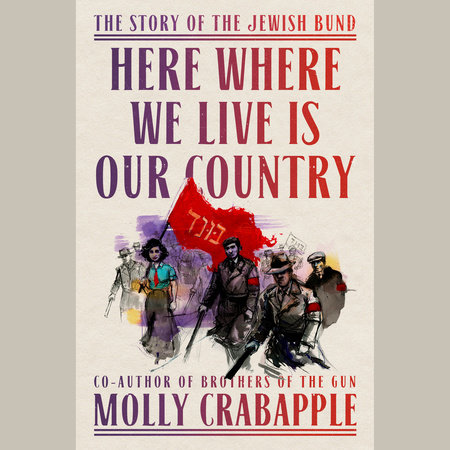
The dramatic story of the Jewish Bund—a revolutionary movement from a vanished world—and its radical vision of solidarity in an age of division.

“Molly Crabapple beckons readers through a portal to an irresistible, lost world, one bound together by passion, solidarity, and a burning hunger for justice.”—Naomi Klein, New York Times bestselling author of No Logo and Doppelganger

In the aftermath of the Holocaust, Sam Rothbort created “memory paintings” with the hope of resurrecting the vanished world of his shtetl childhood. Decades later, his great-granddaughter, the award-winning artist Molly Crabapple, discovered these paintings and one stood out: a girl, her dress the color of sky, hurling a rock through a cottage window. Itka the Bundist, Breaking Windows.

Itka is how Crabapple met the Jewish Labor Bund. Once the most influential Jewish political force in eastern Europe, the Bund was secular, socialist, and uncompromisingly anti-Zionist. The Bundists fought for dignity and equality, not in an imagined homeland in Palestine but “here where we live.”

In the first popular history of the Bund, Crabapple re-creates their extraordinary world through dramatic portraits of insurgent poets and antireligious rebels, clandestine revolutionaries and lovers on the barricades. The Bundists live deeply within this violent, volatile, and somehow hopeful period, as their stories interweave with the Russian Revolution and the Holocaust. The Bund’s rise and fall raises the vital question: What can we learn from a movement that, for all its toughness, imagination, and moral clarity, was largely destroyed?

Here Where We Live Is Our Country reanimates a band of idealists who broadened our global political imagination. As we once again contend with nationalism, repression, and the struggle for belonging, the Bund’s remarkable story and message—that liberation, dignity, and solidarity must begin where we stand—reaches across time as a guide to our own urgent moment.

*Includes a downloadable PDF containing the Cast of Characters and illustrations from the printed book
Chapter 1

Origins

(1772–­1897)

Every family has its legends.

My mother brought me up on stories of her family’s nonconformity. We came from a line of grand and impecunious artists. There was Cousin Jack Lush, a militant vegetarian long before it was en vogue. Cousin Jack walked across America to prove the health benefits of his diet. When he finally reached the East Coast, some mayor came out to present him with the key to his city, but Jack could not stop walking and passed him by. Eventually he walked off the entire continent, into the Caribbean, where he retired as the battery king of Trinidad. Or so my mother said. His sister, the dark beauty Vivian, was a sculptress, the sole protégée of Attilio Piccirilli, the Bronx’s “master of stone,” and carved her own sister, naked, for the doors of Rockefeller Center. Another relative, back in the 1930s, dreamed of buying a van and driving it down South to sell Theosophical pamphlets, and thus deliver a message of peace to Alabama in his thick Jewish accent. This cousin wrote to my great-­grandfather Sam to raise funds but was not, I presume, successful. His was only one of the fascinating letters addressed to Sam. There are piles of these, crammed with spiraling Yiddish script—­reminiscences of Paris, notes from famous writers, Rosh Hashanah cards with art nouveau type pressed into the luxuriant cardstock—­that my mother kept in shoeboxes in her closet.

If Jack and Vivian were stars in my mother’s recounting of family lore, my great-­grandfather Sam Rothbort was the moon and sun combined. He was an artist whose thousands of sculptures filled the storage room for which my mother begrudgingly paid. He was the humanist who thought all men were brothers, and the prankster who could eat fire and hang by his feet from a chin-­up bar well into his eighties. He was an autodidact whose daughter, my glamorous grandmother Ruth, stewed in resentment because he would not send her to college, and he was a monomaniac who took back his paintings from the Brooklyn Museum in a fit of pique, only to spread them out on the lawn of his humble house in Sheepshead Bay, dubbed “the Rothbort Home Museum of Direct Art,” in an effort to impress his genius directly upon the masses. He was a Great Man, in his mind and our minds, unrecognized by this selfish city. He was New York. He was ours.

My mother grew up close to her grandfather. When she was sick, Sam spooned honey in her mouth and called it medicine. He taught her to paint, just as she taught me. Falling asleep each night surrounded by his art, I tried to absorb his gift by proxy. I would stare at the wood frames he carved himself, each Yiddish letter gouged with a chisel, and imagine that someday I would paint something good enough to hang inside them. I read Sam’s self-­published book of essays, Out Of Wood and Stone, and I listened eagerly to my mother’s stories. I never met Sam Rothbort, but I might as well have. I knew him. He spoke to me through countless mediums, his smile wry, his black eyes mischievous. He had made himself an artist. This meant I could do the same.

In the myriad photos Sam Rothbort left, he appears in many guises. In one, taken during his twenties, when he had just arrived in America, he stands awkwardly, his head pinched by a derby a size too small. In another, he balances on a scaffold and applies swirls of plaster to a ceiling. There he is in his Brooklyn garden, and in the pages of a long-­out-­of-­print New York art magazine. These photos, as much as his paintings, fleshed out his image as Artist Progenitor, who brought the family line to the New World in 1904 and remained alive long enough to see my parents wed. Occasionally, my mother would find a photo of the family that he had left behind in Volkovysk, his hometown in the old country. Was it Russia or Poland? Our notions were vague. I could divine no resemblance between the family members in the photos and my jovial great-grandpa. His relatives were skinny, religious Jews, men in black coats and women with wigs, like the Williamsburg Chassidim. They didn’t smile, because life was hard in the Old World. Their pinched mouths seemed to whisper a warning.

You might have made it in America, kid. But it’s different back in Europe. Poverty. Shacks. Cholera. In the end we all were gassed.

No need to look back.

The Past

As a kid, I never felt at home in the present. I loathed school, loathed my peers, loathed my own awkward inability to speak. I imagined that I would have done splendidly elsewhere, in a bohemia from long ago and far away. My great-­grandfather was one thread to this imagined future-­past. The biography section of my local library provided others. I took out fat volumes on Lola Montez and Oscar Wilde and tried to scry my own future in their stories. I bought armfuls of thrift store paperbacks for similar reasons. The past soaked my art. I copied Goya and memorized the poems of Edna St. Vincent Millay. After I left home at seventeen, I tried to live like I was some mashup of Anaïs Nin and Toulouse-­Lautrec, often to comic effect. I posed for art classes for cash. I hid myself in the corners of burlesque clubs, where I drew fan dancers and fire-­eaters who were themselves trying to resurrect a half-­fictitious Paris. After I moved into a squalid little tenement in Williamsburg, I hung Sam’s paintings on my walls. But my fascination for my great-­grandfather didn’t extend to the place he came from. I imagined myself in lavish capital cities—­Paris, Mexico City, Saint Petersburg, built by people who were not his people—­and never in the Volkovysk of his birth. A darker history loomed in the background of the family photos he brought from Russia, one that I declined to research further. I papered over the ignorance with stereotype. I didn’t look back.

Only later did I ask myself about the history that had shaped Sam Rothbort. I was a journalist by then. I had traveled to war zones and interviewed refugees in camps that disgraced the European continent. I had sat on a balcony in Gaza and listened to Israeli bombs fall in the distance until, at last, the muezzin called in the dawn. Used to asking questions about others, I now began to wonder about my own family’s past. Sam’s unconventionality had paved the way for mine, but why was he himself so different from how the world intended him to be? Why was he, the son of a Talmudic scholar, never seen inside a synagogue? Why did he sculpt a communist fist, then add rueful commentary in his notebooks? Why did he denounce war? At a time when intermarriage was taboo, why did he accept my Puerto Rican father? Why did he never mention Israel?

What was the nature of his bond to Volkovysk, his hometown, which he immortalized in six hundred loving watercolors? How did he create himself in a place as grindingly oppressive as his birthplace? Then my mother gave me one of his notes, found in a shoebox, with these enigmatic words: “I belonged to the underground.” And for the first time, I realized that Sam Rothbort had not just been shaped by the Pale of Settlement. He had tried to shape it in turn.

The Pale

“Everyone makes mistakes, even God,” says Benya Krik, the Jewish gangster king of Isaac Babel’s Odessa Stories. “Was it not a mistake on God’s part to settle the Jews in Russia, where they have been tormented as if in hell?” Of course, Jews had settled themselves in those lands long before The Russian Empire claimed them for herself.

In the mid-­1300s, as the Black Death burned across Western Europe, Jews became scapegoats, booted from one fiefdom to the next, until the Kingdom of Poland saw an opportunity for economic development: in 1343, King Casimir the Great granted Jews legal protections. Nobles invited them to establish towns on the banks of the country’s many rivers, to run liquor monopolies, and to collect taxes from peasants. So Sam’s ancestors came.

Centuries passed, times of strife and times of acceptance, until this world shattered in 1772. That August, Prussian, Russian, and Austrian troops simultaneously invaded the Polish-Lithuanian Commonwealth and sliced it up amongst themselves. Sam’s ancestors ended up on the Russian side.

The partition brought more than a million Jews under the control of the Russian Empire. Immediately, the Russian nobility fretted about what this would do to their Orthodox Christian kingdom. Worried that these rapacious infidels would prey upon the peasantry, Catherine the Great drew a border around her newly conquered portion of Poland and declared it to be the Pale of Settlement, the place Jews could not leave. Things got worse with each tsar that followed. By the time Catherine’s great-­grandson, Tsar Nicholas I, took the throne, whole bodies of law had been written to restrict the empire’s Jewish subjects. Tsar Nicholas I wrote his policies with the declared aim of forcing a third of Jews to die, a third to emigrate, and a third to convert to Christianity. Most Jews were already banned from the great cities of Saint Petersburg and Moscow, but he expelled them from the countryside, barred them from all manner of professions, and harshly restricted their admission to universities. Jewish boys became eligible for military conscription at age twelve, with the term lasting twenty-­five years. Bigotry was constant and mob attacks a regular occurrence.
© Daniel Efram
Molly Crabapple is an artist and writer based in New York. She is the author of two books, Drawing Blood and Brothers of the Gun (with Marwan Hisham), which was longlisted for a National Book Award. Her reportage is the winner of the Bernhard Labor Journalism Award, and has been published in The New York Times, New York Review of Books, The Paris Review, Vanity Fair, The Guardian, Rolling Stone, The New Yorker, and elsewhere. Her animations have won two Emmys and an Edward R. Murrow Award. Her art is in the permanent collections of the Museum of Modern Art. View titles by Molly Crabapple
Here Where We Live Is Our Country is that rarest of books: a gripping, human story of love, idealism, and betrayal—and an immense, rigorous contribution to the historical record. Reading it feels revolutionary.”—Naomi Klein, New York Times bestselling author of No Logo and Doppelleganger

“Molly Crabapple not only recounts, with a novelist’s mastery of detail, one of the most extraordinary rebellions of the human spirit in modern history. She animates, too, elegantly and boldly, a political and spiritual tradition that the zealots of ethnonationalism had managed to suppress for too long. In the long battles ahead for truth and dignity, her book will be an indispensable resource.”—Pankaj Mishra, author of the New York Times Notable Book Age of Anger and The World After Gaza

“Vast in scope, elegiac in prose, Here Where We Live Is Our Country brings to life the profound humanity of those who stood up to the blood-soaked ethnonationalisms that led to so many of the twentieth century’s storied horrors. Molly Crabapple, with this great work, adds to her growing legacy as a unique American genius.”—Jason Stanley, New York Times bestselling author of How Fascism Works

“Molly Crabapple’s words are as glorious as her colors, her writing as vivid as her painting. Reading her Here Where We Live Is Our Country today, with Gaza in ruins and the rest of the world seemingly on the road to ruin, is revelatory, a reminder that in even in the most dehumanizing of time a loving humanity might endure, even if only fleetingly.”—Greg Gandin, author of Pulitzer Prize-winning The End of the Myth

“Molly Crabapple takes us through decades of forgotten memories to rediscover an essential part of Jewish history and a revolutionary movement whose organization and ideals are more relevant than ever, and which may yet point the way towards a better future.”—Mike Duncan, author of New York Times bestselling Hero of Two Worlds: The Marquis de Lafayette in the Age of Revolution

“Remarkable for its historical sweep as well as its timeliness, Here Where We Live Is Our Country is a true tour de force.”—Jon Lee Anderson, staff writer for The New Yorker and author of Che Guevara: a revolutionary life

“This deeply affecting account . . . explores the largely forgotten history of the Bund . . . (which) considered Zionism a ‘submission’ to antisemitism . . . (and) ‘[fought] for freedom and dignity in the place where they lived’ . . . Writing with lyricism and great depth of feeling, Crabapple movingly presents the principled Bund, decimated by the Holocaust and sidelined postwar by Soviet socialism on one side and Zionism on the other . . . Readers will be rapt.”Publishers Weekly, starred review

About

The dramatic story of the Jewish Bund—a revolutionary movement from a vanished world—and its radical vision of solidarity in an age of division.

“Molly Crabapple beckons readers through a portal to an irresistible, lost world, one bound together by passion, solidarity, and a burning hunger for justice.”—Naomi Klein, New York Times bestselling author of No Logo and Doppelganger

In the aftermath of the Holocaust, Sam Rothbort created “memory paintings” with the hope of resurrecting the vanished world of his shtetl childhood. Decades later, his great-granddaughter, the award-winning artist Molly Crabapple, discovered these paintings and one stood out: a girl, her dress the color of sky, hurling a rock through a cottage window. Itka the Bundist, Breaking Windows.

Itka is how Crabapple met the Jewish Labor Bund. Once the most influential Jewish political force in eastern Europe, the Bund was secular, socialist, and uncompromisingly anti-Zionist. The Bundists fought for dignity and equality, not in an imagined homeland in Palestine but “here where we live.”

In the first popular history of the Bund, Crabapple re-creates their extraordinary world through dramatic portraits of insurgent poets and antireligious rebels, clandestine revolutionaries and lovers on the barricades. The Bundists live deeply within this violent, volatile, and somehow hopeful period, as their stories interweave with the Russian Revolution and the Holocaust. The Bund’s rise and fall raises the vital question: What can we learn from a movement that, for all its toughness, imagination, and moral clarity, was largely destroyed?

Here Where We Live Is Our Country reanimates a band of idealists who broadened our global political imagination. As we once again contend with nationalism, repression, and the struggle for belonging, the Bund’s remarkable story and message—that liberation, dignity, and solidarity must begin where we stand—reaches across time as a guide to our own urgent moment.

*Includes a downloadable PDF containing the Cast of Characters and illustrations from the printed book

Excerpt

Chapter 1

Origins

(1772–­1897)

Every family has its legends.

My mother brought me up on stories of her family’s nonconformity. We came from a line of grand and impecunious artists. There was Cousin Jack Lush, a militant vegetarian long before it was en vogue. Cousin Jack walked across America to prove the health benefits of his diet. When he finally reached the East Coast, some mayor came out to present him with the key to his city, but Jack could not stop walking and passed him by. Eventually he walked off the entire continent, into the Caribbean, where he retired as the battery king of Trinidad. Or so my mother said. His sister, the dark beauty Vivian, was a sculptress, the sole protégée of Attilio Piccirilli, the Bronx’s “master of stone,” and carved her own sister, naked, for the doors of Rockefeller Center. Another relative, back in the 1930s, dreamed of buying a van and driving it down South to sell Theosophical pamphlets, and thus deliver a message of peace to Alabama in his thick Jewish accent. This cousin wrote to my great-­grandfather Sam to raise funds but was not, I presume, successful. His was only one of the fascinating letters addressed to Sam. There are piles of these, crammed with spiraling Yiddish script—­reminiscences of Paris, notes from famous writers, Rosh Hashanah cards with art nouveau type pressed into the luxuriant cardstock—­that my mother kept in shoeboxes in her closet.

If Jack and Vivian were stars in my mother’s recounting of family lore, my great-­grandfather Sam Rothbort was the moon and sun combined. He was an artist whose thousands of sculptures filled the storage room for which my mother begrudgingly paid. He was the humanist who thought all men were brothers, and the prankster who could eat fire and hang by his feet from a chin-­up bar well into his eighties. He was an autodidact whose daughter, my glamorous grandmother Ruth, stewed in resentment because he would not send her to college, and he was a monomaniac who took back his paintings from the Brooklyn Museum in a fit of pique, only to spread them out on the lawn of his humble house in Sheepshead Bay, dubbed “the Rothbort Home Museum of Direct Art,” in an effort to impress his genius directly upon the masses. He was a Great Man, in his mind and our minds, unrecognized by this selfish city. He was New York. He was ours.

My mother grew up close to her grandfather. When she was sick, Sam spooned honey in her mouth and called it medicine. He taught her to paint, just as she taught me. Falling asleep each night surrounded by his art, I tried to absorb his gift by proxy. I would stare at the wood frames he carved himself, each Yiddish letter gouged with a chisel, and imagine that someday I would paint something good enough to hang inside them. I read Sam’s self-­published book of essays, Out Of Wood and Stone, and I listened eagerly to my mother’s stories. I never met Sam Rothbort, but I might as well have. I knew him. He spoke to me through countless mediums, his smile wry, his black eyes mischievous. He had made himself an artist. This meant I could do the same.

In the myriad photos Sam Rothbort left, he appears in many guises. In one, taken during his twenties, when he had just arrived in America, he stands awkwardly, his head pinched by a derby a size too small. In another, he balances on a scaffold and applies swirls of plaster to a ceiling. There he is in his Brooklyn garden, and in the pages of a long-­out-­of-­print New York art magazine. These photos, as much as his paintings, fleshed out his image as Artist Progenitor, who brought the family line to the New World in 1904 and remained alive long enough to see my parents wed. Occasionally, my mother would find a photo of the family that he had left behind in Volkovysk, his hometown in the old country. Was it Russia or Poland? Our notions were vague. I could divine no resemblance between the family members in the photos and my jovial great-grandpa. His relatives were skinny, religious Jews, men in black coats and women with wigs, like the Williamsburg Chassidim. They didn’t smile, because life was hard in the Old World. Their pinched mouths seemed to whisper a warning.

You might have made it in America, kid. But it’s different back in Europe. Poverty. Shacks. Cholera. In the end we all were gassed.

No need to look back.

The Past

As a kid, I never felt at home in the present. I loathed school, loathed my peers, loathed my own awkward inability to speak. I imagined that I would have done splendidly elsewhere, in a bohemia from long ago and far away. My great-­grandfather was one thread to this imagined future-­past. The biography section of my local library provided others. I took out fat volumes on Lola Montez and Oscar Wilde and tried to scry my own future in their stories. I bought armfuls of thrift store paperbacks for similar reasons. The past soaked my art. I copied Goya and memorized the poems of Edna St. Vincent Millay. After I left home at seventeen, I tried to live like I was some mashup of Anaïs Nin and Toulouse-­Lautrec, often to comic effect. I posed for art classes for cash. I hid myself in the corners of burlesque clubs, where I drew fan dancers and fire-­eaters who were themselves trying to resurrect a half-­fictitious Paris. After I moved into a squalid little tenement in Williamsburg, I hung Sam’s paintings on my walls. But my fascination for my great-­grandfather didn’t extend to the place he came from. I imagined myself in lavish capital cities—­Paris, Mexico City, Saint Petersburg, built by people who were not his people—­and never in the Volkovysk of his birth. A darker history loomed in the background of the family photos he brought from Russia, one that I declined to research further. I papered over the ignorance with stereotype. I didn’t look back.

Only later did I ask myself about the history that had shaped Sam Rothbort. I was a journalist by then. I had traveled to war zones and interviewed refugees in camps that disgraced the European continent. I had sat on a balcony in Gaza and listened to Israeli bombs fall in the distance until, at last, the muezzin called in the dawn. Used to asking questions about others, I now began to wonder about my own family’s past. Sam’s unconventionality had paved the way for mine, but why was he himself so different from how the world intended him to be? Why was he, the son of a Talmudic scholar, never seen inside a synagogue? Why did he sculpt a communist fist, then add rueful commentary in his notebooks? Why did he denounce war? At a time when intermarriage was taboo, why did he accept my Puerto Rican father? Why did he never mention Israel?

What was the nature of his bond to Volkovysk, his hometown, which he immortalized in six hundred loving watercolors? How did he create himself in a place as grindingly oppressive as his birthplace? Then my mother gave me one of his notes, found in a shoebox, with these enigmatic words: “I belonged to the underground.” And for the first time, I realized that Sam Rothbort had not just been shaped by the Pale of Settlement. He had tried to shape it in turn.

The Pale

“Everyone makes mistakes, even God,” says Benya Krik, the Jewish gangster king of Isaac Babel’s Odessa Stories. “Was it not a mistake on God’s part to settle the Jews in Russia, where they have been tormented as if in hell?” Of course, Jews had settled themselves in those lands long before The Russian Empire claimed them for herself.

In the mid-­1300s, as the Black Death burned across Western Europe, Jews became scapegoats, booted from one fiefdom to the next, until the Kingdom of Poland saw an opportunity for economic development: in 1343, King Casimir the Great granted Jews legal protections. Nobles invited them to establish towns on the banks of the country’s many rivers, to run liquor monopolies, and to collect taxes from peasants. So Sam’s ancestors came.

Centuries passed, times of strife and times of acceptance, until this world shattered in 1772. That August, Prussian, Russian, and Austrian troops simultaneously invaded the Polish-Lithuanian Commonwealth and sliced it up amongst themselves. Sam’s ancestors ended up on the Russian side.

The partition brought more than a million Jews under the control of the Russian Empire. Immediately, the Russian nobility fretted about what this would do to their Orthodox Christian kingdom. Worried that these rapacious infidels would prey upon the peasantry, Catherine the Great drew a border around her newly conquered portion of Poland and declared it to be the Pale of Settlement, the place Jews could not leave. Things got worse with each tsar that followed. By the time Catherine’s great-­grandson, Tsar Nicholas I, took the throne, whole bodies of law had been written to restrict the empire’s Jewish subjects. Tsar Nicholas I wrote his policies with the declared aim of forcing a third of Jews to die, a third to emigrate, and a third to convert to Christianity. Most Jews were already banned from the great cities of Saint Petersburg and Moscow, but he expelled them from the countryside, barred them from all manner of professions, and harshly restricted their admission to universities. Jewish boys became eligible for military conscription at age twelve, with the term lasting twenty-­five years. Bigotry was constant and mob attacks a regular occurrence.

Author

© Daniel Efram
Molly Crabapple is an artist and writer based in New York. She is the author of two books, Drawing Blood and Brothers of the Gun (with Marwan Hisham), which was longlisted for a National Book Award. Her reportage is the winner of the Bernhard Labor Journalism Award, and has been published in The New York Times, New York Review of Books, The Paris Review, Vanity Fair, The Guardian, Rolling Stone, The New Yorker, and elsewhere. Her animations have won two Emmys and an Edward R. Murrow Award. Her art is in the permanent collections of the Museum of Modern Art. View titles by Molly Crabapple

Praise

Here Where We Live Is Our Country is that rarest of books: a gripping, human story of love, idealism, and betrayal—and an immense, rigorous contribution to the historical record. Reading it feels revolutionary.”—Naomi Klein, New York Times bestselling author of No Logo and Doppelleganger

“Molly Crabapple not only recounts, with a novelist’s mastery of detail, one of the most extraordinary rebellions of the human spirit in modern history. She animates, too, elegantly and boldly, a political and spiritual tradition that the zealots of ethnonationalism had managed to suppress for too long. In the long battles ahead for truth and dignity, her book will be an indispensable resource.”—Pankaj Mishra, author of the New York Times Notable Book Age of Anger and The World After Gaza

“Vast in scope, elegiac in prose, Here Where We Live Is Our Country brings to life the profound humanity of those who stood up to the blood-soaked ethnonationalisms that led to so many of the twentieth century’s storied horrors. Molly Crabapple, with this great work, adds to her growing legacy as a unique American genius.”—Jason Stanley, New York Times bestselling author of How Fascism Works

“Molly Crabapple’s words are as glorious as her colors, her writing as vivid as her painting. Reading her Here Where We Live Is Our Country today, with Gaza in ruins and the rest of the world seemingly on the road to ruin, is revelatory, a reminder that in even in the most dehumanizing of time a loving humanity might endure, even if only fleetingly.”—Greg Gandin, author of Pulitzer Prize-winning The End of the Myth

“Molly Crabapple takes us through decades of forgotten memories to rediscover an essential part of Jewish history and a revolutionary movement whose organization and ideals are more relevant than ever, and which may yet point the way towards a better future.”—Mike Duncan, author of New York Times bestselling Hero of Two Worlds: The Marquis de Lafayette in the Age of Revolution

“Remarkable for its historical sweep as well as its timeliness, Here Where We Live Is Our Country is a true tour de force.”—Jon Lee Anderson, staff writer for The New Yorker and author of Che Guevara: a revolutionary life

“This deeply affecting account . . . explores the largely forgotten history of the Bund . . . (which) considered Zionism a ‘submission’ to antisemitism . . . (and) ‘[fought] for freedom and dignity in the place where they lived’ . . . Writing with lyricism and great depth of feeling, Crabapple movingly presents the principled Bund, decimated by the Holocaust and sidelined postwar by Soviet socialism on one side and Zionism on the other . . . Readers will be rapt.”Publishers Weekly, starred review

Books for Women’s History Month

In honor of Women’s History Month in March, we are sharing books by women who have shaped history and have fought for their communities. Our list includes books about women who fought for racial justice, abortion rights, equality in the workplace, and ranges in topics from women in politics and prominent women in history to

Read more